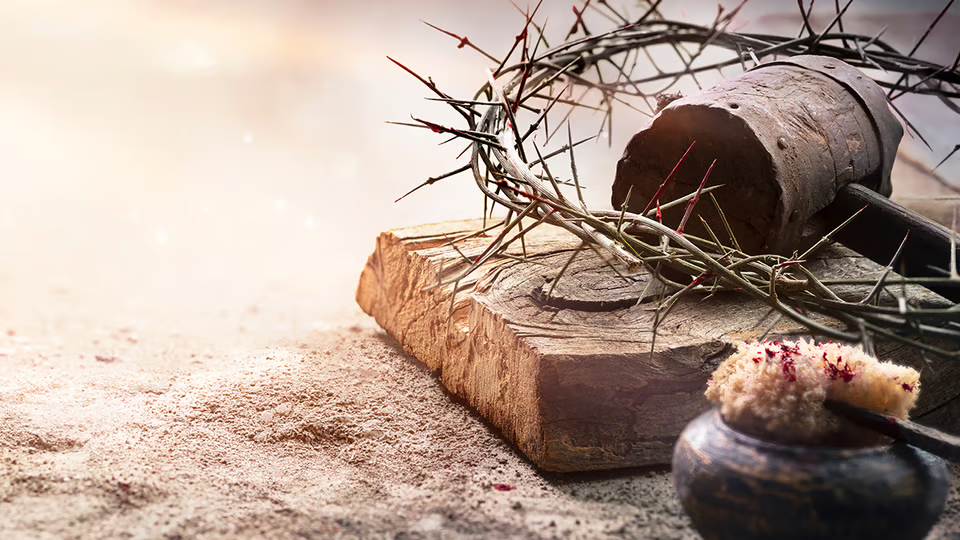
The ultimate example of love was Jesus Christ’s giving His life so we could live. The willingness to sacrifice is an essential aspect of real godly love.
I have always been moved by the stories of people who were willing to risk their lives for other people—sometimes for ones they didn’t even know.
For example, consider the story of Ahmed al-Ahmed, who saved many lives when he rushed to wrestle a gun away from one of the shooters targeting a Hanukkah celebration at Australia’s Bondi Beach Dec. 14, 2025.
“‘He said he’d do it again,’ Ahmed al-Ahmed’s [lawyer] Sam Issa said Monday [Dec. 15] after speaking to his client in hospital. ‘But the pain has started to take a toll on him. He’s not well at all. He’s riddled with bullets. Our hero is struggling at the moment’” (Newsweek.com).
Then there’s the 2013 story of William Ayotte, a 71-year-old Canadian who heard a scream outside.
“‘I went to my front door and opened the door and I looked outside and about 40 feet away was a bear mauling a woman,’ he told the Winnipeg News Station CTV. ‘The bear had the woman by the head and was wagging her around in the air, and I couldn’t believe what I was seeing, so I was thinking I’ve got to do something.’ So, Ayotte grabbed a shovel, ran up to the bear, and hit it square in the eye” (BBC.com).
And I still remember the story of the selfless hero of a 1982 plane crash.
“There they floated. Scared. Traumatized. Six people had just survived the crash of Air Florida Flight 90 into a bridge over the Potomac River in Washington, D.C., in January 1982. They hung on to the jet’s damaged tail section in the freezing water.
“Five of them would live because the sixth, one-by-one, would hand them a life ring attached to a rope hanging from a helicopter. When the copter came back a sixth time, the man had slipped into the water to his death” (PalmBeachPost.com).
These are amazing and poignant examples of deep concern and care for others, even above concern for self.
No greater love
God the Father and Jesus Christ displayed the ultimate in self-sacrificial love—a love that surpasses our comprehension (Ephesians 3:19).
“For God so loved the world that He gave His only begotten Son, that whoever believes in Him should not perish but have everlasting life” (John 3:16).
As Jesus said the night before His ultimate sacrifice:
“Greater love has no one than this, than to lay down one’s life for his friends” (John 15:13).
Jesus was willing to die for His friends. And this love was not limited to those who were already friends and followers. The apostle Paul explained:
“For when we were still without strength, in due time Christ died for the ungodly.
“For scarcely for a righteous man will one die; yet perhaps for a good man someone would even dare to die.
“But God demonstrates His own love toward us, in that while we were still sinners, Christ died for us” (Romans 5:6-8).
We can be deeply thankful for such love. But He is God, and that level of love seems so far beyond what we can show. How does God’s love relate to how we are to love?
What is love?
The introduction of Shannon Bream’s book The Love Stories of the Bible Speak says:
“What is love? It’s not what the world tells us, or whatever our emotions tell us it is. We can only truly understand and share love in its purest form if we allow God to show the way” (2023).
Love in the Bible
Love is mentioned in the Bible a lot: 361 times in the New King James Version! The books that contain the most mentions are:
- 1 John, 36.
- Song of Solomon, 30.
- Psalms, 29.
- John, 26.
- Proverbs, 18.
- Deuteronomy, 16.
The first mention of love is in Genesis 22:2, a passage that prefigures the awesome sacrifice God would later give.
God said to Abraham, “Take now your son, your only son Isaac, whom you love, and go to the land of Moriah, and offer him there as a burnt offering on one of the mountains of which I shall tell you.”
This foreshadowed the greatest act of love—the sacrifice of God’s beloved Son to pay the death penalty we deserved in our place.
God never intended for Abraham to actually sacrifice Isaac, and He hates the idea of human sacrifice (Deuteronomy 12:31; Jeremiah 7:31). But He sought to know if Abraham, His friend, could act out and begin to grasp the depth of love that God Himself would show for all of us. Meditating on Abraham’s experience can help us gain a deeper understanding of God’s unfathomable love.
Of course, the words translated “love” in the Bible have a range of meanings, as the English word does today. And the Bible doesn’t shy away from describing wrong and harmful love. But the overwhelming message is that there is a supreme love that is the essence of what God is, what He wants us to be, and what leads to beautiful, meaningful and satisfying relationships.
The Bible itself is a love story, and the main character is the perfect example of love.
What real love is not
It’s interesting that Paul’s famous Love Chapter lists as many things that love is not as things it is. Some of the polar opposites of love too often show up in so-called love stories today.
Jealousy and illicit desire may be the stuff of romance novels and rom-com movies, but they are not signs of real love.
The Amplified Bible puts the list of things love is not this way:
Love “is not jealous or envious; love does not brag and is not proud or arrogant. It is not rude; it is not self-seeking, it is not provoked [nor overly sensitive and easily angered]; it does not take into account a wrong endured. It does not rejoice at injustice” (1 Corinthians 13:4-6).
Other versions of verse 6 say “love does not delight in evil” (New International Version) and “is never glad with sin” (International Standard Version).
What real love is
The Love Chapter also lists these positive traits:
“Love suffers long and is kind . . . rejoices in the truth; bears all things, believes all things, hopes all things, endures all things. Love never fails” (1 Corinthians 13:4, 6-8).
Suffering, bearing and enduring again highlight the self-sacrificing quality of godly love. And all of this without fail—in the footsteps of our unfailing God.
Another love chapter
The apostle John uses love 21 times in 1 John 4 alone. Consider the great summary he gives in verses 7-9 and 18-21 about God’s love and what His love should inspire us to do.
God not only sets the example of love, but He defines Himself as love! And that should inspire us to act in love toward God and our fellow man.
“Beloved, let us love one another, for love is of God; and everyone who loves is born of God and knows God.
“He who does not love does not know God, for God is love.
“In this the love of God was manifested toward us, that God has sent His only begotten Son into the world, that we might live through Him” (1 John 4:7-9).
God not only sets the example of love, but He defines Himself as love! And that should inspire us to act in love toward God and our fellow man.
“There is no fear in love; but perfect love casts out fear, because fear involves torment. But he who fears has not been made perfect in love.
“We love Him because He first loved us.
“If someone says, ‘I love God,’ and hates his brother, he is a liar; for he who does not love his brother whom he has seen, how can he love God whom he has not seen?
“And this commandment we have from Him: that he who loves God must love his brother also” (verses 18-21).
To follow God’s example of love, we can’t put limits on whom we will love. As Jesus said in Matthew 25:45 about those who did not serve others, “Assuredly, I say to you, inasmuch as you did not do it to one of the least of these, you did not do it to Me.”
Sincere and fervent love
Godly love is not put-on or shallow.
Both Peter and Paul emphasized the sincerity of godly love:
“Since you have purified your souls in obeying the truth through the Spirit in sincere love of the brethren, love one another fervently with a pure heart” (1 Peter 1:22).
Paul expands on this: “Love is to be sincere and active [the real thing—without guile and hypocrisy]” (Romans 12:9, Amplified Bible).
This article can only scratch the surface. The subject of love is an overarching theme of the Bible and God’s plan. Take the time to study about it further in our articles “God Is Love” and “Fruit of the Spirit: Love.”
About the Author

Mike Bennett
Mike Bennett is editorial content manager for the Church of God, a Worldwide Association, in the Dallas, Texas, area. He coordinates the Life, Hope & Truth website, Discern magazine, the Daily Bible Verse Blog and the Life, Hope & Truth Weekly Newsletter (including World Watch Weekly). He is also part of the Personal Correspondence team of ministers who have the privilege of answering questions sent to Life, Hope & Truth.