Ancient prophecies occurred exactly as God predicted. End-time prophecies will too. When God gives a warning, we must understand—and heed!
Decades after King Nebuchadnezzar looted and burned God’s temple in Jerusalem, his descendant, King Belshazzar held a great feast. Though his city was under siege, he was seemingly unconcerned, sure the walls of Babylon were impregnable.
“In his drunken bravado he thought of a novel way of entertaining his guests. What about those beautiful golden goblets and bowls from Solomon’s temple . . . ? Why not use them?” (The Expositor’s Bible Commentary, note on Daniel 5:1-4).
“They drank wine, and praised the gods of gold and silver, bronze and iron, wood and stone” (Daniel 5:4).
His audacity, idolatry and pride followed the pattern Nebuchadnezzar had set (Daniel 3:1-7; 4:30). And the true God had had enough.
What was the handwriting on the wall in the Bible?
“In the same hour the fingers of a man’s hand appeared and wrote opposite the lampstand on the plaster of the wall of the king’s palace” (Daniel 5:5).
This supernatural phenomenon terrified the king. He could read the letters that were written, but he couldn’t understand what they meant for him. Neither could his astrologers and wise men.
Eventually, Daniel was called.
“Mene, Mene, Tekel, Upharsin” meaning
After reminding everyone what God had done to humble Nebuchadnezzar’s pride (verses 20-21), Daniel told Belshazzar, “You have lifted yourself up against the Lord of heaven.” God was fed up with his ego and sacrilege (verses 22-23).
Then Daniel explained the handwriting on the wall.
- Mene meaning: numbered. It was repeated for emphasis. Daniel explained, “God has numbered your kingdom, and finished it” (verse 26).
- Tekel meaning: weighed. Daniel said, “You have been weighed in the balances, and found wanting” (verse 27).
- Upharsin meaning: divided. This is the plural form of the word peres. Daniel explained, “Your kingdom has been divided, and given to the Medes and Persians” (verse 28).
This prophecy, like many others, outlined sins and consequences. Belshazzar’s sins, and Babylon’s sins, led to this dramatic impending punishment.
The prophecy fulfilled
“That very night Belshazzar, king of the Chaldeans, was slain” (verse 30).
History records that the Medo-Persian soldiers, having diverted water from the Euphrates River, were able to sneak into Babylon through the riverbed on Oct. 12, 539 B.C.
The clear fulfillment of this and other prophecies should alert us to pay attention to the prophecies that apply to our times.
What’s written for us? And are we seeing the handwriting on the wall?
Signs of the end times
An instance of a supernatural hand writing on the wall is recorded only once in the Bible, but prophetic warnings are found throughout the Scriptures. Many of them are aimed at end-time audiences, and they are just as serious and frightening as the message to Belshazzar.
One such pivotal prophecy was spoken by Jesus Himself. After He prophesied the utter destruction of the centerpiece of Jerusalem—the renovated temple—His shocked disciples asked, “What will be the sign of Your coming, and of the end of the age?” (Matthew 24:3).
Jesus’ answers should be as alarming to modern readers as the handwriting of a disembodied hand was to the Babylonians.
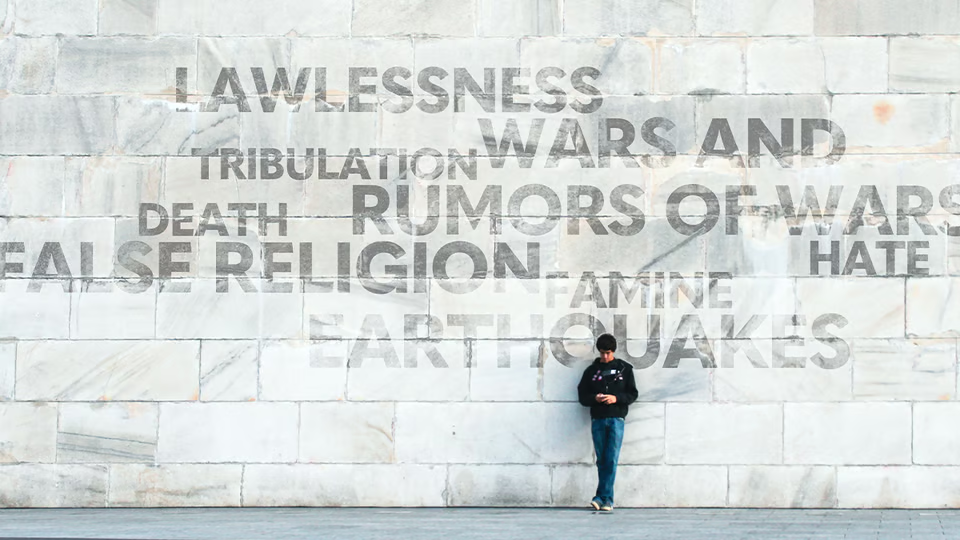
After warning about religious deception, Jesus said, “And you will hear of wars and rumors of wars. See that you are not troubled; for all these things must come to pass, but the end is not yet.
“For nation will rise against nation, and kingdom against kingdom. And there will be famines, pestilences, and earthquakes in various places.
“All these are the beginning of sorrows”—literally, of birth pangs (verses 6-8).
They would be followed by tribulation, persecution and martyrdom. “There will be great tribulation, such as has not been since the beginning of the world,” Jesus said (verse 21). Imagine—worse than the horrors inflicted by any of the evil despots of history!
In these terrifying end-time events we can discern echoes of the messages God wrote on the wall long before.
Our days are numbered
Our modern world has continued to follow the pattern of rebellion against God and His laws that has led to the destruction of previous civilizations. This time God warns, “Unless those days were shortened, no flesh would be saved” (verse 22).
Human extinction became possible when we began to unleash the unthinkable destructive power of the atom in 1945. Since then, new weapons of mass destruction have multiplied, including chemical and biological agents.
All the bad news of today’s world will be replaced by the truly good news of the world to come.
And now the nuclear risk is proliferating again. It never went away, but the chance of nuclear war by error or diabolical design is exploding today.
“East Asia is where the world’s fastest buildups are unfolding, in China and North Korea. A dangerous proliferation cascade may be about to break out, right in the shadow of Hiroshima. It would likely start in South Korea, and spread first to Japan. It might not stop there. The decades-long effort to keep nuclear weapons from spreading across the planet may be about to collapse” (Ross Andersen, “The New Arms Race,” The Atlantic, August 2025, p. 28).
According to Dan Smith, director of the Stockholm International Peace Research Institute, the new nuclear arms race will have “much more risk and uncertainty” than during the Cold War era.
“The coming nuclear arms race is going to be as much about AI, cyberspace and outer space as it is about missiles in bunkers or on submarines or bombs on aircrafts. It’s going to be as much about the software as about the hardware” (“Risk of Nuclear War Grows Amid New Arms Race,” DW.com).
The perceived danger of not having nuclear weapons could soon lead nations like Iran, Saudi Arabia, Turkey, Germany and Poland to seek their own arsenals.
With each new member of the nuclear club, and with the rising possibility of terrorists using weapons of mass destruction, the sense of our days being numbered becomes more real.
Our actions have been weighed and found wanting
Why is all this happening?
“God is a just judge, and God is angry with the wicked every day” (Psalm 7:11).
God’s laws are clearly recorded in the Bible. And the consequences for obeying and for disobeying are also spelled out in chapters such as Leviticus 26 and Deuteronomy 28.
For example, God warned, “But if you do not obey Me, and do not observe all these commandments” (Leviticus 26:14), a long list of painful, terrifying and devastating curses will come (verses 16-39). (See our online article “Why Is Our Modern World Under Ancient Curses?”)
So the punishments for sin, though sometimes delayed (Ecclesiastes 8:11), do not have to be a surprise to people today, even as they should not have been a surprise to Belshazzar (Daniel 5:22).
But God knows that humanity has succumbed to Satan’s deception (Revelation 12:9). Thus, “every way of a man is right in his own eyes” (Proverbs 21:2). But not so in God’s eyes. The verse continues, “But the LORD weighs the hearts.” And in His justice, God also weighs our actions (1 Samuel 2:3).
Jesus compared the end time to the days of Noah (Matthew 24:37). Before the Flood, God weighed humanity and found that “the wickedness of man was great in the earth, and that every intent of the thoughts of his heart was only evil continually. And the LORD was sorry that He had made man on the earth, and He was grieved in His heart” (Genesis 6:5-6).
Jesus warned of the time before His return, “And because lawlessness will abound, the love of many will grow cold” (Matthew 24:12).
The apostle Paul also listed selfish and evil end-time attitudes that will weigh heavily on God’s scales of justice:
“For men will be lovers of themselves, lovers of money, boasters, proud, blasphemers, disobedient to parents, unthankful, unholy, unloving, unforgiving, slanderers, without self-control, brutal, despisers of good, traitors, headstrong, haughty, lovers of pleasure rather than lovers of God” (2 Timothy 3:2-4).
Can anyone say these attitudes are not hallmarks of our age?
And so humanity continues barreling toward the precipice of the limits of God’s patience with sin and evil. In the end, God warns of the day of His wrath, the day of the Lord (Isaiah 13:9).
“I will punish the world for its evil, and the wicked for their iniquity; I will halt the arrogance of the proud, and will lay low the haughtiness of the terrible” (verse 11).
See more about the sins of our age in the article “Why Is God Angry With America?” Though America is on the leading edge of some of these sins, in fact, God has weighed all nations and has found all wanting.
Our divided world will be defeated
Ian Bremmer, president and founder of Eurasia Group, sees our world as defined by division and disruption. He wrote:
“We’re entering a uniquely dangerous period of world history on par with the 1930s and the early Cold War . . . The more immediate danger is the unraveling of the world’s security and economic architecture leaving many spaces—both countries and crucial domains like cyberspace, outer space, and the deep seas—ungoverned and undergoverned, wide open for rogue actors to increasingly operate with impunity.
“Nature abhors a vacuum” (“Welcome to a World Defined by Polarization, Instability, and Disruption”).
Prophecies of the end-time world depict a divided world, when “nation will rise against nation, and kingdom against kingdom” (Matthew 24:7). As we saw in 2 Timothy 3, “Men will be lovers of themselves.”
Even the 10 “kings” who will support the end-time beast power will be united for only a short time in their evil rampage (Revelation 17:12), and they will have underlying divisions, like iron and clay (Daniel 2:42-43).
But in the end, the divided kingdoms of this world will be replaced by the unified and permanent Kingdom of God. “He shall reign forever and ever!” (Revelation 11:15).
All the bad news of today’s world will be replaced by the truly good news of the world to come. You can study this in detail in our free booklet The World to Come: What It Will Be Like.
Christians called to watch
Christians can be encouraged by this knowledge of God’s plan and the sure outcome of peace beyond the end-time storms.
But, in the meantime, we are called to watch. After outlining the panorama of end-time events, Jesus said:
“But take heed to yourselves, lest your hearts be weighed down with carousing, drunkenness, and cares of this life, and that Day come on you unexpectedly.
“For it will come as a snare on all those who dwell on the face of the whole earth.
“Watch therefore, and pray always that you may be counted worthy to escape all these things that will come to pass, and to stand before the Son of Man” (Luke 21:34-36).
We are called to watch as world events fulfill the biblical prophecies. We are called to read the writing on the wall, to recognize the signs of the times, and to be ready.
Those who hear the warnings and heed—who recognize the evils that are propelling our world toward destruction and prayerfully overcome their personal sins—who are “purified, made white, and refined” spiritually—will be wise and be given understanding (Daniel 12:10).
In times that induce “perplexity” and “fear,” Jesus said to “look up and lift up your heads, because your redemption draws near” (Luke 21:25-26, 28). “When you see these things happening, know that the kingdom of God is near” (verse 31).
God wants you to understand. To gain a broader overview and deeper understanding of His prophetic plan, dig into our free 76-page booklet How to Understand Prophecy.
About the Author

Mike Bennett
Mike Bennett is editorial content manager for the Church of God, a Worldwide Association, in the Dallas, Texas, area. He coordinates the Life, Hope & Truth website, Discern magazine, the Daily Bible Verse Blog and the Life, Hope & Truth Weekly Newsletter (including World Watch Weekly). He is also part of the Personal Correspondence team of ministers who have the privilege of answering questions sent to Life, Hope & Truth.