Has the greatest crisis in the history of the Atlantic alliance exposed and accelerated the demise of NATO and the West?
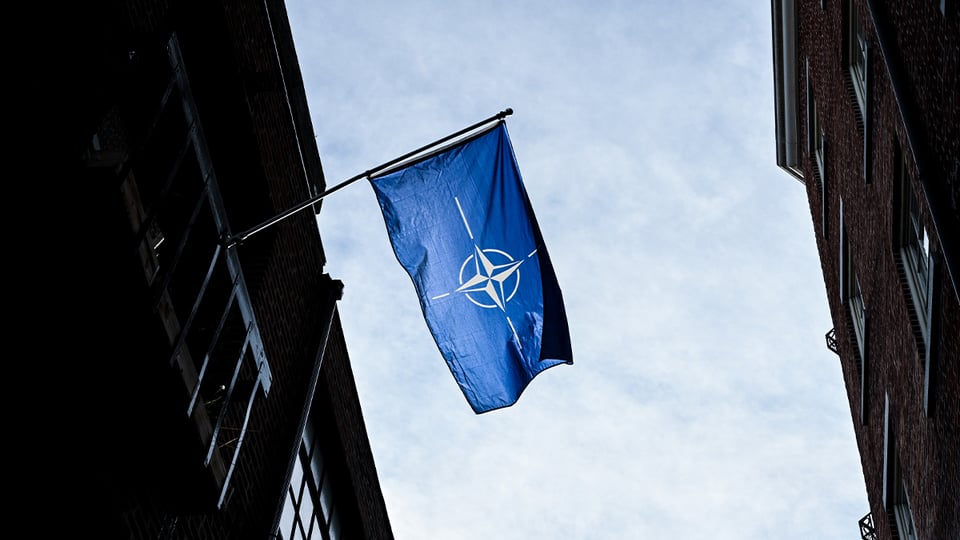
Olga Kaya via Getty Images
For nearly eight decades, the American-led North Atlantic Treaty Organization (NATO) has been the jewel in the crown of Western security. It has given Europe its longest era of relative peace since the peak of the Roman Empire.
Recent events have turbocharged the sense of rupture in what may be the most successful alliance in history. The transatlantic angst that simmered during the first term of U.S. President Donald Trump has boiled over into a potential realignment that would profoundly reshape the global order.
Despite its member nations having a shared history, culture and political inheritance, NATO has always been a strained coalition beset by divisions. Its dependence upon a decision-making process requiring consensus—originally of 12 but now of 32 member countries—often means progress moves at the glacial speed of the slowest member.
The anatomy of an alliance
NATO came into existence because of a sense of threat to the security and freedom of member countries in Europe and North America. Speaking to the signatories in April 1949, President Harry Truman said, “To protect this area against war will be a long step toward permanent peace in the whole world.”
Decades later, President Ronald Reagan trumpeted that “the Atlantic alliance is the core of America’s foreign policy and of America’s own security.” NATO has provided Washington, as the first among equals, vast political influence and a network of bases to project power worldwide.
Nevertheless, the transatlantic alliance has frequently been seen as divided and lacking purpose—in 2019 French President Emmanuel Macron even described it as experiencing “brain death.” Former U.S. ambassador to NATO Donald Rumsfeld once quipped that it has a lucky habit of being “saved” once a decade by a new crisis between the West and the Kremlin.
The Russian invasion of Ukraine in 2022 was just such a shot of adrenaline for NATO, and it kick-started its most ambitious activity in recent memory. But that boost has since worn off, replaced by the cold reality of an administration that no longer views the defense of Europe as America’s primary interest.
The turning point
The West has found itself at a critical juncture since President Trump returned to the White House determined to finish the job of global realignment. His “National Security Strategy,” released in November 2025, struck leaders in European capitals like a bucket of cold water and signaled not just a shift in policy, but a filing for divorce.
The report accused elected European leaders of doubling down on immigration policies in a rush to “civilizational erasure.” It described Europe as betraying Western civilization itself, warning that the continent could become unrecognizable within two decades. The report even suggested that the current administration in Washington views Europe as growing too weak to be reliable, and more of a burden than an ally.
Many saw the report as another sign of the end of the Western order. The report “effectively declared civilizational war on the EU and its values,” Paul Taylor, a senior visiting fellow at the European Policy Centre, wrote in The Guardian.
Greenland: a contentious chunk of ice
The frustrations, once spoken of in hushed tones in Europe, turned to loud outrage when the American president threatened to invade Greenland, mocking it as relying on “two dog sleds” for defense.
The introduction of hypersonic glide missiles able to fly over the polar regions at upwards of 11 times the speed of sound has turned the Arctic into an indispensable part of NATO’s defense. In addition to its strategic location, the frozen island is home to massive deposits of crucial rare earth minerals.
That crisis was averted, but it was the first time that governments in Europe contemplated the ramifications of one NATO member invading another.
Iran and the Strait of Hormuz
Soon after, the U.S. and Israel attacked Iran without consulting NATO or other allies. Some NATO members refused to allow the Americans to use bases in their countries or even to use their airspace, sparking American ire. When President Trump called for NATO members to help reopen the Strait of Hormuz, they refused, leading him to call NATO “a paper tiger” and “cowards” on social media.
“They didn’t want to join the fight to stop a Nuclear Powered Iran. Now that fight is Militarily WON, with very little danger for them, they complain about the high oil prices they are forced to pay, but don’t want to help open the Strait of Hormuz, a simple military maneuver that is the single reason for the high oil prices,” he wrote.
America’s “Donroe Doctrine”
The Trump administration has been open in its contempt for the alliance, characterizing NATO as a money pit and lambasting feckless allies for not bearing their share of the load. Washington seems to view Europe as a museum of past glories just waiting for an obituary to be written.
At the heart of this tumultuous rupture is the so-called Donroe Doctrine, a pivot toward a sometimes-jarring transactional approach to geopolitics that views allies not as force multipliers, but as grasping dependents. Underlying this is the fact the United States is overstretched, spending more on debt service than on defense, so it can no longer afford to subsidize Europe’s defense.
Flattery as a defense against Donald Trump
European leaders, initially caught off guard by the president’s harsh language and tariff threats, have experimented with a strategy of containment through deference.
The European approach has been characterized as a desperate performance for an audience of one. Alain Frachon, a columnist in France’s prominent newspaper Le Monde, noted that leaders have “flattered him, congratulated him, praised his achievements and thanked him: anything to avoid upsetting the great man” (Sept. 5, 2025).
Some observers have gone further. Writing for The Atlantic, Robert Kagan noted that certain leaders resorted to “appealing to his vanity . . . acceding to his punitive tariffs without resistance” and even calling him “Daddy” (Sept. 10, 2025).
The winter chill between Europe and the U.S.
But the mask of deference is slipping. The Jan. 23, 2026, cover of the German weekly Der Spiegel depicted European leaders dressed in Nordic warrior garb and brandishing swords. Translated into English, the headline reads, “Donald, That’s Enough!” At the bottom are the words: “How Europe can stand up to Trump’s imperialism.”
The Spectator, a British weekly, also took up the fight against the American president, stating: “His narcissism, vulgarity and bombast seemed to confirm every suspicion about America at its worst: nativist, isolationist, crudely self-interested—a fortress America led by a man with little patience for allies or alliances” (Feb. 2, 2026).
For decades, America was viewed as the ultimate guarantor of European security and liberal values. A January 2026 YouGov survey found 64 percent of Britons view the U.S. unfavorably—up 28 points since November 2023. A staggering 71 percent of Germans now consider the United States an adversary, according to a January 2026 Forsa poll.
The rhetoric from European leaders has likewise been stripped of the usual diplomatic niceties.
French President Emmanuel Macron insisted the EU must be “uncompromising,” while European Commission President Ursula von der Leyen declared that “battle lines” were being drawn.
German Chancellor Friedrich Merz, the leader of Europe’s most populous democracy, said, “The Americans are now pursuing their own interests very, very aggressively” and concluded Germany must do the same.
Europe’s long retreat
This extraordinary continent occupies just 4 percent of the world’s landmass (excluding Russia). Yet it shaped much of human history for the past 500 years by conquering and administering as much as 80 percent of the planet.
The fear of Russian troops in Ukraine—NATO’s backyard—has Europeans confronting reality.
Now Europe appears to have become a collection of bystanders. By nearly every metric of hard power, Europe’s proportion of global economic and military strength is at its lowest ebb since the Middle Ages.
The numbers describe a stagnation that is difficult to ignore. Since 2009, European household wealth has grown by only a third as much as that of Americans.
Europe is falling behind in the digital age
Europe today generates neither the new technologies nor the competitive businesses the 21st century demands. A risk-averse culture and stifling regulation have led to only four of the world’s top 50 tech companies being European.
While the EU overtaxes and overregulates the industries it still possesses, U.S. technology giants—Microsoft, Meta, Amazon and Alphabet’s Google—are planning to spend up to $670 billion to build out AI infrastructure this year alone.
EU tech czar Henna Virkkunen recognizes the need for a technology independence moment, and the European Parliament passed a sweeping “technology sovereignty” resolution to promote and favor homegrown digital products.
Still, according to a January 2025 survey by Bitkom, a Berlin-based digital lobby group, some 80 percent of German companies rely on American digital technologies to function.
The doomsday scenario now whispered about in European capitals is a White House executive order that, in the heat of a trade dispute or security crisis, cuts off the region’s access to the data centers or email software that businesses and governments need to survive.
Thinking the unthinkable
For years, Europe has enjoyed the security of the American nuclear umbrella. But the decades of neglect that have followed as a result have hollowed out the defense industries of NATO’s European members. They instead rely on the U.S., which remains the indispensable nation when it comes to the tools of modern war.
“If anyone thinks that the European Union—or Europe as a whole—can defend itself without the U.S., keep dreaming. You can’t. We can’t,” NATO Secretary General Mark Rutte told a stunned European Parliament.
The fear of Russian troops in Ukraine—NATO’s backyard—has Europeans confronting reality.
Faced with the potential removal of the nuclear protection America provides, more Europeans are floating the formerly inconceivable idea of acquiring or developing their own nuclear weapons. News of a “joint Nordic” nuclear deterrent or a German nuclear program have garnered a lot of recent headlines:
- “Britain in Talks to Protect Sweden With Nuclear Deterrent” (The Telegraph, Jan. 27, 2026).
- “Germany May Develop Its Own Nuclear Weapons With EU Allies” (New York Post, Feb. 1, 2026).
- “Trump’s Greenland Gambit Pushes Europe to Look to Its Own Nuclear Arsenals” (Politico, Feb. 21, 2026).
Europe at a crossroads
For nearly 80 years, the dream of a unified, peaceful Europe has been the continent’s secular religion.
We are witnessing the early tremors of a shift, as internal strife weakens the NATO shield and Europe is forced to look to its own defense.
10 kings and one mind
The book of Revelation speaks of a startling geopolitical alignment: “The ten horns which you saw are ten kings who have received no kingdom as yet, but they receive authority for one hour as kings with the beast” (Revelation 17:12).
In a future geopolitical crisis, a mixed union of 10 national leaders or regional blocs within Europe will give their power and authority to a coming powerful leader the Bible calls the beast or the king of the North (Daniel 11:40). The book of Daniel also describes this end-time leader as a man with “fierce features, who understands sinister schemes” (Daniel 8:23). He will gain power through cunning and political maneuvering.
The economic colossus he will lead will rival any in history, and it will possess a shocking military sting that will catch the world off guard (Daniel 11:40-41).
The current fracturing of NATO may be the catalyst for this prophecy. A two-speed Europe or a core Europe is often discussed in the halls of power. As NATO weakens, a smaller, more dedicated group of nations—the 10 kings—may indeed emerge from the chaos to form the hard core of this final beast power.
Many may wonder, given Europe’s current position, how it could ever rise to such a place of dominance again. Yet biblical prophecy indicates that when this resurgence occurs, the world will be astonished—having assumed that the European-led order would not rise again (Revelation 13:3).
Only time will reveal how such a dramatic revival might unfold.
However, history shows that periods of crisis can drive rapid change in Europe. Less than a century ago, Germany lay devastated and economically shattered in the aftermath of World War I. Yet in just over a decade, a charismatic leader rose to power and rebuilt the nation’s military strength, enabling it to once again plunge the world into world war.
So, watch Europe. Watch for an economic resurgence in Europe that threatens the economic vitality of America and China. Watch for NATO to become more anti-American or more irrelevant. Watch calls for a European army and development of a stronger nuclear deterrent. Watch for a strongman who can lead a confident, independent Europe, rather than take orders from Washington.
The stage is being set for a final act that was written thousands of years ago.
Learn more in our booklet How to Understand Prophecy.