After Jesus sent His disciples across the sea, they faced a fierce storm and saw a figure walking on the water. What did this experience teach them?
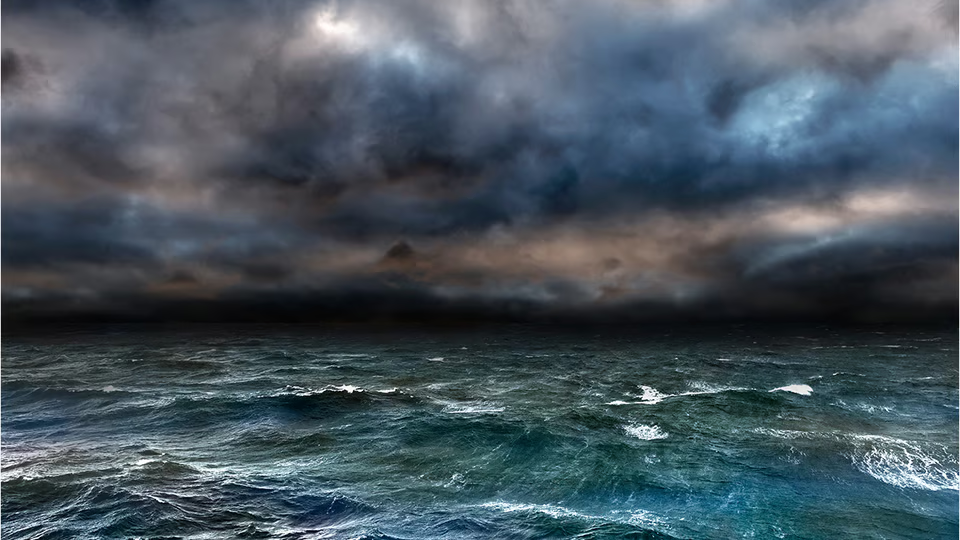
After Jesus miraculously fed over 5,000 people, He sent the multitudes home and commanded His disciples to row over to the other side of the Sea of Galilee without Him.
Instead of joining them, Jesus “went up on the mountain by Himself to pray” (Matthew 14:23).
John explains that Jesus did this because He sensed there was a movement simmering among the people to take Him by force and proclaim Him king of Israel (John 6:15). This wouldn’t have been merely a symbolic proclamation, but would have triggered a violent Jewish uprising against Rome.
Since this was unequivocally not Jesus’ will or why He came to earth then, Jesus stymied a potential uprising by simply disappearing into the mountains for a while. He used this time removed from the crowds to pray to the Father—possibly seeking guidance on how to avoid this situation moving forward.
Jesus had to use great wisdom to ensure His ministry wasn’t curtailed by this threat of being seized by those seeking to spark a military rebellion against Rome.
A storm erupts
After the disciples rowed 3 to 4 miles into the Sea of Galilee (which is 8 miles across at its broadest point), a mighty windstorm struck the sea, causing their boat to be “tossed by the waves” (Matthew 14:24). This occurred in “the fourth watch of the night” (verse 25)—sometime between 3 and 6 a.m.
These men had already experienced a similarly violent storm and witnessed Jesus instantly calm it with a verbal command. But here they were in the same situation—except this time Jesus was seemingly far away.
Perhaps they were terrified that, without Jesus near to save them, the boat would capsize and they would all drown.
A silhouette appears on the water
As they struggled to keep the boat afloat against the battering winds and waves, they suddenly saw a figure walking toward them on the waters.
“When they saw Him walking on the sea, they supposed it was a ghost, and cried out; for they all saw Him and were troubled” (Mark 6:49-50, emphasis added throughout). Matthew adds, “They cried out for fear” (Matthew 14:26).
The word translated ghost is the Greek word phantasma (from which we get the English word phantom). This word can describe an apparition, a specter, a spirit or a mental image. Some translations simply render it “a spirit.”
Though it’s tempting to project the modern meaning of ghost—a disembodied soul of a dead person—on the disciples’ choice of wording, that’s probably not what they actually feared. Belief in and fear of disembodied dead people (ghosts) was not something they would have learned in their Jewish upbringing or from Jesus’ instruction.
It’s more likely they were using the term to describe a demonic spirit.
They had encountered demons many times as they accompanied Jesus. They had already seen Him exercise absolute authority over the demonic realm.
As the disciples saw the silhouette walking toward them on the water, they might well have leaped to the conclusion that a demon was approaching to harm them—seizing an opportunity while Jesus was nowhere in sight.
“Do not be afraid”
Before they did anything foolish, Jesus spoke to make it clear that the figure on the water was none other than their Master and Teacher: “Take courage, it is I; do not be afraid” (Matthew 14:27, New American Standard Bible).
When we face fear or danger, we can pray for these three things: courage, God’s presence and the strength to confront the situation without being paralyzed by fear.
Jesus’ presence reassured them that no harm would come to them. But He also wanted to teach them that God knows our needs before we even ask Him (Matthew 6:8). He didn’t need to be present with them in the boat to know of their predicament. In fact, Mark records that while Jesus was still on land, miles away, miraculously “He saw them straining at rowing” (Mark 6:48).
This is a reminder of God’s omniscience—His perfect ability to see and know all things at all times (Isaiah 9:7). Through His connection to the Father, Jesus could be aware of things happening outside the limitations of human senses.
Peter leaves the boat
Upon hearing his Teacher’s voice, Peter was the first to respond and answer: “Lord, if it is You, command me to come to You on the water” (Matthew 14:28).
Seeing Jesus do yet another physically impossible act—walk on water—Peter asked for the same ability. Jesus had already shared certain elements of His power with them at various times, such as the ability to heal and cast out demons, so now Peter was asking for this ability as well.
Jesus answered, “Come” (verse 29).Peter then gripped the boat’s edge, lifted both feet over and planted his full weight on the water—trusting it would support him as firmly as solid ground.
And it did.
It’s easy to be critical of Peter, knowing what happened next, but we should remember that all the others stayed safely inside the boat. It was only Peter who had the courage to step onto the water and, at least momentarily, trust God to allow him to do the impossible.
However, that faith-driven courage lasted only a few moments.
After a few steps, his physical senses took over. He looked around, took his focus off his Master and fixed it on the dangers of the raging storm and the impossibility of walking on water.
“Why did you doubt?”
“When he saw that the wind was boisterous, he was afraid; and beginning to sink he cried out, saying, ‘Lord, save me!’” (verse 30).
Though Peter couldn’t sustain the faith to continue walking on the water, he still trusted that Christ could maintain His own footing and also pull him to safety.
Understanding that Peter’s life was now in grave danger, “immediately Jesus stretched out His hand and caught him.” With Peter firmly in His grasp, Jesus asked a piercing question: “O you of little faith, why did you doubt?” (verse 31).
Uncharacteristically, Peter had no answer.
There’s no doubt Peter pondered and chewed on that question for the rest of his life—and so should we today.
Jesus lifted Peter out from the water, and they got into the boat. Instantly, the storm ceased and a peaceful calm settled back over the waters.
As we’ve pointed out in past articles, when Christ entered a chaotic scene, the effect of His presence was restoration of peace and calm—which foreshadows the impact of His presence on earth after His return (Hebrews 4:13).
Though we’re not told who exactly was in the boat with Peter, it appears there were some who were still unsure of Christ’s identity, but after seeing this, accepted and worshipped Him as the Son of God (Matthew 14:33).
Faith that makes the impossible possible
This incident took place during a period of Jesus’ ministry focused on training His disciples. His words to Peter were meant to help him, and the others, grasp the importance of replacing doubt and fear with faith and courage.
They needed to learn that when we have strong faith in God’s power, things that seem physically impossible become possible.
They also had to learn that the impossible must align with God’s will. Peter walked on water only because he asked and was granted Christ’s permission. That didn’t mean he could walk on water anytime he wanted, if only He could muster up the faith.
Not long after this incident, Jesus reiterated this lesson: “If you have faith as a mustard seed, you will say to this mountain, ‘Move from here to there,’ and it will move; and nothing will be impossible for you” (Matthew 17:20).
Though God could easily allow a person to move a mountain—just as He could enable a man to walk on water—He would do so only if it served His will and purpose.
The Bible is filled with examples of God doing the impossible—parting seas, raining bread from heaven or giving people instant fluency in languages they never learned. But He performed these miracles only when the impossible was needed and aligned with His will.
God isn’t interested in spectacle. What He is really seeking is people who faithfully live in alignment with His way and will.
The most important thing to seek is not the ability to walk on water, but the faith to . . .
Walk as He walked.
About the Author

Erik Jones
Erik Jones is a full-time writer and editor at the Life, Hope & Truth offices in McKinney, Texas.