The Meaning of Isaiah 42:21: He Will Exalt the Law and Make It Honorable
How do you view God’s law? Many Christians have a negative opinion of it, but you may be surprised how God perceives His own laws.

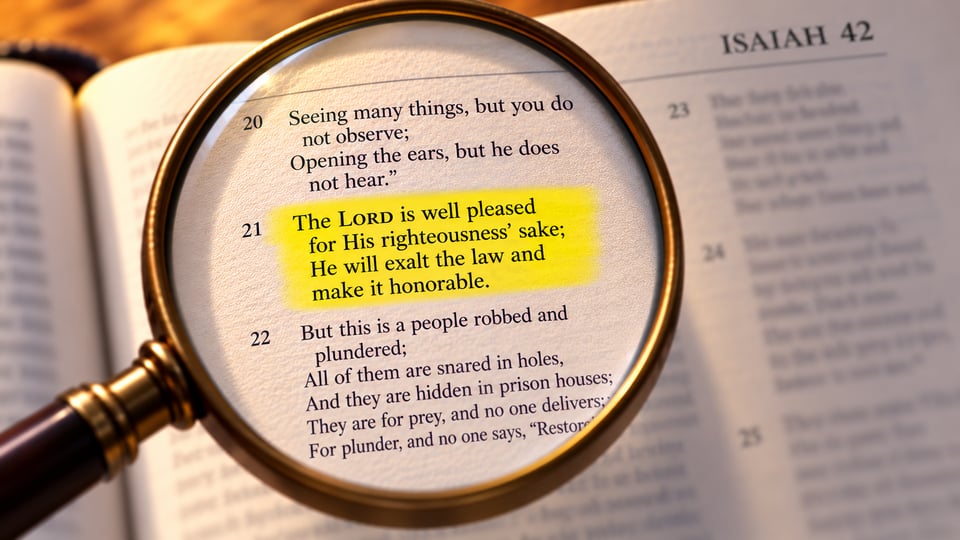
Made by LHT Staff using AI
What does Isaiah 42:21 say?
“The LORD is well pleased for His righteousness’ sake; He will exalt the law and make it honorable.”
God commanded Adam and Eve not to eat from the tree of the knowledge of good and evil (Genesis 2:17). Instead, they listened to the serpent, preferring to decide for themselves what is good and evil (Genesis 3:1-6).
Humanity has continued down that same path, dismissing God’s law in favor of defining right and wrong for themselves. As a result, many today view God’s law as burdensome, outdated or even unnecessary.
Yet Isaiah 42:21 speaks of a time when God’s law will be magnified and made honorable. What does that mean, and when will it happen?
Let’s analyze this verse phrase-by-phrase to discover exactly what it reveals.
“The LORD is well pleased for His righteousness’ sake”
Righteousness pleases God. It drives everything He does, and He never acts unrighteously.
Why?
Because righteousness reflects His character. According to the Brown-Driver-Briggs Hebrew and English Lexicon, “righteousness” means doing “justice” or “what is right, just or normal.”
Put simply, righteousness is living life right.
But how does God determine His own righteousness? Does He base His decisions on feelings, societal norms or fluctuating preferences? Does He change His mind when it comes to matters of morality?
God’s law reflects His righteous character and guides us in becoming more like Him. Because God’s character is eternal, the law that reveals His character is enduring as well.
God is not like us humans. His character is not like ours, and it is not subject to change (James 1:17; Numbers 23:19; Malachi 3:6; Hebrews 13:8).
The Bible declares that all God does is perfect and just, upholding truth without injustice and always remaining upright (Deuteronomy 32:4; Psalm 145:17; 1 John 1:5).
The prophet Isaiah describes God’s ways as being far, far higher than ours—“as the heavens are higher than the earth” (Isaiah 55:9).
How can we understand God if our own human reasoning is so far removed from His?
Everything we know about God comes from what He reveals to us. The primary method by which He reveals Himself is His Word (Deuteronomy 29:29).
Through His laws, God reveals aspects of His character to us. Consider the following verses:
- “For all Your commandments are righteousness” (Psalm 119:172).
- “Your righteousness is an everlasting righteousness, and Your law is truth” (Psalm 119:142).
- “O, that you had heeded My commandments! Then your peace would have been like a river, and your righteousness like the waves of the sea” (Isaiah 48:18).
- “Listen to Me, you who know righteousness, you people in whose heart is My law” (Isaiah 51:7).
God’s law reflects His righteous character and guides us in becoming more like Him. Because God’s character is eternal, the law that reveals His character is enduring as well. Rather than doing away with His law, Isaiah 42:21 reveals that God “will exalt the law and make it honorable.”
“He will exalt the law”
The Hebrew word translated “exalt” means “become great” or “be magnified.” It can also mean “make powerful” (Brown-Driver-Briggs Hebrew and English Lexicon).
Consider how other versions translate this phrase:
- King James Version: “he will magnify the law.”
- New Living Translation: “the LORD has exalted his glorious law.”
- New International Version: “to make his law great.”
What does it mean to magnify God’s law? We need look no further than how Jesus interacted with God’s law.
He taught that lust is adultery in the heart and that hatred is the spirit of murder. He exalted the law by affirming that marriage is intended to be a lifelong covenant and by teaching that truthfulness makes oaths unnecessary.
Rather than merely conforming to a list of dos and don’ts, God’s people are called to pursue His perfect character (Matthew 5:21-48).
But why does God need to exalt His law?
Because many in this world dismiss it. Mainstream Christianity comes up with countless excuses to discard the laws of the Bible. They say things like:
- “God’s law is done away with.”
- “God’s law is a burden.”
- “All we need is love.”
- “Jesus fulfilled the law for us.”
- “We are saved by grace alone.”
Ever since the Garden of Eden, mankind has downplayed God’s commandments. Why is it so difficult for us to exalt God’s law, as He does?
It is because the law is spiritual, while we are carnal (Romans 7:14). As such, the carnal mind, our natural mind, is automatically opposed and hostile to God’s law and resists submission to it (Romans 8:7).
God lamented that ancient Israel lacked the heart to keep His law, saying, “Oh, that they had such a heart in them that they would fear Me and always keep all My commandments” (Deuteronomy 5:29).
To fix the problem of the human heart, God promises His help, so we can be partakers of the divine nature (2 Peter 1:4).
God plans to give us a “new heart” and a “new spirit” (Ezekiel 11:9; 18:31; 36:26 ). It is by this spirit—His Holy Spirit—that God will write His laws in our hearts and minds, giving us the help we need to overcome our carnal nature and obey Him (Hebrews 8:10; 10:16; Jeremiah 31:33).
“And make it honorable”
Those God has called and given His Holy Spirit today can obey God’s law in both letter and spirit. But what about the rest of the world?
It isn’t yet God’s purpose to bestow His Holy Spirit on all people. But one day He’ll do just that.
In Joel 2:28, God promises, “I will pour out My Spirit on all flesh.”
A day is coming when everyone, from the least to the greatest, will come to know God.
A day is coming when everyone, from the least to the greatest, will come to know God (Jeremiah 31:34). They will seek God and His law (Isaiah 2:2-3; Micah 4:1-2).
When all people keep His laws, the earth will be filled with the knowledge of God, “as the waters cover the sea” (Isaiah 11:9; Habakkuk 2:14).
God and His laws will be revered by all people. This profound transformation will bring peace, making war a thing of the past (Isaiah 2:4; Micah 4:3-4).
Many professing Christians believe that God’s law is no longer applicable. However, Christ warned against this fallacy, stating He did not come to destroy the law, but to fulfill it (Matthew 5:17). (For a deeper explanation of what this means, read “Did Jesus Fulfill the Law?”)
Which way will you choose?
Christ further warned that many would come to Him with works done in His name, but He would say to them, “I never knew you; depart from Me, you who practice lawlessness!” (Matthew 7:21-23).
Why?
Because if we claim to know God and do not keep His commandments, we are liars. But those who know God will keep His commandments (1 John 2:3-4).
God has “set before you life and death, blessing and cursing; therefore choose life, that both you and your descendants may live” (Deuteronomy 30:19).
Which path will you choose? The path of righteousness that leads to life, or the way of sin, rejecting God’s law, that leads to death (Romans 5:21; 6:23)?
Heed and magnify God’s law and choose life!
Date Posted: October 21, 2026
About the Author

Isaac Khalil
Isaac Khalil is husband to his lovely wife, Natasha, and father to son Eli and daughter Abigal. He loves to spend time with family and friends doing various things like watching movies, playing chess, playing board games and going out. He enjoys studying biblical topics and discussing the Bible with his friends. He is also a news junkie and is constantly reading and sharing news connected with Bible prophecy.