What Is the Meaning of Galatians 2:20? Crucified With Christ?
Paul packed a lot in a single statement. How much can we learn about Christianity from this one verse? What does Galatians 2:20 mean?


At baptism, the old man—your former sinful self—must be buried for good.
What does Galatians 2:20 say?
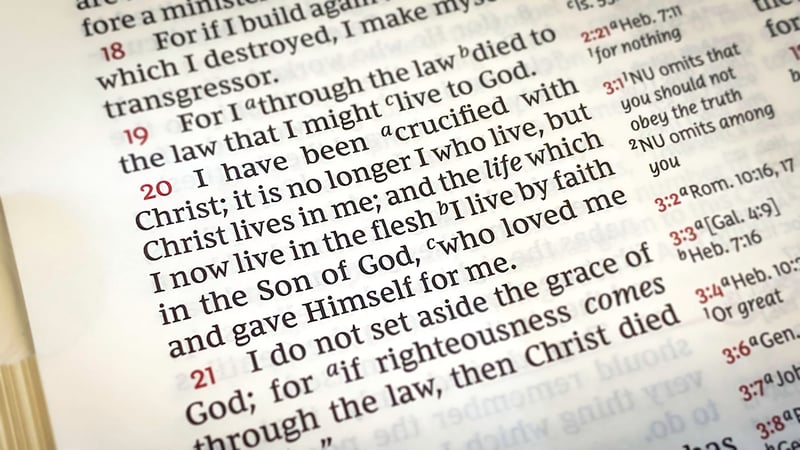
“I have been crucified with Christ; it is no longer I who live, but Christ lives in me; and the life which I now live in the flesh I live by faith in the Son of God, who loved me and gave Himself for me.”
The apostle Paul writes, “I have been crucified with Christ; it is no longer I who live, but Christ lives in me; and the life which I now live in the flesh I live by faith in the Son of God, who loved me and gave Himself for me.”
Let’s analyze this phrase by phrase and see what this verse tells us about the definition of Christianity.
“I have been crucified with Christ”
Paul saw himself as sharing in the death of Jesus Christ, a point he makes clear in Romans:
“Or do you not know that as many of us [Christians] as were baptized into Christ Jesus were baptized into His death [crucifixion]?” (Romans 6:3).
The idea here is that when a sinner repents and undergoes baptism, he or she symbolically participates in the Savior’s crucifixion.
We deserved to die that death. But our faith in His sacrifice means we can share in it symbolically.
That truth is a beacon of hope. For Paul, it meant he no longer had to identify with the misguided religious fanatic who once dragged Christians from their homes and sentenced them to prison or worse.
The person he used to be was dead and gone.
The same holds true for us. The things we did, the things we said, the people we were—everything that characterized our sinful way of life was transferred onto Jesus Christ as He died.
We have been crucified with Christ.
To learn more about the deep spiritual symbolism of baptism, read “What Do the Symbols of Baptism Mean?”
“It is no longer I who live”
But the symbolic death of our former selves is not the end point. It is the catalyst for a new way of life—one that lives for God and not for self.
The Greek word translated “I” in this phrase is ego. The sense of the word is best understood as self, or that which feels, acts or thinks.
Paul is saying then that “it is no longer my self, or my will, that lives.”
This aligns exactly with Jesus’ instructions to those who want to be His followers: “If anyone desires to come after Me, let him deny himself, and take up his cross daily, and follow Me” (Luke 9:23, emphasis added throughout).
Denying ourselves and taking up our cross means surrendering our will and committing ourselves entirely to God’s perfect will.
Denying ourselves and taking up our cross means surrendering our will and committing ourselves entirely to God’s perfect will. This is at the heart and core of what it means to be a Christian.
Confessing “it is no longer I who live” is determining, from the depths of our being, not to be self-directed, self-focused and self-driven.
The attitude of self-will no longer has a place in the Christian’s life.
The book of Proverbs puts it this way: “There is a way [the way of the self] that seems right to a man, but its end is the way of death” (Proverbs 14:12).
We all have to repent of going our old way and commit to living a new way. This was the attitude Paul had when he was struck down on his way to Damascus and confronted with the reality of his sins. He was actually persecuting Christ, but when God opened his eyes, he humbly asked, “Lord, what do You want me to do?” (Acts 9:6).
The heartfelt attitude of “Lord, what do You want me to do?” goes hand in hand with the acknowledgment that “it is no longer I who live.”
“But Christ lives in me”
When Jesus walked the earth as a flesh-and-blood human being, He lived with His followers. But shortly before His death, He prophesied of a time when He would no longer live with them, but within them through the Holy Spirit (John 13:33; 14:16-18).
True Christians are identified by the presence of God’s Spirit in them, which is possible only through repentance, baptism and the laying on of hands.
As Christians, we can have Jesus live in us because His Spirit is in us (Romans 8:9-10) and thus His mind is in us.
That does not mean that Christ takes possession of us, controlling everything we say and do—taking over our decision-making. Having the mind of Christ means having access to His guidance, His leadership and His direction.
To the degree we yield to His Spirit—that is, obey and follow it—we will live as He lived. And the more we live as He did, the more He lives His life in each of us.
To learn more about the importance of imitating Christ, read “Walk as He Walked.”
Christ lives in us in order to change us from the inside out, showing us how to think, act and talk like Him.
Converted Christians are currently undergoing a metamorphosis to become like Christ (Romans 8:29; 12:2).
Just as Christ lived in Paul, so Christ lives in every one of His true followers (1 John 3:24).
“And the life which I now live in the flesh I live by faith in the Son of God”
We remain “in the flesh” even after repentance and baptism. That means we’re still physical. We still have a life to live, things to do and decisions to make—but we strive to walk by a different standard now.
The strength to live by this new standard comes by “the faith of the Son of God” (as it is translated in the King James Version, Literal Standard Version and Smith’s Literal Translation).
It’s not enough to just have faith in Christ—that is, to just believe He existed and died for our sins. Many believe in Jesus without really striving to follow Him (Luke 6:46). James pointed out that even the demons have a form of faith in God—they know He exists and that He has authority (James 2:19).
The faith we need is “the faith of the Son of God”—the very faith that Christ had.
That means we are to live by everything He did and taught, every law and principle He laid out for us.
“Who loved me and gave Himself for me”
Christ’s willingness to die on our behalf was the ultimate expression of love.
The Word, who had lived from eternity in absolute, indescribable glory, “emptied” Himself of His divine prerogatives, became Jesus of Nazareth, and gave Himself for you and me (Philippians 2:7-8, English Standard Version).
He did that to fulfill God’s plan.
John 3:16 explains, “For God so loved the world that He gave His only begotten Son, that whoever believes in Him should not perish but have everlasting life.”
God has always intended to grow His family through humans. To transform all of us into glorious spirit beings. To share eternity with us. It’s been the focal point of His plan and purpose. But for His plan to move forward, sin had to be dealt with.
Jesus laid down His life so we can receive eternal life.
God did not make that decision begrudgingly.
Notice Isaiah 53:10: “Yet it pleased the LORD to bruise Him; He has put Him to grief.”
Even in Jesus’ intense agony and suffering, God kept the end in mind. It was a brutal death, hard to watch, but the Father knew what the result of His Son’s sacrifice would be:
Billions of potential members entering His divine family.
Jesus, from His standpoint, did not allow the shame and humiliation of the crucifixion to deter Him from accomplishing what He had set out to do (Hebrews 12:2).
And what was Christ’s motive for giving Himself for us? Love.
To learn more about God’s incredible plan and purpose for your life, download our free booklet God’s Purpose for You: Discovering Why You Were Born.
Christianity summarized in one verse
Galatians 2:20 is a powerful explanation of every true Christian’s responsibility.
To summarize, true Christians:
- Count their old sinful lives as having died with Christ.
- Deny themselves and surrender to God.
- Let Christ live in them—following Him in everything—in recognition of His deep love.
That is Christianity summarized in a single verse.
Date Posted: April 6, 2026
About the Author

Kendrick Diaz
Kendrick Diaz is a full-time writer at the Life, Hope & Truth offices in McKinney, Texas. He spends his workdays writing blog posts and articles for Discern magazine and LifeHopeandTruth.com.