

Lyudmila Lucienne/iStock via Getty Images
For over five years, I’ve been writing a column for Discern magazine called “Walk as He Walked.” The series follows the life of Jesus Christ as recorded in the four Gospels (the books of Matthew, Mark, Luke and John), examining major events in His life chronologically, episode by episode.
In addition to exploring the background and circumstances of these events, the series focuses primarily on applying John’s admonition to “walk just as He walked” (1 John 2:6). You can read all the past articles in the series here: “Walk as He Walked.”
This may seem unusual, considering how commonly churches, religious publications and websites use images intended to portray Jesus.
This is no accident. In fact, it is our Church’s longstanding policy to avoid using any image intended to portray Jesus Christ. Admittedly, this sometimes makes illustrating these articles challenging, requiring us to use symbolic imagery or modern scenes instead.
Why are we so careful to avoid portraying Jesus?
What do we know about Jesus’ appearance?
If you read through the four Gospel accounts of Jesus’ life, you’ll notice that none of the Gospel writers ever attempted to record a description of Jesus’ physical appearance.
The closest references to His appearance are indirect references—statements of how ordinary Jesus appeared. Both Luke and John describe instances where He was able to enter or exit a large crowd completely unnoticed despite some being on the lookout for Him (Luke 4:28-30; John 7:10-11; 8:59).
The most definitive thing we can say about Jesus’ appearance is this—Jesus looked like an average Jewish man of His time.
In fact, when Judas betrayed Jesus with a seemingly friendly kiss, the gesture served a specific purpose—to positively identify Jesus to the authorities who came to arrest Him (Matthew 26:47-48). Presumably, without the kiss, the authorities would have struggled to distinguish Jesus from the other 11 disciples.
So, the most definitive thing we can say about Jesus’ appearance is this—Jesus looked like an average Jewish man of His time.
In fact, it was actually prophesied in the Old Testament that the Messiah would not stand out from His contemporaries as physically unique: “He had no special beauty or form to make us notice him; there was nothing in his appearance to make us desire him” (Isaiah 53:2, New Century Version).
Isaiah’s prophecy shows Jesus was neither unusually unattractive nor strikingly handsome, and there’s no indication He possessed a particularly distinctive build or physique. Rather, He looked like an ordinary first-century Jewish man.
Although we cannot reconstruct Jesus’ exact appearance, the Gospels and historical evidence about first-century Jewish men offer some clues about His general appearance.
- He would have had an olive complexion and would have been heavily tanned due to spending much of His time outdoors in the brutal Middle Eastern sun.
- He would have been relatively strong and healthy due to spending His young adult years doing manual labor as a carpenter and walking extensively on the uneven and hilly terrain of Judea and Galilee during His ministry. (The Gospels also show that Jesus had a normal diet and often ate with others, giving us no reason to believe He would have appeared to be emaciated or just skin and bones.)
- He would have had short, dark hair—which was the common hairstyle for men of the time and also the standard Paul taught to men in the early Church (1 Corinthians 11:14). He also wore a beard (Isaiah 50:6).
- He would have been relatively short by modern standards—likely between 5 feet 1 inch and 5 feet 5 inches tall, the average height of Jewish men of His time.
Considering these things, we recognize that the common artistic portrayals of Jesus often lead people astray. He is typically depicted as a pale, slender (sometimes even emaciated), fair-skinned European with long, flowing hair. While we cannot know Jesus’ exact physical features, we can confidently state that He did not resemble the familiar image.
The origins of the common image of “Jesus”
The history of the development of the common “Jesus” image is fascinating. When artists started trying to portray Him artistically hundreds of years after His time on earth, they had nothing to go on, since none of those who saw Him in the flesh left any sort of physical descriptions of Him.
The idea of attributing the features of pagan gods to Jesus Christ should have been—and should still be—appalling to anyone seeking to follow Him.
So, in lieu of any New Testament description of His face or build, artists began to use characteristics of the Greco-Roman gods as their inspiration.
In an article titled “The Two Faces of Jesus,” published in Bible Review (Oct. 2002), art historian Robin M. Jensen explained that beardless portrayals of Jesus closely resemble depictions of pagan gods such as Apollo, Dionysus and Hercules. She noted that: “The resemblance is so strong that art historians have at times been unsure whether an image depicts Jesus or a pagan deity.”
The idea of attributing the features of pagan gods to Jesus Christ should have been—and should still be—appalling to anyone seeking to follow Him. Yet we should not be surprised that such portrayals emerged during an era when the imagery and practices of pagan religions were being syncretized into the form of Christianity coalescing in Europe.
You can read more of this in our article “Where Did the Popular Image of Jesus Come From?”
What about more accurate portrayals of Jesus?
Considering what we can deduce about His appearance, would it be permissible to construct a more accurate image of Jesus using these general characteristics as our guidelines? Some religious organizations, such as Jehovah’s Witnesses, also recognize that Jesus likely wore His hair short. Their publications frequently feature illustrations of Jesus with shorter hair.
However, we believe the problem with images of Jesus goes beyond just the historical inaccuracies of traditional portrayals.
God was careful to never reveal His appearance to the Israelites—He did not want them to try to create images or likenesses of Him.
Notice these words Moses spoke to Israel: “Take careful heed to yourselves, for you saw no form when the LORD spoke to you at Horeb out of the midst of the fire, lest you act corruptly and make for yourselves a carved image in the form of any figure: the likeness of male or female” (Deuteronomy 4:15-16).
God didn’t want His people to create any images of Him. That is one of the reasons He has chosen to remain invisible to humanity (Colossians 1:15; 1 Timothy 1:17).
God revealed that one of the primary reasons He didn’t want any likenesses made of Himself was because any human conception or creation attempting to portray Him would inevitably diminish and reduce Him to something much smaller and more limited than He is—for He is truly unlimited (Isaiah 40:18, 25; 46:5).
Paul reinforced this principle when he warned against thinking of God as something “shaped by art and man’s devising” (Acts 17:29). No artist, regardless of talent or sincerity, can adequately capture the greatness and majesty of God. Any attempt to physically portray Him will fall far short of His true glory.
Simply put, you can’t reduce the limitless God to any kind of human picture, statue or graphic.
God wants our view of Him to be completely informed by His Word of truth instead of being shaped by the ideas of human beings.
Jesus Christ was divine—He was God “manifested in the flesh” (1 Timothy 3:16; see also John 1:1-2). Attempting to draw or sculpt likenesses of Him violates this principle and the Second Commandment.
God did not reveal His appearance to ancient Israel, and Scripture has not preserved a description of Jesus’ physical appearance when He walked the earth as a Man. This absence is significant.
Instead of focusing on His physical features, the Gospel writers very intentionally concentrated on His teachings, actions and example.
It is interesting that the earliest surviving images believed to depict Jesus begin to appear in the archaeological record in the late second and early third centuries. The first-century Church and its leaders, understanding the biblical prohibitions against images of God, strictly avoided creating images of their Savior.
Although Scripture provides two striking descriptions of Christ’s current glorified appearance (Revelation 1:13-16; 19:11-16), these were not given to inspire artistic representations of Him. Rather, they were given to offer us a limited glimpse of the power and glory He possesses now and will display when He returns to earth.
Any attempt to artistically recreate these descriptions would inevitably fall far short of capturing the fullness of His divine glory and violate the Second Commandment.
For more insight on this command, read “Second Commandment: You Shall Not Make a Carved Image” and “Releasing the Burden of Idolatry.”
The danger of images and portrayals of Jesus
One of the greatest dangers and unfortunate realities of human portrayals of Jesus is that they inevitably solidify themselves in our minds and cause many to think of that image of Jesus when they read the Gospels or think about the events of Christ’s life.
Every artistic portrayal of Jesus requires an artist to invent details that Scripture has not revealed. Once these images become ingrained in our minds, they influence how we picture Jesus when we read the Gospels or meditate on His life. Instead of viewing Christ through human imagination, our view of Him should be fully informed by God’s inspired Word.
Envisioning Moses through the image of Charlton Heston is one thing, but it is far more dangerous and problematic to imagine the Savior of humanity, God in the flesh, through the image of a human actor. The Ten Commandments (1956). Paramount Pictures.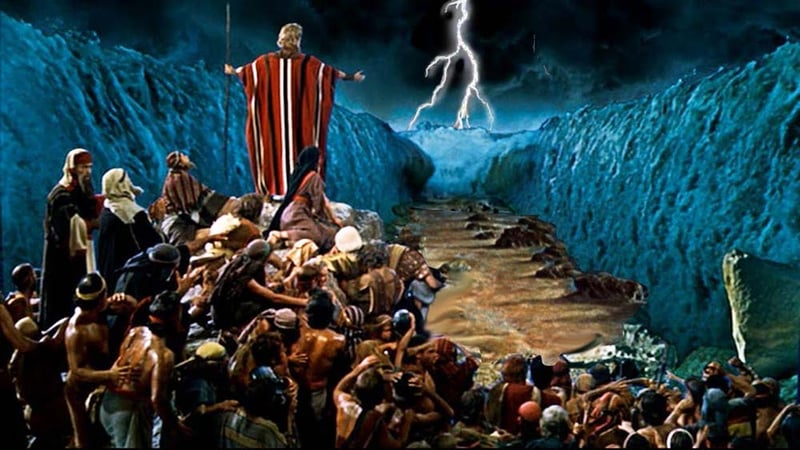
I’ve never seen a movie about Jesus Christ. But I can attest from multiple viewings of Cecil B. Demille’s 1956 film, The Ten Commandments, that it can be a challenge to think about or read about the story of the Exodus without my mind defaulting to scenes permanently implanted in my memory from the movie.
Envisioning Moses through the image of Charlton Heston is one thing, but it is another thing entirely—and far more dangerous and problematic—to imagine the Savior of humanity, God in the flesh, through the image of a human actor or an inaccurate image.
Any production claiming to tell Jesus’ story will inevitably introduce fictional elements or reflect the religious biases of its creators. These distortions go beyond simply misrepresenting His physical appearance. While embellishments and creative license are generally accepted in historical fiction, they cannot be dismissed as harmless when portraying the life of Jesus Christ.
An accurate understanding of the most important life ever lived is too important to risk allowing filmmakers’ imaginations to shape our perception of who He was, what He taught and how He lived.
This is exactly why God commanded us to avoid any portrayals of Himself, because He wants our view of Him to be completely informed by His Word of truth instead of being shaped by the ideas of human beings.
Helping people discover the genuine Jesus
One of our goals in publishing the “Walk as He Walked” series has been to help readers develop an accurate understanding of Jesus Christ—shaped by the Scriptures and careful, responsible explanation of their meaning.
Peter reminded Christians to love and believe Jesus Christ despite never physically seeing Him (1 Peter 1:8). Rather than promoting images as aids to faith, Peter emphasized a relationship with Christ that does not depend on seeing an image of His face. That relationship should be built on faith, obedience and understanding His words and example.
When it comes to our relationship with both God the Father and Jesus Christ, we are to “walk by faith, not by sight” (2 Corinthians 5:7).
Through this series and our other publications, we hope to replace deeply ingrained misconceptions and false teachings about Jesus with the truth revealed in God’s Word.
We want our readers to know the true Jesus Christ through His words, teachings and example—not through images conceived by human imagination. That is why you will not see an image attempting to portray Jesus in our publications, on our websites or in our Church services.
Date Posted: November 16, 2026
About the Author

Erik Jones
Erik Jones is a full-time writer and editor at the Life, Hope & Truth offices in McKinney, Texas.