Patriarchy has a bad name to many people today. What is biblical patriarchy? What did God really intend for fatherhood and families?
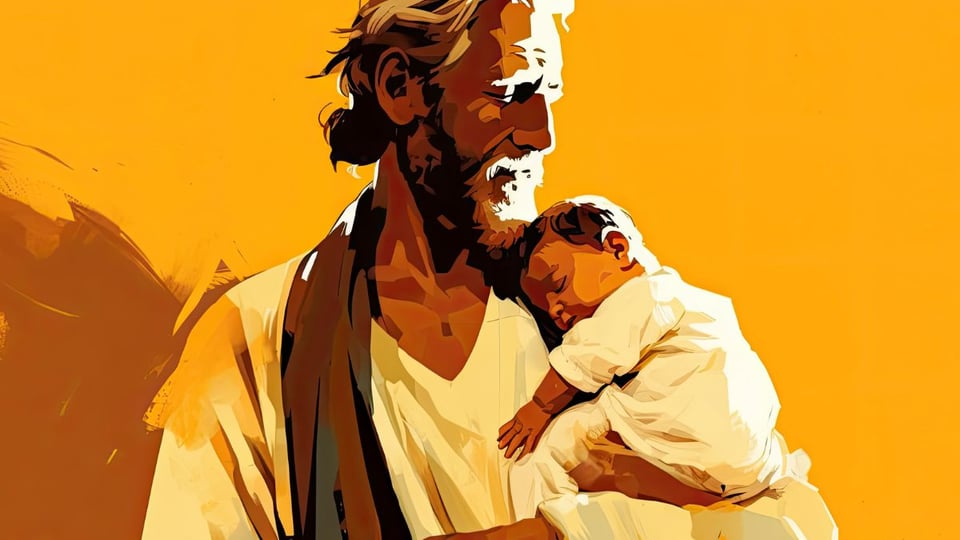
This graphic illustrates the patriarch Abraham gently holding baby Isaac.
Image Credit:PhotoGranary via Lightstock
What is patriarchy?
Simply, patriarchy means “social organization in which the father is head of the family and ancestry and inheritance are traced in the male line” (Merriam-Webster.com Kids Definition).
This has been a very common form of social organization through recorded history, from ancient Mesopotamia to ancient Rome to Europe in the High Middle Ages (A History of Western Society, Vol. 1, pp. 22, 125, 292).
But patriarchies are not all the same. As we will see, the rules and expectations for fathers and families in the Bible are unique.
Who were the biblical patriarchs?
The founding fathers of the nation of Israel can include those before the Flood and after. But patriarch and patriarchal are most often used for Abraham, Isaac and Jacob. The Bible even refers to the LORD as “the God of Abraham, the God of Isaac, and the God of Jacob” (Exodus 3:6; Matthew 22:32).
Unlike most heroes in ancient literature, the Bible doesn’t spare its main characters, instead sharing their faults and sins as well as their admirable qualities.
King David and the 12 sons of Jacob are also referred to as patriarchs (Acts 2:29; 7:8-9).
It’s interesting to note that the wives of the patriarchs also receive considerable space in the biblical narrative. Sarah, Rebekah, Leah and Rachel were not bystanders or powerless, but were very influential in the formation of what was to eventually become many nations.
Why did God work through the patriarchs?
God tested and worked with the biblical patriarchs in a special way, preparing them for even greater service in the Kingdom of God.
God recorded the positive choices and actions of the patriarchs to teach us. Here are a few examples:
“By faith Abraham obeyed when he was called to go out to the place which he would receive as an inheritance. And he went out, not knowing where he was going.
“By faith he dwelt in the land of promise as in a foreign country, dwelling in tents with Isaac and Jacob, the heirs with him of the same promise; for he waited for the city which has foundations, whose builder and maker is God” (Hebrews 11:8-10).
Abraham’s faith in God led him to do what God asked him to do, even when it meant leaving the security of his homeland for an unseen future hope.
This was followed by an even greater test, foreshadowing the sacrifice God would make for all of us:
“By faith Abraham, when he was tested, offered up Isaac, and he who had received the promises offered up his only begotten son, of whom it was said, ‘In Isaac your seed shall be called,’ concluding that God was able to raise him up, even from the dead, from which he also received him in a figurative sense” (verses 17-19).
Through all of this, “the Scripture was fulfilled which says, ‘Abraham believed God, and it was accounted to him for righteousness.’ And he was called the friend of God” (James 2:23). By his faith and obedience, he became the spiritual “father of us all” (Romans 4:16). Not just Abraham’s physical descendants, but all people.
Thus Paul connected the New Testament gospel (good news) to the wonderful promise to Abraham: “And the Scripture, foreseeing that God would justify the Gentiles by faith, preached the gospel to Abraham beforehand, saying, ‘In you all the nations shall be blessed’” (Galatians 3:8).
God wants Christians to follow the faith and obedience of the patriarchs.
Flaws of the fathers
But the Bible doesn’t sugarcoat the patriarchs. Unlike most heroes in ancient literature, the Bible doesn’t spare its main characters, instead sharing their faults and sins as well as their admirable qualities.
For example, because Abraham realized that Sarah’s beauty could endanger him, he told a half-truth to Pharaoh and, again later, to Abimelech (Genesis 12:11-20; 20:2-18). Abraham’s deceptions may have spared his life, but they put his wife at great risk.
God got them out of these messes in the end, but the lesson for us is to trust Him from the beginning. It is never okay to lie.
Also, after many long years of waiting for a child, even faithful Abraham and Sarah felt they needed to take things into their own hands. Sarah soon regretted asking Abraham to have a child by her servant Hagar.
The consequences of that faithless choice continue to reverberate today. (See our booklet The Middle East in Prophecy for more about the conflicts this spawned.)
Abraham and Sarah’s son Isaac repeated a sin of his father, lying that his beautiful wife Rebekah was his sister—with similar results (Genesis 26:6-10).
Isaac and Rebekah’s son Jacob also used deception rather than waiting for God to provide what He had promised (Genesis 25:23; 27:5-24).
These bad examples, like all the examples in the Bible, are not in the Bible to allow us to feel smug and secure, but for our admonition (1 Corinthians 10:11). “Therefore let him who thinks he stands take heed lest he fall” (verse 12).
If even the heroes of faith fell to these temptations, we all need to beware.
Why does patriarchy have a bad name today?
The biblical patriarchs had their flaws, but today’s antipathy to patriarchy is more accurately rooted in many other societies throughout history, as well as closer to home. All people are flawed, but in the popular perception, some of the worst sins of mankind have become associated with the term patriarchy.
Today that word is often associated with misogyny and violence toward women. It’s often described in terms of oppression and selfishness.
God is “a father of the fatherless, a defender of widows” (Psalm 68:5). He will gently care for the vulnerable and the hurting.
Some researchers have related patriarchy and misogyny to the prevalence of “child abuse, including neglect, sexual abuse/violence and physical punishments, domestic violence or coercive control, slavery, sex trafficking, or murder” (Christine Forner, Clinical Neuropsychiatry, August 2023).
Such trauma should not be minimized. The pain, suffering and fear are real. Abuse and other heinous sins stain any society, and they do seem to be increasing today. Unfortunately, many have endured abusive situations from their fathers, which has clouded their understanding of the loving, caring approach that God has for all of us.
Yet violence, hatred and selfishness are polar opposites of the kinds of attitudes and relationships our Creator intended.
Fatherhood was designed to be gentle, loving and serving. Family was created to nurture, support and develop the next generation.
But, like everything in this troubled world, these relationships have been tainted and corrupted by the enemy of humanity—Satan the devil.
What did God intend for patriarchy?
Spiritually, men and women have the same potential (1 Peter 3:7), and we will not marry in the age to come (Luke 20:35). Considering that future, what does God intend us to learn from family relationships in this age?
God designed human families, roles and relationships to teach us about His family! God the Father and Jesus Christ, the Son of God, want us to learn the kind of selfless love and service that have always characterized Their relationship. Our loving Father then wants us to become His children!
“I will be a Father to you, and you shall be My sons and daughters, says the LORD Almighty” (2 Corinthians 6:18).
What does our Heavenly Father want for us now in this world?
God’s instructions to husbands and fathers
God wants husbands and fathers to learn the deep, self-sacrificing love that He has:
- “Husbands, love your wives, just as Christ also loved the church and gave Himself for her” (Ephesians 5:25).
- “So husbands ought to love their own wives as their own bodies; he who loves his wife loves himself” (verse 28).
- “Husbands, likewise, dwell with them with understanding, giving honor to the wife, as to the weaker vessel, and as being heirs together of the grace of life, that your prayers may not be hindered” (1 Peter 3:7).
- “And you, fathers, do not provoke your children to wrath, but bring them up in the training and admonition of the Lord” (Ephesians 6:4).
- “Fathers, do not provoke your children, lest they become discouraged” (Colossians 3:21).
God does not tolerate hatred, violence and abuse of women or children. His plan is for warm and loving family relationships.
Study more about God’s intentions in our online article “The Divine Design of Family.”
The perfect Patriarch
In this broken world of broken people and broken relationships, the psalmist David points to the One we can always rely on:
DisobeyArt via GettyImages
“When my father and my mother forsake me, then the LORD will take care of me” (Psalm 27:10).
God is “a father of the fatherless, a defender of widows” (Psalm 68:5). He will gently care for the vulnerable and the hurting.
Our “Father in heaven is perfect” (Matthew 5:48), and “every good gift and every perfect gift is from above, and comes down from the Father of lights, with whom there is no variation or shadow of turning” (James 1:17).
Our Creator knows that this age is getting worse and worse. God sympathizes with us and offers help:
“Let us therefore come boldly to the throne of grace, that we may obtain mercy and find grace to help in time of need” (Hebrews 4:16).
That help includes the mercy and comfort He offers:
“Blessed be the God and Father of our Lord Jesus Christ, the Father of mercies and God of all comfort, who comforts us in all our tribulation, that we may be able to comfort those who are in any trouble, with the comfort with which we ourselves are comforted by God” (2 Corinthians 1:3-4).
And He won’t let this world of hurt and sorrow keep going on. Beyond this, He has a plan to intervene and save us from ourselves. He will send “times of refreshing” and “times of restoration of all things” (Acts 3:19-21).
The apostle John paints a beautiful word picture of the love our Heavenly Father has for us!
“Behold what manner of love the Father has bestowed on us, that we should be called children of God! Therefore the world does not know us, because it did not know Him. Beloved, now we are children of God; and it has not yet been revealed what we shall be, but we know that when He is revealed, we shall be like Him, for we shall see Him as He is. And everyone who has this hope in Him purifies himself, just as He is pure” (1 John 3:1-3).
God wants to have a relationship with you! Take time to learn more about how to achieve that close, warm, loving relationship by studying the biblical passages in our article “Relationship With God.”
About the Author

Mike Bennett
Mike Bennett is editorial content manager for the Church of God, a Worldwide Association, in the Dallas, Texas, area. He coordinates the Life, Hope & Truth website, Discern magazine, the Daily Bible Verse Blog and the Life, Hope & Truth Weekly Newsletter (including World Watch Weekly). He is also part of the Personal Correspondence team of ministers who have the privilege of answering questions sent to Life, Hope & Truth.