Star Trek turns 60 this year. The franchise made its debut with a hopeful vision for humanity’s future—but is utopia really attainable?
ChatGPT
Phasers set to stun. An eyebrow raise from Mr. Spock. Dr. McCoy delivering the iconic (and obvious) news: “He’s dead, Jim.” A panicked Scotty shouting at Captain Kirk, “I cannae change the laws of physics!”
For 60 years, Star Trek has had an outsized cultural impact, both through the characters it brought to life and the futuristic technology it imagined. Modern technologies like cell phones, iPads, personal computers and voice-powered AI assistants all appeared in some form in the Star Trek milieu before they ever became a reality. Multiple astronauts have cited the show as inspiration for their careers in space flight.
But when Star Trek first aired in 1966, its beating heart was not transporter beams and Vulcan salutes, not tense standoffs between Klingons and Romulans. It was a simple question that even modern sci-fi franchises rarely pause to consider:
What if we get it right?
“I don’t believe in a no-win scenario”
Most sci-fi plays out against the backdrop of dystopian tragedy. For one reason or another, the future is grim and prospects are bleak:
World governments have been replaced by ruthless, profit-driven megacorporations. Nuclear winter has ravaged the earth and left mankind nearly extinct (or else severely mutated). Our own brilliant technological innovations have risen up and enslaved us. Etc., etc., etc.
Star Trek opted for a different setting:
After a World War III that turned almost cataclysmic, the human race did the impossible. All the nations of the world set aside their differences to live peaceably under one unified, benevolent government. Wars became a relic of the past, along with poverty and racial inequality. Technological breakthroughs provided for every conceivable need.
With global peace finally attained, humanity and other allied planets set out to explore the final frontier:
Space.
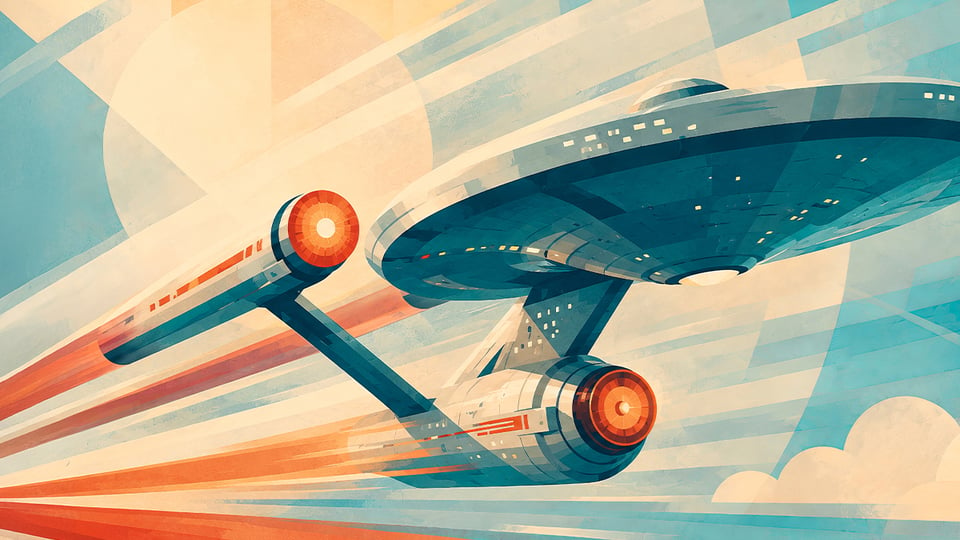
For three seasons, as the starship Enterprise navigated through the show’s opening credits, viewers were reminded of its five-year mission: “to explore strange new worlds, to seek out new life and new civilizations, to boldly go where no man has gone before.”
Unlike the vast majority of science fiction, Star Trek began with incredible optimism about what humanity has the potential to accomplish—if we can just make the right decisions on our way there. And for 60 years, that optimism has inspired multiple generations to think about what might be possible if we all pull in the same direction.
“Highly illogical, captain”
But is it possible?
Can the human race really find a way to set aside differences and build a utopia together? Or are we doomed to wipe ourselves off the map through centuries of bitter infighting and unbridled hubris?
According to the Bible, the answer is no.
To . . . both questions, actually.
Humanity will, one day, find itself on the brink of self-extinction—but it will be powerless to pull itself back from the ledge. It will also, one day, find itself in a utopia—but not one of its own making.
The reason for both these things is an element that rarely makes an appearance in sci-fi stories, but which plays an outsized role in our story:
Divine intervention.
“We dared think of ourselves as gods”
It’s not that we’re incapable of uniting together and pursuing a common goal. It’s just that, historically, that common goal is self-destructive and foolish.
Take the Tower of Babel. Back when the world was united with “one language and one speech” (Genesis 11:1), people set out to build something spectacular: a city with “a tower whose top is in the heavens” (verse 4).
The irony of it all is that rejecting God’s way of life is exactly what has always led the world down the path of self-destruction.
After the Flood, God had told Noah’s family to “be fruitful and multiply, and fill the earth” (Genesis 9:1). But here, seemingly in defiance of that command, Noah’s descendants set out to “make a name for ourselves, lest we be scattered abroad over the face of the whole earth” (Genesis 11:4).
They were never going to reach the heavens with that tower, but their common ambition galvanized them to act as one single unit. And that one single unit was driven by a desire to be like God—to climb to His domain and to operate from His vantage point.
It was the same desire that ended with God evicting Adam and Eve from the Garden of Eden. The first man and first woman ate from the forbidden tree in the hopes of becoming “like God, knowing good and evil” (Genesis 3:5).
And, just like in the Garden, God put an end to Babel’s insurrection. “And the LORD said, ‘Indeed the people are one and they all have one language, and this is what they begin to do; now nothing that they propose to do will be withheld from them. Come, let Us go down and there confuse their language, that they may not understand one another’s speech.’ So the LORD scattered them abroad from there over the face of all the earth, and they ceased building the city” (Genesis 11:6-8).
All that effort, all that potential, poured into a completely fruitless project that ended in confusion.
“Mr. Scott, there was no deity involved”
The Tower of Babel is the origin story of a kingdom called Babylon—a kingdom that will rear its head again before the end of our modern era. The spirit of Babylon, this desire to stand in God’s place and make our own rules, has resurfaced multiple times throughout our short history.
It never lasts.
(Read more in “What Is Babylon?”)
The last book of the Bible, Revelation, communicates its message largely through symbols that offer a glimpse into future events. And in those symbols, we get a disturbing vision of Babylon’s final surge into prominence.
The apostle John, who recorded the vision, wrote:
“I saw a woman sitting on a scarlet beast that was full of blasphemous names, and it had seven heads and ten horns. The woman was arrayed in purple and scarlet, and adorned with gold and jewels and pearls, holding in her hand a golden cup full of abominations and the impurities of her sexual immorality. And on her forehead was written a name of mystery: ‘Babylon the great, mother of prostitutes and of earth’s abominations.’
“And I saw the woman, drunk with the blood of the saints, the blood of the martyrs of Jesus. When I saw her, I marveled greatly” (Revelation 17:3-6, English Standard Version).
The 10 horns of the beast, we’re told, represent “ten kings who have not yet received royal power, but they are to receive authority as kings for one hour, together with the beast” (verse 12, ESV).
With the spiritual impulses of Babylon leading the way, these aspiring end-time leaders will find power and authority in their unity, and they will use that power to create an empire where they live luxuriously while merchants become wealthy by trading, among other things, the “bodies and souls of men” (Revelation 18:9, 13).
Unity . . . of a sort. But a far cry from utopia.
The good news is that it won’t last either.
“Only a fool fights in a burning house”
This final version of Babylon will come to an end during a time the Bible calls “the great tribulation” (Revelation 7:14). It will be a time “such as has not been since the beginning of the world until this time, no, nor ever shall be. And unless those days were shortened, no flesh would be saved; but for the elect’s sake those days will be shortened” (Matthew 24:21-22).
God will pour out His wrath on Babylon and a world determined to oppose His perfect laws. It will be a catastrophic series of blows with the capacity to wipe the whole human race from the earth—relentless plagues and judgments poured out on a world that refuses to consider whether their own stubbornness might be contributing to their problems. Instead, “they [will blaspheme] the name of God who has power over these plagues; and they [will] not repent and give Him glory” (Revelation 16:9).
But just when global annihilation seems inevitable, the whole thing will be cut short. Babylon will collapse after the heavens part and Jesus Christ descends with an army of saints to claim the earth as King of Kings. Even then, with the world smoldering and their empire in tatters, the leaders will attempt to resist: “And I saw the beast, the kings of the earth, and their armies, gathered together to make war against Him who sat on the horse and against His army” (Revelation 19:19).
They will lose. But the world, careening toward self-destruction, will instead receive a gift it could never deserve:
The keys to utopia.
“We overcame our instinct for violence”
Later iterations of Star Trek would treat religion with the gentle condescension of a parent speaking to a child who can’t be expected to know any better. It was often presented as a hurdle holding civilizations back from reaching their true potential—useless baggage to be discarded in pursuit of a better future.
The irony of it all is that rejecting God’s way of life is exactly what has always led the world down the path of self-destruction. From the Garden of Eden to the Tower of Babel to the woman riding the scarlet beast, humanity’s problems always begin with a desire to be like God instead of choosing to listen to God.
After the final collapse of Babylon, the world will begin to rebuild—this time under the guidance of Jesus Christ and His saints. As survivors begin to turn toward understanding and obeying God, others will take note of the blessings that come with that obedience. “In those days ten men from every language of the nations shall grasp the sleeve of a Jewish man, saying, ‘Let us go with you, for we have heard that God is with you’” (Zechariah 8:23).
And as the survivors of humanity’s darkest hour continue to let God guide their way of life, God will guide them toward a future where “they shall not hurt nor destroy in all My holy mountain, for the earth shall be full of the knowledge of the LORD as the waters cover the sea” (Isaiah 11:9).
In that future, “old men and old women shall again sit in the streets of Jerusalem, each one with his staff in his hand because of great age. The streets of the city shall be full of boys and girls playing in its streets” (Zechariah 8:4-5).
Peace, protection and long life—all stemming not from our own brilliance or achievements, but from a personal relationship with God.
And that’s just the beginning.
“It is not life as we know or understand it”
God’s plan even includes hope for the billions who don’t survive the Great Tribulation—and for the countless billions who have died throughout human history. Although Jesus will return to this earth as the King of Kings, His first appearance was as the sacrificial Lamb of God, who died so our sins could be forgiven (John 1:29).
A lot of people have died without understanding or even knowing about that sacrifice. But God is not limited by death, and there is a hope for them.
Every year, God’s people rehearse His plan by celebrating His festivals. Within those annual festivals are important reminders about what God has done, what He is doing and what He will do. Those festivals remind us, for instance, that Jesus Christ first came to the earth to become our “forerunner” (Hebrews 6:20), providing us with a sacrifice that allows us to “come boldly to the throne of grace” (Hebrews 4:16) and into the presence of God.
The benefits of that sacrifice will one day be offered to billions and billions who died without understanding that hope. The end result will be a world with no more tears, sorrow or even death (Revelation 21:4). (Discover more about God’s holy day plan in From Holidays to Holy Days: God’s Plan for You.)
Sixty years ago, Star Trek dared to consider, What if we get it right? But the Bible tells us we can’t. At least, not on our own.
Even so, ahead of us is a story more epic, more hopeful and pointing toward a brighter future than any Star Trek writer ever could have imagined for the human race. But we can get there only by following in the footsteps of Jesus Christ—going boldly, we might say, where one Man has gone before.
About the Author

Jeremy Lallier
Jeremy Lallier is a full-time writer working at the Life, Hope & Truth offices in McKinney, Texas.