Germany in Prophecy, Part 3: A Tale of Two Hearts
Historically, Germany has transformed its national character in times of crisis and war. This should make us mindful of current world conditions and Germany’s rearmament.

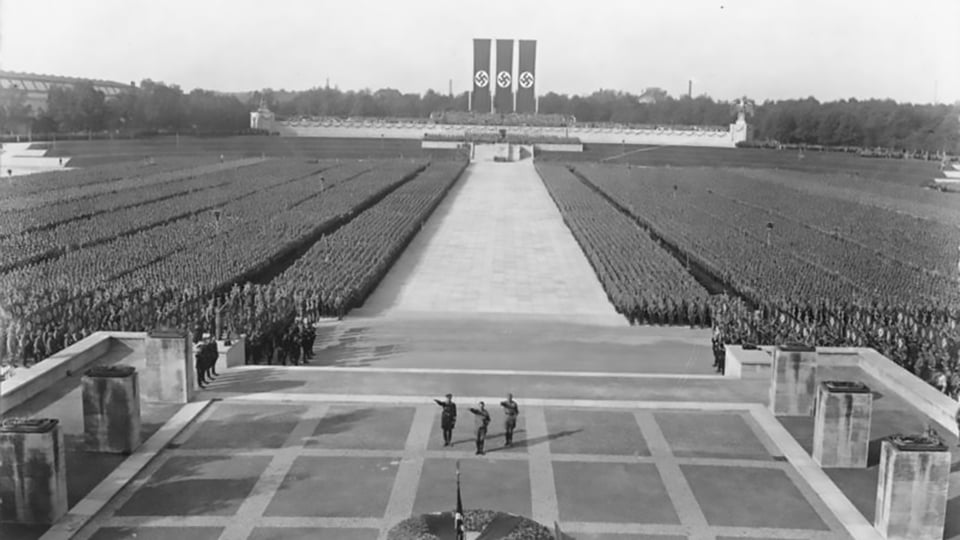
Bundesarchiv, Bild 102-16196 / CC BY-SA 3.0 DE via Wikimedia Commons
Earlier in this series, we examined Germany’s dominance over the Holy Roman Empire and its prophesied final revival. In the previous post, we noted the striking parallels between Nazi Germany and ancient Assyria—particularly their cruelty, drive for expansion and warrior spirit.
Yet the German people are not always inclined toward war.
Since World War II, Germany has been a mostly peaceful nation, and many—including Germans themselves—find it hard to imagine modern Germany repeating its past brutality.
But the Bible warns that this peaceful spirit will not last. In times of crisis, Germany has often undergone dramatic shifts in national character—transformations that have repeatedly led it to prepare for war.
Embracing war in crisis
After World War I, Germany was burdened with punishing reparations. In the early 1920s it suffered terrible hyperinflation. Then, in 1929, the U.S. stock market crashed, which marked the beginning of the Great Depression.
The economic conditions led American banks to withdraw loans made to Germany. As well, the U.S. imposed tariffs on over 20,000 imported goods. This action, combined with other nations’ retaliatory actions, reduced global trade by 66 percent and actually worsened the Depression.
Germany, heavily dependent on foreign loans and exports, was especially hard-hit. Industrial output collapsed, unemployment soared to over 6 million, which fueled severe political instability, leading to the rise of extremist political movements.
Germany’s “savior.” Amid extreme economic struggles, Adolf Hitler sold himself as Germany’s political savior, promising to revitalize its economy through infrastructure projects and an expanded military. Narodowe Archiwum Cyfrowe (public domain), via Wikimedia Commons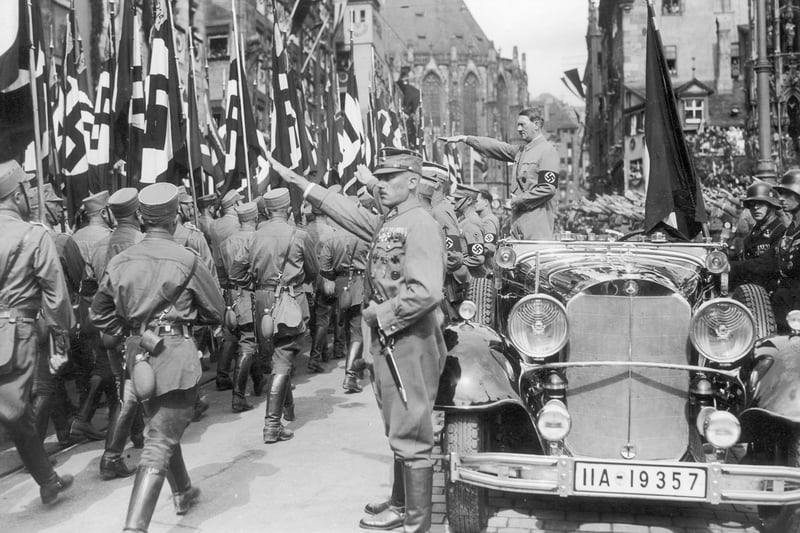
Today, amid U.S. tariffs and German economic stagnation, Friedrich Merz introduced a $1 trillion military and infrastructure package to address the country’s challenges. The new chancellor of Germany said: “Germany is back” and “is making a significant contribution to the defense of freedom and peace in Europe.”
Economists and commentators have warned that U.S. tariffs could threaten a global trade war by undermining the post–World War II free trade system and risk a conflict reminiscent of the 1930s, as countries focus on their own self-interest.
Singapore Prime Minister Lawrence Wong said: “We may well end up with a full-blown global trade war.” Dr. Sunghoon Park, an internationally recognized economist and professor emeritus at Korea University, warns: “If the tariff war persists and expands, the world economy may risk plunging into a large-scale recession or depression, reminiscent of the Great Depression of the 1930s.”
Recently, German car manufacturers asked the government to consider shifting production toward weapons manufacturing in response to economic pressures caused by U.S. tariffs. Interestingly, these carmakers historically supplied arms to Germany’s military.
Germany, long haunted by its Nazi past, has largely avoided rearmament since World War II. However, growing concerns, whether real or perceived, about a potential U.S. withdrawal from Europe, Russian aggression and internal political pressures have prompted Germany to reconsider that stance.
A BBC article titled “Germany Decides to Leave History in the Past and Prepare for War” should alert us that we are living in rapidly changing and perilous times.
History seems to be repeating itself.
The changing face of Germany
Germany experienced a sudden change prior to World War II, which was greatly influenced by a strong and radical leader.
American journalist Dorothy Thompson warned the world of Hitler. In her April 1940 Foreign Affairs article “The Problem Child of Europe,” she noted the changing face of Germany.
She wrote: “When a drastic revolution occurs in a society the change in atmosphere and behavior is so overwhelming that one cannot believe one’s eyes and ears. This is not the society with which one was familiar, the place where one felt so much at home. The old society had a face that one knew and trusted. Suddenly it is gone. Another face is there—a strange, foreign face. One thinks, ‘This is a nightmare.’”
Germany, under crisis, has a history of transforming its character and becoming a different nation.
A change of heart
Isaiah prophesied that Assyria has two hearts: “Woe to Assyria, the rod of My anger and the staff in whose hand is My indignation . . . Yet he does not mean so, nor does his heart think so; but it is in his heart to destroy, and cut off not a few nations” (Isaiah 10:5, 7).
Germany, under crisis, has a history of transforming its character and becoming a different nation.
In other words, Assyria has one heart that does not mean to destroy and another that, at certain times, leads it to an aggression that causes the destruction of many nations.
Are the German people more evil than other people?
No.
The heart of all humans is capable of doing great good and also great evil ( Genesis 3:22). The wickedness of the human heart exists in every person (Jeremiah 17:9). Solomon prayed that we all may know “the plague” of our “own heart” (1 Kings 8:38).
Then what is Isaiah referring to by a heart that will destroy, but does not mean so? To understand this, let’s consider the Assyrian and German mind.
It’s important, of course, to remember that we are speaking in general terms. National characteristics do not apply to every individual within an ethnicity and do not reflect the characteristics of all German or German-descended individuals. What we will look at here are historical characteristics and patterns of the Assyrian and German nations.
The Assyrian mind
The Assyrians had a distinctive mindset characterized by engineering skill and scientific innovation. In the seventh century B.C., under King Ashurbanipal, they developed some of the world’s earliest postal and road systems, linking the far reaches of their empire.
Some believe Assyria’s Nimrud lens is an early example of optical craftsmanship, possibly used as a primitive telescope or magnifier.
Meticulous and brutal. The Assyrians were highly advanced yet ruthlessly violent. This relief shows Ashurbanipal’s army mutilating a defeated enemy—brutality later echoed by German soldiers during World War II. Carole Raddato / British Museum, CC BY 4.0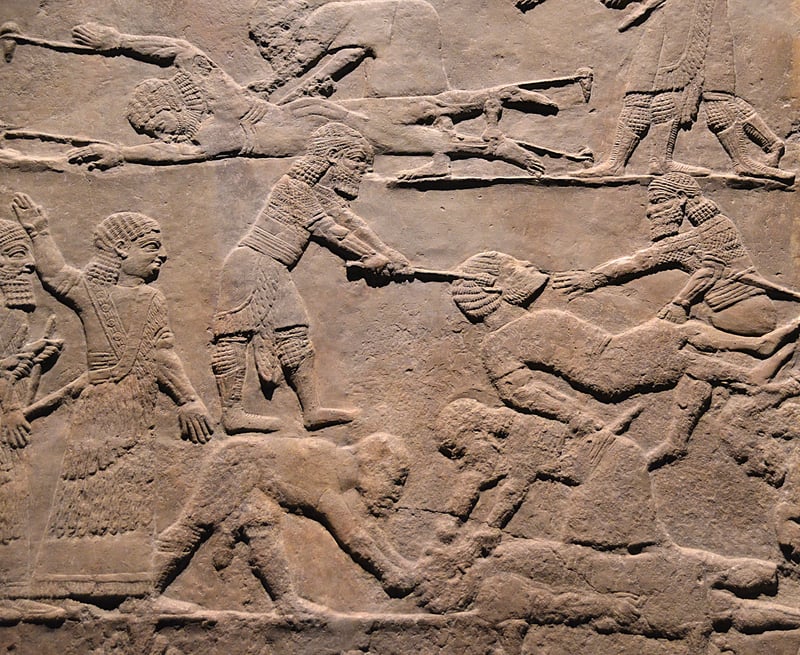
They were truly an intelligent civilization. But what occurs when that same skill, intelligence and precision is dedicated to war?
When that kind of mindset is focused on war, it often results in the development of an advanced and powerful war machine.
The Assyrians established the first professional army, integrating infantry, cavalry and chariots for better mobility. When Sennacherib attacked Hezekiah, his forces numbered 185,000 (2 Kings 19:35), a formidable number for that era.
The Assyrians were among the first to mass-produce iron weapons—much stronger than bronze—and they developed advanced siege techniques, including battering rams, towers, tunnels and ramps, which played a major role in their conquest of Lachish (2 Chronicles 32:9).
Their logistics enabled extended campaigns supported by well-maintained supply lines. They also employed terror tactics—deportations, executions and destruction—to crush opposition and deter resistance. Through innovation, discipline and organization, the Assyrians built a military machine that dominated the ancient Middle East for centuries.
Now, let’s consider the Germans.
The German mind
Before World War II, Germany was among the world’s leading nations in science and innovation, producing a remarkable number of Nobel Prize winners in physics, chemistry and medicine.
Few realize how profoundly Germany has shaped the modern world.
German inventors and engineers contributed to many transformative technologies, including the printing press (Johannes Gutenberg), automobile (Karl Benz), diesel engine (Rudolf Diesel), motorcycle (Gottlieb Daimler), glider (Otto Lilienthal), jet engine (Hans von Ohain), airship (Ferdinand von Zeppelin), helicopter (Heinrich Focke), aspirin (Felix Hoffmann), computer (Konrad Zuse) and chemical fertilizers (Fritz Haber and Carl Bosch).
During World War II, the United States relied on several German-born refugees and émigrés to help develop the atomic bomb. Among them were Hans Bethe and Klaus Fuchs.
A land of brilliant minds. Germany has produced some of history’s most influential thinkers and artists. This monument honors Ludwig van Beethoven in his birthplace of Bonn, Germany. PhotoFires/iStock via Getty Images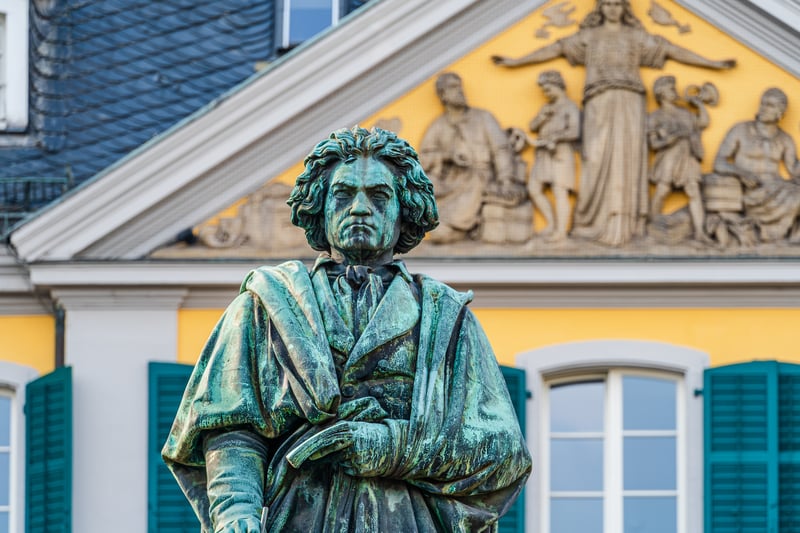
Germany has also produced some of history’s most influential thinkers (for good and for bad)—Immanuel Kant, Georg Hegel, Friedrich Nietzsche and Karl Marx.
In culture, many of music’s greatest classical composers came from Germany, including Johann Sebastian Bach, Ludwig van Beethoven, Felix Mendelssohn, Johannes Brahms, Richard Strauss and Richard Wagner. While Wolfgang Amadeus Mozart was Austrian, his language firmly placed him within the broader German cultural sphere.
Like ancient Assyria, modern-day Germany has boasted some of the world’s most brilliant minds.
But when a technical and inventive mindset is channeled into warfare, it results in powerfully destructive military technology—machine guns, tanks, submarines, cruise missiles, rockets and nuclear fission—that can annihilate nations.
Like ancient Assyria, Nazi Germany relied on a core of engineers attached to military units in order to clear obstacles and overcome defenses. Nazi Germany also conducted inhumane experiments on prisoners in the name of advancing medical and military knowledge.
We should be deeply concerned about this inventive mindset being redirected toward warfare—especially in an age of artificial intelligence and autonomous weapons. Rapid advances in nuclear fusion, bioengineering, nanotechnology, laser systems, space warfare and quantum computing can lead to technologies of immense power that can be used for unprecedented destruction.
At the Munich Security Conference 2026, Friedrich Merz described Germany’s defense-technology sector as booming, highlighting the development of so-called disruptive technologies. Once again, the German mind appears to be turning toward war—something Scripture says the world will marvel at when this war machine rises (Revelation 13:3-4).
A recent 60 Minutes episode on Germany’s rearmament illustrates this mindset, showcasing unconventional innovations, such as remote-controlled cockroaches used for reconnaissance.
Friedrich Merz spoke of the need for a change of mindset, urging Germany to “turn the switch in our minds now.” This echoes the biblical warning of a coming change of heart.
History suggests we should be deeply concerned when German ingenuity is redirected toward warfare and soberly reflect on the change of heart that has so often preceded the destruction of nations.
God warned of a future time when humanity’s weapons would become so devastating that if God did not intervene, “no flesh would be saved” (Matthew 24:22).
When the German mind turns to war, the world should worry.
In 2011 Radosław Sikorski (then Poland’s minister of foreign affairs and now also deputy prime minister) remarked, “I fear German power less than German inaction.”
His statement reflected a concern that Germany’s reluctance to lead and innovate could hinder Europe’s progress, yet that view is shortsighted. Germany’s resurgence of power could revive fears of military ambition and dominance. Poland was the first nation invaded by Germany at the start of World War II.
A love for war
In their heyday, both the Assyrian and German militaries were described as “war machines” for their efficiency, speed and lethality.
The Assyrians were a warrior people, and their chief god, Ashur, was the god of war. If your god is war, it means you worship war. It’s a trait also associated with the Germans, especially during times of military buildup and war.
Architect of terror. Heinrich Himmler, head of the infamous SS, inspects a prisoner-of-war camp in Russia in 1941. Walter Frentz/National Archives at College Park (NARA Identifier: 540164) via Wikimedia Commons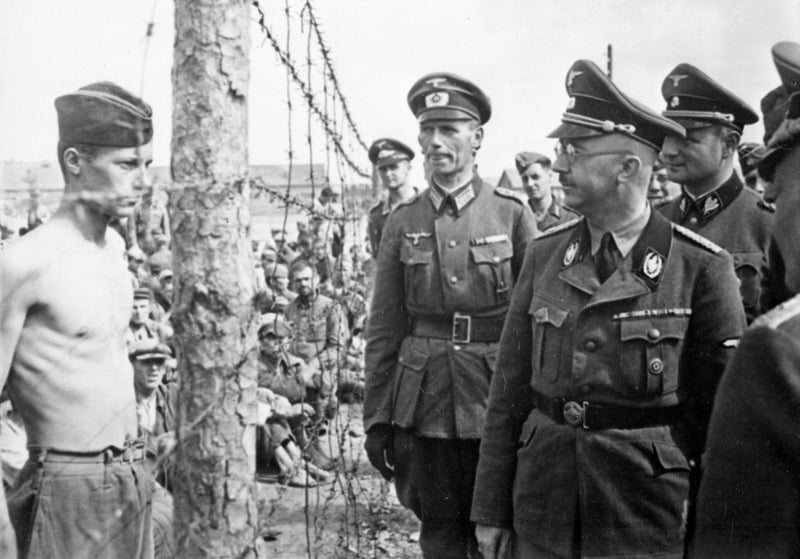
Speaking of the German love for war, Heinrich Heine, a German poet, said, “Christianity—and that is its greatest merit—has somewhat mitigated that brutal Germanic love of war, but it could not destroy it.”
American historian William Manchester in The Arms of Krupp: The Rise and Fall of the Industrial Dynasty That Armed Germany at War, observed: “Modern Krupp admirers suggest that Alfred [Krupp] was inspired by national pride. One of them notes that in those proud days, ‘the poetic genius of the youth of Germany was saturated with militaristic ideals, and death in battle was prized as a sacred duty on behalf of Fatherland, home, and family’” (1968, p. 63).
Adolf Hitler glorified war and said, “Any alliance whose purpose is not the intention to wage war is senseless and useless.”
Bible prophecy depicts Assyria as a nation that will “take the prey” (Isaiah 10:6). If its victims are portrayed as prey, that means Assyria could be called a predatory nation.
A predatory nation
Assyrian reliefs depict their kings as powerful lion hunters. This is eerily similar to how Nimrod, the founder of Nineveh (Genesis 10:8-11), is described: “the mighty hunter before the LORD” (verse 9).
Lion hunters. Assyrian kings celebrated their power and ferocity through images of lion hunts. Fittingly, the Bible also portrays Assyria as a lion—fierce and devastating to its prey. Photo by British Museum / public domain, via Wikimedia Commons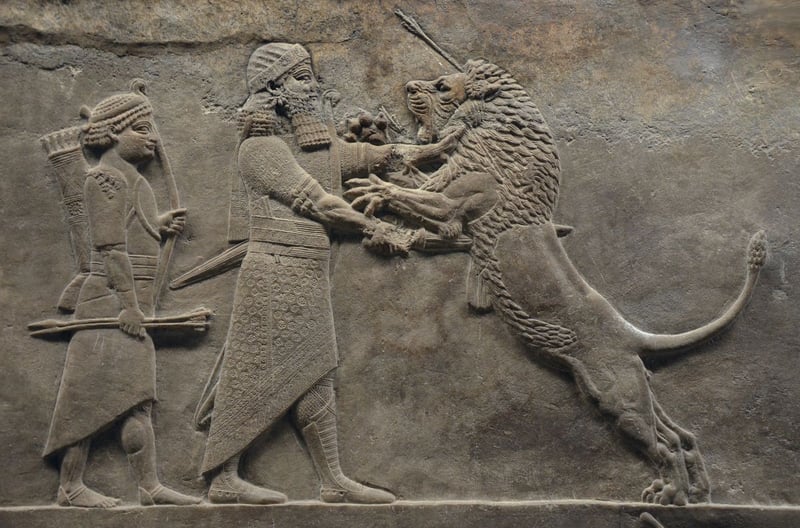
In a chilling historical parallel, Nazi Germany also became a nation of predators, relentlessly pursuing Jews from house to house and across national borders.
Germany went from relatively docile to a predatory nation when a charismatic leader arose and stirred up their militaristic spirit.
Nazi Germany portrayed itself as a predator to symbolize power, strength and dominance.
They used the eagle to symbolize their rule and named tanks after large predatory cats such as the tiger and the panther. (This tradition continues even today with modern German tanks referred to as leopards.)
Hitler was known as Wolf; and his headquarters, the Wolf’s Lair. German U-boats attacked in groups called wolf packs. The Nazis prided themselves on their portrayal as predators. Joseph Goebbels, who would be Adolf Hitler’s propaganda minister, said, “We are coming neither as friends or neutrals. We come as enemies! As the wolf attacks the sheep, so come we.”
A rod of iron
Bible prophecy asserts that God will use Assyria as the “rod” of His anger against an “ungodly nation” (Isaiah 10:5-6).
Earlier, God warned that one of the curses Israel would experience if they disobeyed Him was a “yoke of iron on your neck” (Deuteronomy 28:48). However, God also decreed that He would save Israel from this yoke of iron (Isaiah 10:27).
A nation of iron. Paul von Hindenburg, Kaiser Wilhelm II and Erich Ludendorff, each wearing an Iron Cross, reviewing troop movements during World War I. U.S. National Archives, NARA 99-02150 (public domain), via Wikimedia Commons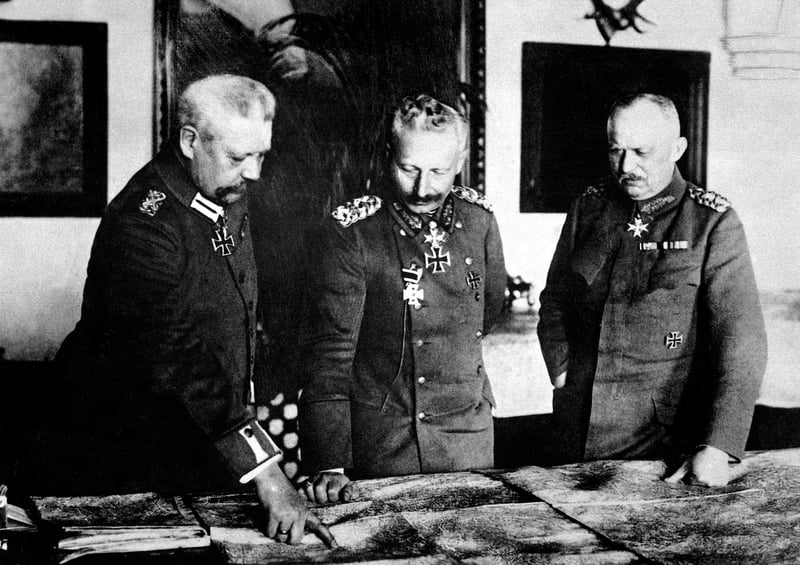
In what’s become known as his “Blood and Iron” speech, Otto von Bismarck, the father of modern Germany, famously said, “It is not by speeches and majority resolutions that the great questions of the time are decided . . . but by iron and blood.” Bismarck came to be known as Germany’s “Iron Chancellor.”
Nazi Germany awarded the Iron Cross for bravery.
The symbol of iron can be seen even in the treaty between Nazi Germany and Fascist Italy—dubbed the Pact of Steel. Iron is, of course, the primary component of steel.
Nebuchadnezzar’s statue depicted the Roman Empire and its revivals as legs of iron, and its final end-time revival as feet composed “partly of iron and partly of clay” (Daniel 2:33, 40).
A final revival
The Germans will rise again, and we are witnessing their remilitarization before our eyes. Daniel describes the end-time ruler of the final revival of the Roman Empire as one who will “exalt himself above them all” (Daniel 11:37).
Adolf Hitler, representing a portion of the ninth revival of the Roman Empire, was a type of the ultimate fulfillment of this prophecy. Though raised Roman Catholic and having signed a concordat with the Vatican, Hitler despised Christianity, viewing its humility and “turn the other cheek” teachings as signs of weakness.
It seems the political and military heart of the European beast will be centered in Germany, while its religious heart will be rooted in Rome.
Instead, Hitler preferred the use of force to get his way.
He said, “You see, it’s been our misfortune to have the wrong religion. Why didn’t we have the religion of the Japanese, who regard sacrifice for the Fatherland as the highest good? The Mohammedan religion too would have been much more compatible to us than Christianity. Why did it have to be Christianity with its meekness and flabbiness?” (quoted by Albert Speer, Inside the Third Reich, p. 96).
The final leader of the end-time Roman Empire will be more closely aligned with religion than Adolf Hitler. He will ally himself with a religious leader called “the false prophet” (Revelation 16:13), who is also labeled “another beast . . . [who had] two horns like a lamb and spoke like a dragon” (Revelation 13:11). In other words, this false prophet will appear to represent Christ (the Lamb), but will teach the doctrines of Satan.
It seems the political and military heart of this coming European power will center in Germany, while its religious heart will be rooted in Rome.
A new heart
The war this final beast power will unleash will bring mankind to the brink of destruction (Matthew 24:22). But the good news is that Jesus Christ will destroy this political and religious power. Prophecy reveals: “He shall come to his end, and no one will help him” (Daniel 11:45).
More detail is given in Revelation 19:20: “Then the beast was captured, and with him the false prophet who worked signs in his presence, by which he deceived those who received the mark of the beast and those who worshiped his image. These two were cast alive into the lake of fire burning with brimstone.”
With their destruction will begin a new reign—the reign of Jesus Christ and the Kingdom of God.
The nations will go through a transformation where they will unlearn the ways of war. “Nation shall not lift up sword against nation, neither shall they learn war anymore” (Isaiah 2:4).
All peoples—including the modern Assyrians—will then begin to experience a change of heart as God’s Spirit is poured out on “all flesh” (Ezekiel 36:26-27; Joel 2:28). God’s laws will be inscribed in the hearts and minds of all people, allowing everyone to come to know God (Hebrews 10:15-16; 8:10-11).
Read the previous two blogs in this series:
- Germany in Prophecy, Part 1: Germany Dominates the Holy Roman Empire
- Germany in Prophecy, Part 2: A Rod of Correction
Date Posted: February 18, 2026
About the Author

Isaac Khalil
Isaac Khalil is husband to his lovely wife, Natasha, and father to son Eli and daughter Abigal. He loves to spend time with family and friends doing various things like watching movies, playing chess, playing board games and going out. He enjoys studying biblical topics and discussing the Bible with his friends. He is also a news junkie and is constantly reading and sharing news connected with Bible prophecy.