Germany in Prophecy, Part 2: A Rod of Correction
Germany is rising as a key global influence that will shape the future. What is Germany’s biblical identity, and how will God use this nation in the end times?

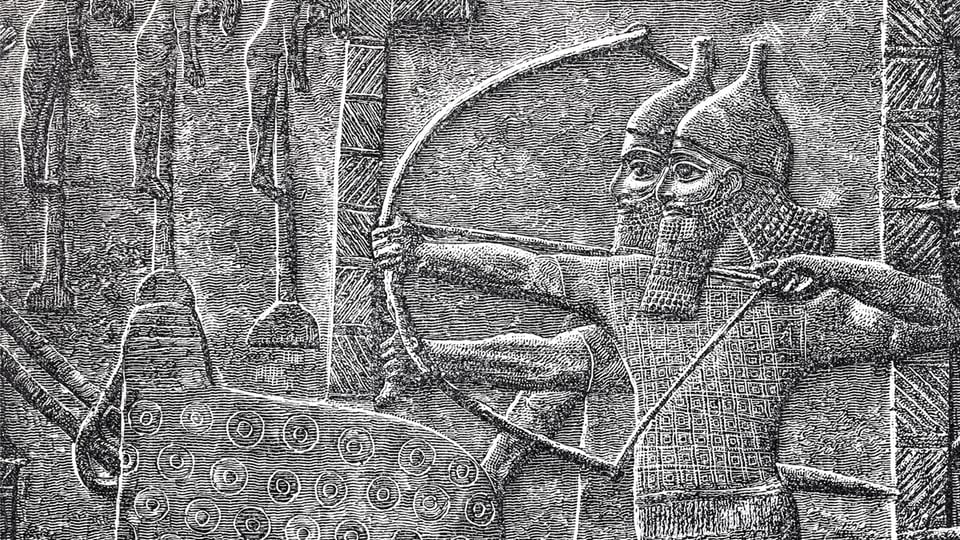
An Assyrian wall relief depicting Tiglath-Pileser III besieging a city. The Assyrians’ cruel brutality is captured in the impaled victims in the background.
Image Credit:Clu/DigitalVision Vectors via Getty Images
In our previous post, we examined Germany’s dominance of the Holy Roman Empire. In this post, we’ll examine Germany’s identity in the Bible.
Many nations in the Bible are known by their ancient names, but only a few gentile (non-Israelite) nations still carry their biblical names today—most notably Egypt, Syria and Lebanon.
But who is Germany in the Bible?
Determining a nation’s identity
A nation’s biblical identity can be difficult to determine and often requires careful study. At times, a people’s identity is hinted at through their national traits and characteristics. God is able to declare “the end from the beginning, and from ancient times things that are not yet done” (Isaiah 46:9-10).
The Bible reveals distinct characteristics of nations—traits passed down from generation to generation, much like within families. In many ways, nations are simply families grown large.
Of course, not every individual within that nation will possess these characteristics. However, certain broad traits have appeared frequently enough in history to be recognized as recurring national patterns.
A careful study of these overall national character traits points to a connection between modern Germany and the ancient biblical nation of Assyria.
A rod of correction
Because of the northern kingdom of Israel’s disobedience and rebellion, God warned that He would send “a nation of fierce countenance” to punish them (Deuteronomy 28:49-50).
At the time of Israel’s captivity, that nation was ancient Assyria.
God called Assyria the “rod” of His anger and the “staff” of His indignation—a tool He would use to correct His people. At the same time, Isaiah also pronounced a “woe” against Assyria for its arrogance, brutality and cruelty, which far exceeded God’s intent (Isaiah 10:5-6).
Assyrian domination. This relief from the Black Obelisk shows King Jehu of Israel bowing down before the Assyrian king Shalmaneser III. 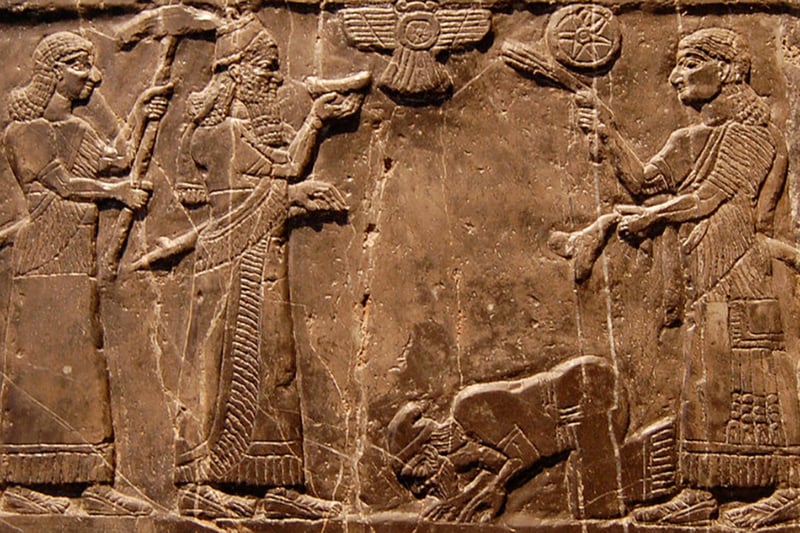
About 10 years later, his son Shalmaneser V began a three-year siege of Israel’s capital, Samaria, which was completed by his successor, Sargon II. The Israelites were taken into captivity and relocated to regions northeast of their homeland—areas corresponding to modern Iraq and Iran (2 Kings 17:1-6; 18:9-11).
The 10 tribes of Israel, captured by Assyria, never returned to their land and became known as the “lost 10 tribes” of Israel. They were seemingly lost to history, with many historians believing they were simply assimilated into the surrounding peoples and ceased to exist as an identifiable people.
But though the tribes of Israel were seemingly lost and forgotten to history, they weren’t lost and forgotten to God.
To learn more about the modern identity of the “lost 10 tribes” of Israel, download our booklet, “The United States, Britain and the Commonwealth in Prophecy.”
An Assyria-Germany connection?
One of Isaiah’s sons was Shear-Jashub (Isaiah 7:3), whose name means “a remnant will return” (Brown-Driver-Briggs Hebrew Lexicon), a theme in the book of Isaiah.
God foretold that a “remnant of His people who will be left from Assyria” would one day return—a prophecy that has yet to be fulfilled. Isaiah likens this future deliverance to a second exodus, not from Egypt, but from Assyria (Isaiah 11:16; compare Micah 7:12; Hosea 11:11; Zechariah 10:10).
However, this future deliverance from Assyria will not be from Israel’s ancient captivity, but from a yet future end-time captivity, from which God will once again deliver His people. Because Israel has not yet repented or learned from its past, its descendants will go into captivity again. But God promises to set His hand again “the second time” and deliver them, as foretold in Isaiah 11:11.
Other prophets also foretell of a remnant that will return in a later exodus.
Jeremiah, prophesying of the end times, foretold that people would no longer refer to God as the One who “brought up the children of Israel from the land of Egypt”—that is, the first exodus. Instead, He will be known as the One who “brought up and led the descendants of the house of Israel from the north country” (Jeremiah 23:7-8). Here, Jeremiah reveals that the second exodus will come from the north.
Trier, Germany. According to a fascinating legend, Trier, Germany’s oldest city, was founded by an Assyrian prince. Bloodua / iStock via Getty Images
Isaiah also foretells that in the end times, Assyria will be so devastated that its remaining trees could be counted by even a child (Isaiah 10:19).
Historically, ancient Assyria, which defeated ancient Israel, was located east and northeast of Israel, being centered in what is northern Iraq and northeastern Syria today. Today, Iraq is not known for trees.
Modern Iraq has only about 2 percent of its land covered by trees, whereas Germany—located geographically north of Israel—has close to one-third of its land covered by forest.
After the fall of Assyria in 612 B.C., many Assyrians are believed to have migrated northward into parts of Europe. Ancient writers even recorded sightings of peoples identified as Assyrians in the region. In Letter 123, Jerome mentions the Assyrians among the barbarian tribes, stating, “Assur [Assyria] also is joined with them.”
Germany has a fascinating legend that the city of Trier, Germany’s oldest city, was originally settled by an Assyrian prince named Trebeta. An inscription on the facade of the Red House on Trier’s main market square, refers to this legend, claiming to predate Rome by 1,300 years.
According to this legend, Trebeta was Ninus’s son. Ninus later married Queen Semiramis, and after Ninus’s death, Semiramis took over the kingdom. Fearing for his safety, Trebeta fled from his stepmother, traveled across Europe and founded a settlement in present-day Trier.
The name Nineveh means “abode of Ninus” (Brown-Driver-Briggs Hebrew Lexicon). Encyclopaedia Britannica notes that Ninus is associated with the city’s founder, which would equate Ninus with Nimrod and position Trebeta as his son.
Tracing the movements of migrating peoples in ancient times is difficult, yet the connection between ancient Assyria and modern Germany becomes stronger when viewed through the lens of national characteristics described in the Bible and seen in history. These traits—especially traits of discipline, order, efficiency, ruthlessness and military strength—show a striking similarity between Germany and ancient Assyria.
These traits became especially evident during the rise of Nazi Germany.
A cruel nation
A dominant characteristic of ancient Assyria was its brutal cruelty, virtually unmatched in history except in modern times.
In The Anvil of Civilization, historian Leonard Cottrell writes: “In all the annals of human conquest, it is difficult to find any people more dedicated to bloodshed and slaughter than the Assyrians. Their ferocity and cruelty have few parallels save in modern times. The kings were generals; their nobles belonged to a military caste; their trade was war” (1957, p. 165).
The Assyrians were not only cruel—they took pride in their cruelty and openly boasted of it.
For example, Ashurnasirpal II had this inscription put on a monument: “Their men, young and old, I took prisoners. Of some I cut off their feet and hands; of others I cut off the noses, ears and lips; of the young men’s ears I made a heap; of the old men’s heads I made a minaret. I exposed their heads as a trophy in front of their city. The male children and the female children I burnt in the flames. The city I destroyed, and consumed, and burnt with fire” (Israel Smith Clare, Library of Universal History, Vol. 1 Ancient Oriental Nations, 1897, p. 151).
Brutal warriors. This eighth-century Assyrian relief shows Assyrian soldiers in battle. Historians consider Assyria one of the most brutal civilizations in history. TonyBaggett / iStock via Getty Images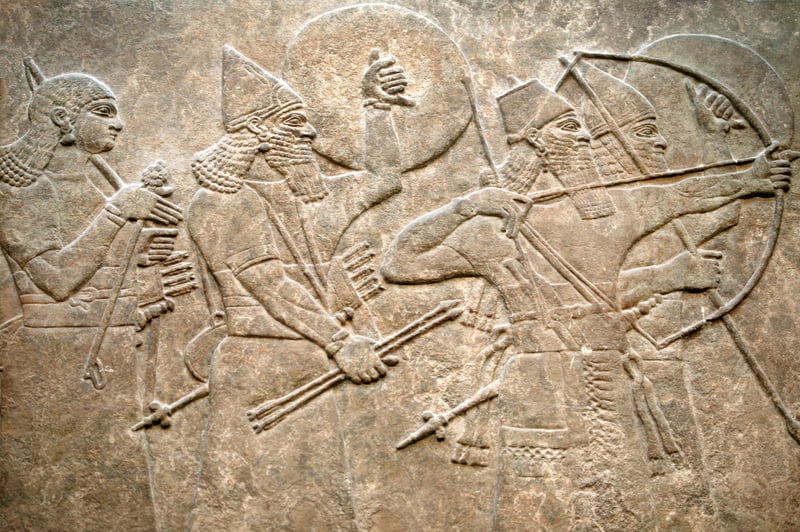
As foretold, they were a nation that showed no mercy, a people that “does not respect the elderly nor show favor to the young” (Deuteronomy 28:50).
Nazi Germany bears a remarkable resemblance to the ancient Assyrians in their cruelty, a fact noted by some historians.
Scholar Simon Anglim notes, “While historians tend to shy away from analogies, it is tempting to see the Assyrian Empire, which dominated the Middle East from 900-612 BC, as a historical forebear of Nazi Germany: an aggressive, murderously vindictive regime supported by a magnificent and successful war machine. As with the German army of World War II, the Assyrian army was the most technologically and doctrinally advanced of its day and was a model for others for generations afterwards.”
Both Assyria and Germany used fear and terror as a method of control. Heinrich Himmler, the notorious head of the German SS, said: “The best political weapon is the weapon of terror. Cruelty commands respect. Men may hate us. But, we don’t ask for their love; only for their fear.”
The book of Nahum describes Nineveh (one of ancient Assyria’s greatest cities) as “the bloody city” where “its victim never departs.” It depicts a city responsible for “a multitude of slain,” “a great number of bodies” and “countless corpses”—so many that people “stumble over the corpses” (Nahum 3:1-3).
The cruelty of the Assyrians was unparalleled in the ancient world—surpassed only by that of the Nazis during World War II. The biblical descriptions of the slain and of people stumbling over corpses evoke haunting parallels to the horrific scenes witnessed by the Allies as they liberated the Nazi death camps in Europe.
A nation intent on conquest
The Assyrians were a fiercely warlike people who viewed lands beyond their control as chaotic, believing it was their divine duty to impose order under their supreme god, Ashur. He was often depicted as a figure wielding a bow, encircled by a winged sun disk. Isaiah alluded to this imagery when he described the Assyrian conquests as the “stretching out of his wings” over the land (Isaiah 8:7-8).
The Reichsadler. As a symbol of its power, Nazi Germany adopted a spread-winged eagle resembling the ancient Assyrian symbol of Ashur. German Federal Archives (Bundesarchiv) via Wikimedia Commons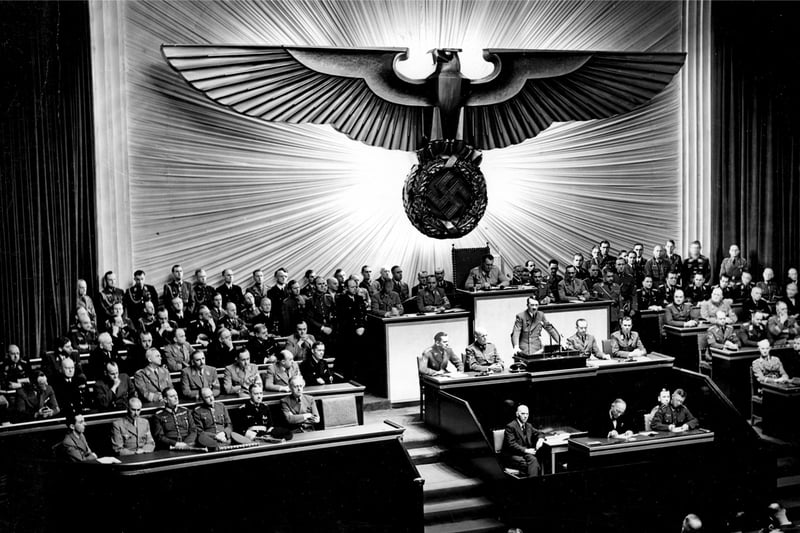
Both ancient Assyria and modern Germany faced similar geographical pressures that drove their expansion.
Although Assyria lay to the northeast of Israel and Germany to the north of Europe, both occupied fertile yet resource-poor regions dependent on imports. Each was surrounded by rival powers and lacked substantial natural barriers, leaving them vulnerable to invasion.
Consequently, both felt compelled to expand their borders or risk being overtaken by their neighbors. Neither respected national boundaries. Isaiah, writing about the king of Assyria, said he “removed the boundaries of the people” (Isaiah 10:13).
Adolf Hitler aggressively pursued territorial expansion under a policy he called “Lebensraum,” or living space. Through it, he sought to enlarge Germany’s territory and bring other peoples under German control. Similarly, ancient Assyria believed that all nations should submit to its god Ashur and, by extension, to Assyrian rule.
Both powers saw themselves as inherently superior and destined to dominate others. The Assyrians even declared that their “princes” were meant to be “kings” over other nations (verse 8).
Plundering the nations
Isaiah wrote of how ancient Assyria would “seize the spoil” while plundering nations (verse 6) and boastfully claim to “have robbed their treasuries” (verse 13). Assyria demanded heavy tribute from vassal states, which would often lead them to rebel (2 Kings 15:19-20; 17:3-4; 18:7-8).
Similarly, Adolf Hitler expanded Germany by using the spoils of war to support its continued war efforts.
History’s most notorius thieves. The Nazis looted conquered nations and hid vast amounts of stolen gold and cultural treasures, including these caches stored in a German salt mine. German Federal Archives (Bundesarchiv) via Wikimedia Commons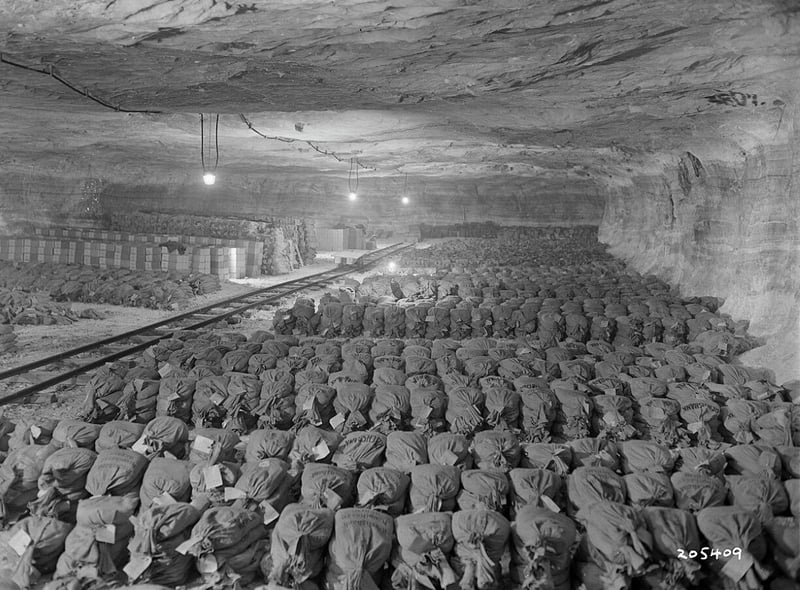
It was a practice continued in Nazi Germany, where deportees were used for forced labor. But this is something the Assyrians themselves will ultimately face, experiencing what they have done to others (Isaiah 31:8).
When the ancient Assyrians captured a nation, they would kidnap its gods and take them to Assyria to show their gods’ dominance over the other gods. Hosea referred to this practice in his prophecy that Israel’s calf-idol would be “carried to Assyria as a present for King Jareb” (Hosea 10:5-6).
What were the modern idols given as gifts to the king of Assyria? We can learn from Nazi Germany.
Nazi Germany created a special division called Einsatzstab Reichsleiter Rosenberg, which specialized in culturally plundering the nations they conquered. When the Allies defeated the German territory, they came across vast amounts of plunder, some of which was still in storage and some hidden in salt mines.
The prophet Nahum prophesied that when Assyria would fall, its enemies would “take spoil of silver! Take spoil of gold! There is no end of treasure, or wealth of every desirable prize” (Nahum 2:9). This was true of both ancient Assyria and the modern Assyrians.
Isaiah’s son, Maher-Shalal-Hash-Baz, was named for this particular trait of the Assyrians. His name means “Haste-to-the-spoil, Quick-to-the-prey” (Adam Clarke Commentary, note on Isaiah 8:3).
Mighty warriors
Assyrian kings were crowned in the temple of Ashur and considered it their divine duty to expand the empire. They were often skilled military leaders. They considered themselves to be Ashur’s representatives on earth, serving as intermediaries between god and humanity.
When the Assyrian kings came to power, they often abandoned their personal names and adopted a divine name, usually including the name Ashur. For example:
- Ashur-nirari: “Ashur is my help.”
- Ashur-rabi: “Ashur is great.”
- Ashur-dain-aplu: “Ashur is the heir’s judge.”
- Ashur-etil-ilani: “Ashur is the lord of the tree.”
Obsessed with expansion. Like the Assyrians, Adolf Hitler was obsessed with expanding Germany through conquest. German Federal Archives (Bundesarchiv) via Wikimedia Commons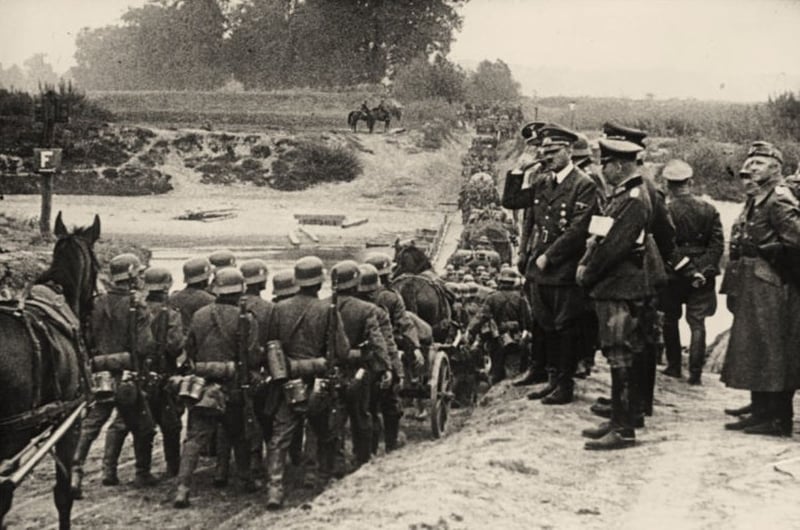
The Germans also saw it as a divine duty to expand their empire. Just one year before World War I began, Kaiser Wilhelm II stated, “I look upon the people and the nation, as handed on to me, as a responsibility conferred upon me by God. And I believe, as it is written in the Bible, that it is my duty to increase this heritage, for which one day I shall be called upon to give an account. Whoever tries to interfere with my task, I shall crush.”
Adolf Hitler was also a military leader consumed with conquest, much like the ancient Assyrian kings. Isaiah describes the Assyrians as conquering nations “like a valiant man” (Isaiah 10:13). The relentless Assyrian warriors advanced from victory to victory.
In a striking parallel, Nazi Germany swept through Europe with similar speed and ferocity: Poland fell within a month, Denmark in six hours, Norway in two months, France in six weeks, Belgium in 18 days, the Netherlands in five days, Luxembourg in one day, Yugoslavia in under two weeks and Greece in eight weeks.
They conquered with ease, just as Isaiah described Assyria’s power—as effortlessly as “one gathers eggs” from a nest (Isaiah 10:14).
Yet God tells us not to be afraid of the Assyrians.
Do not be afraid of Assyria
The Assyrian reputation for cruelty preceded them. This is likely why Jonah ran away from God’s commission to preach repentance to the people of Nineveh. Jonah wanted God to destroy them because of their great wickedness (Jonah 1:2).
After reading about ancient Assyria and seeing the rise of Nazi Germany and their cruelty, it is hard to comprehend God’s instruction to His people, “Do not be afraid of the Assyrian”—when He also says the Assyrian “shall strike you with a rod and lift up his staff against you” (Isaiah 10:24).
It is even harder to comprehend how God uses Assyria as a tool in His hand. When a people reject God’s correction, He sometimes allows a more wicked nation to rise against them to demonstrate that His ways are just, while human ways are not (Ezekiel 18:25).
Scripture reminds us that God disciplines those He loves (Hebrews 12:6; Revelation 3:19).
Fearing the Assyrian is like fearing the hammer rather than the one who wields it. God does not want us to fear the instrument of correction, but to fear Him—for “the fear of the LORD is the beginning of wisdom” (Psalm 111:10; Proverbs 9:10).
Therefore, He urges us to seek Him now, “before the day of the LORD’s anger comes,” so that we may be “hidden in the day of the LORD’s anger” (Zephaniah 2:1-3).
Are you ready to seek God?
Read part 1 of this series here: “Germany in Prophecy, Part 1: Germany Dominates the Holy Roman Empire.”
Date Posted: February 11, 2026
About the Author

Isaac Khalil
Isaac Khalil is husband to his lovely wife, Natasha, and father to son Eli and daughter Abigal. He loves to spend time with family and friends doing various things like watching movies, playing chess, playing board games and going out. He enjoys studying biblical topics and discussing the Bible with his friends. He is also a news junkie and is constantly reading and sharing news connected with Bible prophecy.