The Portrait of a Good Leader
Good leaders are hard to find today. What makes an effective leader? Discover the key trait God expects—and how He is developing future leaders.


Ignatiev/E+ via Getty Images
Across the globe, people are rising up in protest against their governments, deeply dissatisfied with those in power. Discontent is spreading as leaders fail to meet the needs and expectations of their citizens.
The world seems to be teetering on the edge of an explosion of violence and unrest. What is driving this surge of turmoil and upheaval?
Growing unrest
In Nepal, Gen Z protesters rallied against a government ban on social media platforms, like Facebook, WhatsApp and Instagram, that was intended to stifle criticism of Nepal’s government. In defiance, protesters took to the streets, clashing with authorities and staging demonstrations.
In Indonesia, outrage was sparked over parliament members’ salaries and housing allowances. The allowance alone was 10 times the country’s minimum wage. Protesters flooded the streets, condemning the stark inequality and demanding fairer governance.
A group of protesters face off with government authorities in the Philippines. h3k27/iStock via Getty Images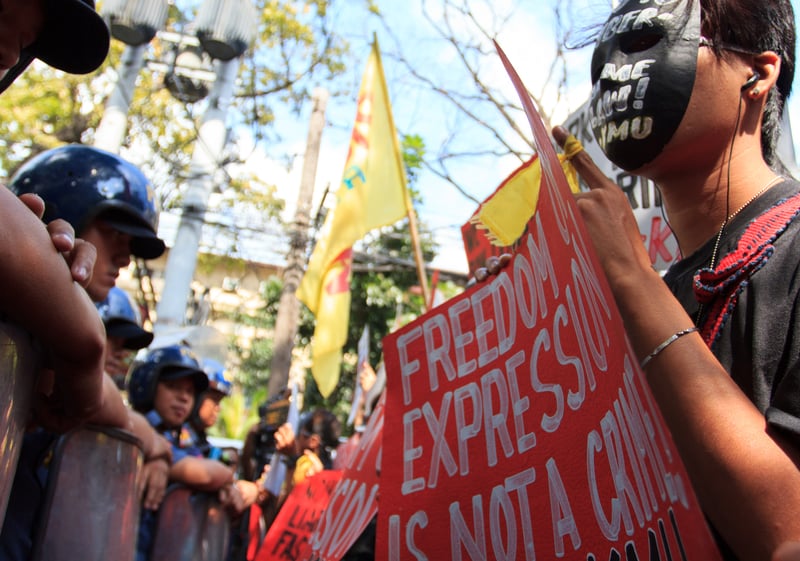
In the Philippines, thousands recently protested a corruption scandal involving bogus flood-control projects. Investigations have revealed that a significant portion of the funds allocated for flood-control projects ended up in the pockets of contractors and politicians. In some cases, “ghost projects” were paid for but never built—leaving entire communities vulnerable. Demonstrations occurred in Manila and across the country, with clashes against police and arrests around government buildings.
In Iran, a significant protest movement has emerged amid worsening economic conditions and longstanding political repression. The demonstrations have been met with harsh government crackdowns, including violent confrontations between security forces and protesters.
Around the world, people are crying out for change—but what kind of change do we need?
If today’s governments collapse, what will ensure better leadership tomorrow? The Bible offers a surprising and timely answer.
The Bible’s solution: righteous leadership
A good leader can make a world of difference to a nation. The book of Proverbs brings this out: “When the righteous are in authority, the people rejoice; but when a wicked man rules, the people groan” (Proverbs 29:2).
We also know what happens when there is no leadership. It creates a situation like that of ancient Israel, where “everyone did what was right in his own eyes” (Judges 21:25).
If you had to choose one word to describe a good leader, what would it be?
I asked a group of young adults this question, and they offered words like godly, wise, patient, strong, gracious, merciful, humble and trustworthy—all powerful qualities.
The Bible highlights another vital attribute, and it encompasses them all.
We need leaders who behave like shepherds.
Jesus Christ perfectly exemplified this trait. Peter described Jesus as the “Chief Shepherd” (1 Peter 5:4).
What’s the key to a leader being a shepherd?
In Deuteronomy 17, God outlines His expectations for a king ruling over His people. The first two criteria are clear: the king must be from among the people and chosen by God (verses 14-15).
Why should leaders come from among the people they lead?
One reason is that it creates a strong connection between the leaders and those served—the leaders will be aware of their history, customs, strengths and struggles.
Good leadership is grounded in humility and service, not in elevating oneself above others.
Many leaders today, though born among the people, are like strangers to their citizens. Perceived as disconnected, they are often viewed as elites—out of touch, living in their own world, and regarding themselves as superior to those they serve.
This creates a divide where people struggle to relate to those in authority.
Jesus offered a different model, teaching His disciples that while worldly leaders wield power and dominate others, we should not. “Yet it shall not be so among you; but whoever desires to become great among you, let him be your servant” (Matthew 20:25-26).
Good leadership is grounded in humility and service, not in elevating oneself above others.
Christ as our Chief Shepherd
Jesus described Himself as the “Good Shepherd” who knows His sheep by name, and they, in turn, recognize His voice and follow Him (John 10:3-4).
This portrays a mutual, intimate relationship between the Shepherd and His flock. He emphasizes the importance of personal connection, which contrasts with the distant relationships today’s leaders have with those they govern.
During His earthly ministry, Jesus did not wield His divine authority as the Lord of the universe in a domineering way. When He returns, will He come again as a gentle Shepherd or as an aloof, domineering ruler?
The book of Revelation describes Jesus returning to “rule them with a rod of iron,” a phrase also applied to those who reign under Him (Revelation 19:15; 2:27).
After His resurrection, Jesus met His disciples while they were fishing. When Peter recognized Him on the shore, he eagerly jumped into the water to reach Him (John 21:7).
In their encounter, Jesus asked Peter three times, “Do you love Me?” instructing him to “feed My lambs,” “tend My sheep” and “feed My sheep” (verses 15-17). Here, Jesus, the Good Shepherd, used shepherding language to address Peter, a fisherman.
The Greek word translated as “tend” in this passage is the same word rendered as “rule” in “rule with a rod of iron.” According to Strong’s Concordance, this word, poimainō, means “to tend as a shepherd,” with its root tied to “shepherd.” Thus, rather than ruling sheep with harsh authority, it implies tending to them with care and guidance.
The rod of iron also refers to strict adherence to God’s way of life. In that respect, it is firm; no deviation from God’s way—to the right or the left—will be tolerated (Deuteronomy 5:32; 17:20; Joshua 1:7; 23:6).
The shepherd’s rod was used to protect the flock from predators and to correct wandering sheep, nudging or prodding them back into the flock, back to God’s way of life.
Isaiah prophesied that in the future, Spirit-led leaders will guide people by gently intervening when they stray from God’s path, saying, “This is the way, walk in it” (Isaiah 30:21).
Leadership in God’s future Kingdom
God will select kings to rule with Christ at His return.
Consider the following scriptures:
- Luke 19:17, 19: The good and faithful servants will have authority over cities.
- Revelation 1:6; 5:10: God will establish kings and priests on the earth.
- Revelation 2:26-27: Those who overcome will rule over nations.
This aspect of rulership, a kingdom on earth ruled by Jesus Christ and His saints, is often overlooked. To this end, God is preparing a kingdom of kings and priests to reign with Him on earth.
The leaders of tomorrow will be shepherds and servants.
God is preparing His Kingdom by training future leaders. If He is calling you, begin now to develop the heart of a servant and the care of a shepherd—so that when Christ returns, you will be ready to reign with Him.
Date Posted: March 11, 2026
About the Author

Isaac Khalil
Isaac Khalil is husband to his lovely wife, Natasha, and father to son Eli and daughter Abigal. He loves to spend time with family and friends doing various things like watching movies, playing chess, playing board games and going out. He enjoys studying biblical topics and discussing the Bible with his friends. He is also a news junkie and is constantly reading and sharing news connected with Bible prophecy.