Does the Tearing of the Temple Veil Mean God’s Law Is Abolished?
Immediately following Jesus’ death, the veil of the temple was torn in two. Some believe this signified that God’s law was abolished. What did it actually mean?

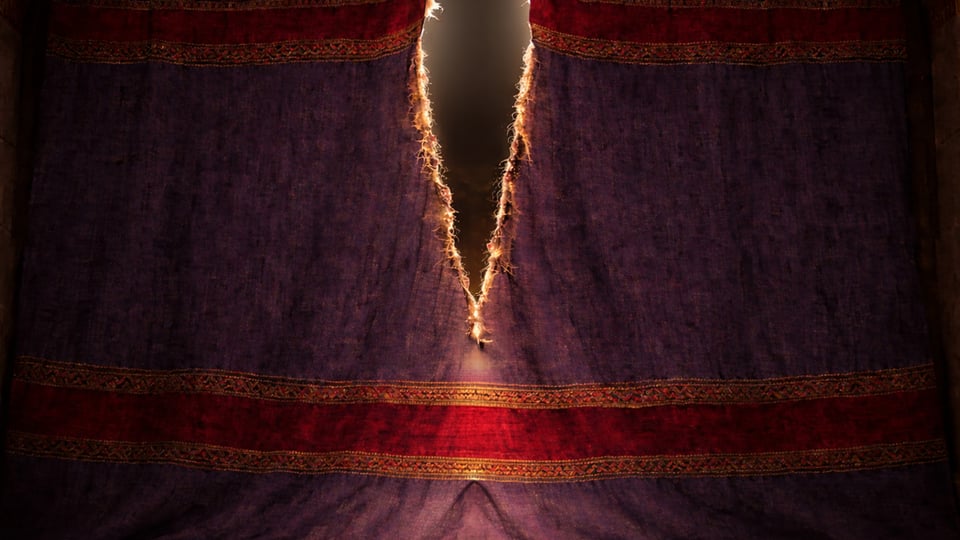
The tearing of the massive curtain that closed off the innermost part of the temple was highly significant.
Image Credit:LHT staff using AI
A viewer of one of our Life, Hope & Truth Presents videos posted the following comment: “The law ended when Jesus was crucified and the veil on the temple was torn.”
Matthew describes this dramatic moment following Jesus’ death: “Then, behold, the veil of the temple was torn in two from top to bottom” (Matthew 27:51).
Certainly, the tearing of the massive curtain that closed off the innermost part of the temple at the moment of Jesus’ death was highly significant. And the fact that it was torn from the top to the bottom clearly showed that it was an act of God Himself.
But did it somehow signify the end of the law of God? If not, what did the tearing of the veil actually mean?
What the “end of the law” would mean
Let’s first consider the possibility that the tearing of the veil actually meant the end of God’s law.
If it did, we must honestly ask, Which law?
Through the death of Jesus, are children no longer obliged to respect their parents? Are children forever freed from parental oversight? That’s what a suspension of the Fifth Commandment would mean.
What about sexual morality, which is defined and governed by the Seventh Commandment? With Christ’s crucifixion, did God sanction every type of sexual behavior, essentially declaring nothing to be immoral?
Or was the Eighth Commandment about stealing rescinded, thereby making it perfectly acceptable for people to seize whatever they wanted, essentially eradicating the concept of private property?
Imagine such a world! It would be bizarre for anyone to think that Jesus’ death brought about these changes! No legitimate follower of Christ believes that Jesus’ death diminished these commandments in any way.
These laws, however, are not what people typically have in mind when they claim that “the law was abolished at the cross.” Their focus is usually centered on laws like the Fourth Commandment: “Remember the Sabbath day, to keep it holy” (Exodus 20:8).
It is sad to see such reasoning about the Sabbath. Claiming that Jesus’ death ended the need to observe the Sabbath is just as absurd as the notion that it ended any of the other of God’s 10 Commandments. (See our eye-opening booklet The Sabbath: A Neglected Gift From God.)
The tearing of the veil did not mean the end of the Sabbath law. So, what did it mean?
Tearing the veil had great meaning
Though no scripture suggests that the tearing of the veil meant God’s law was abolished, the event does carry profound significance.
To properly understand that significance, we need some background on this unique veil.
This veil was a special curtain in the wilderness tabernacle and in Solomon’s and Herod’s temples.
No one was permitted to enter this curtained-off room except the high priest. To go “behind the veil” was to symbolically come before the throne of God.
This veil was not a thin, see-through curtain, but a massive, heavy fabric barrier that completely separated one section of the sanctuary from the rest. Some sources suggest it was approximately 60 feet high, 30 feet wide and 4 inches thick.
Imagining several heavy-duty moving blankets layered together might help one visualize how substantial and dense this veil was. It truly sealed off that part of the temple and would have been impossible for humans to tear with their bare hands.
Realizing its size amplifies how incredible it was for it to be torn in two from top to bottom upon Jesus’ death. The tearing was undeniably an act of God Himself, for no human force alone could accomplish it.
You can read God’s instructions for the construction of the tabernacle and, later, the temple in numerous places in the Old Testament. (See our article “Eli, Eli, Lama Sabachthani?” for more details.)
The chamber separated by the veil was known as the “Most Holy Place” in the Old Testament and the “Holiest of All” in Hebrews—a book that explains the deep spiritual meaning behind the physical tabernacle and temple (Exodus 26:33; 1 Chronicles 6:49; Hebrews 9:3).
The way to God’s throne was closed
No one was permitted to enter this curtained-off room except the high priest. To go “behind the veil” was to symbolically come before the throne of God. Its separation signified that those under the Old Covenant did not have free access to God’s throne. (To learn the symbolic significance of the objects behind the veil, read “What Does the Ark of the Covenant Represent?”)
Said another way, direct access to God, forgiveness and His Holy Spirit was not generally accessible to the people under the Old Covenant.
Even the high priest could enter this room only once a year! That was on the Day of Atonement, one of God’s annual holy days. Though largely unfamiliar to most professing Christians today, the symbolism of this day is essential to understanding the spiritual significance of the tearing of the veil.
You can read about its deep Christian meaning in in our articles “The Day of Atonement: Removing the Enemy, Reconciling All to God” and “Sacrifice of Jesus.” Together, they show the significance of the tearing of the temple veil.
Through the veil of His flesh
If the tearing of this veil didn’t abolish the law of God—what did it accomplish?
In short, it signified that under the New Covenant, mankind could be reconciled to God and granted direct access to Him. No longer would human beings have to come to God’s throne through the intercession of a human high priest.
Hebrews 10:19-22 summarizes this profound truth: “Therefore, brethren, having boldness to enter the Holiest by the blood of Jesus, by a new and living way which He consecrated for us, through the veil, that is, His flesh, and having a High Priest over the house of God, let us draw near with a true heart in full assurance of faith” (emphasis added).
“Through the veil, that is, His flesh” is a poignant, albeit gruesome, reference to Jesus’ death by crucifixion. It is drawing an analogy between the crucifixion and the phenomenal tearing of the temple curtain/veil. Both were outstanding miracles, but the death of Jesus was infinitely more significant.
The veil symbolized humanity’s separation from God. The penalty for sin—every thought and deed that breaks God’s law—was paid through Christ’s perfect sacrifice, which opened the pathway to reconciliation and salvation.
The tearing of the veil and the law of God
Scripture tells us that Jesus’ death opened the way for us to have God’s law written in our hearts and minds, which is the essence of the New Covenant (Hebrews 8:7-12; 10:15-17).
Jesus’ death did not end the law. Neither did it instantly perfect us.
Instead, it opened the way for us to connect with God, seek His mercy and forgiveness and have access to His Holy Spirit, which empowers us to obey God’s law.
When we properly understand the dramatic moment when the temple veil was torn in half, we gain a deeper understanding of our need to obey God’s laws and have the help He provides to make that possible.
Date Posted: March 25, 2026
About the Author

Cecil Maranville
Cecil Maranville is a minister of the Church of God, a Worldwide Association. He worked for many years with the responses to questions our readers send to this website and is now retired.