
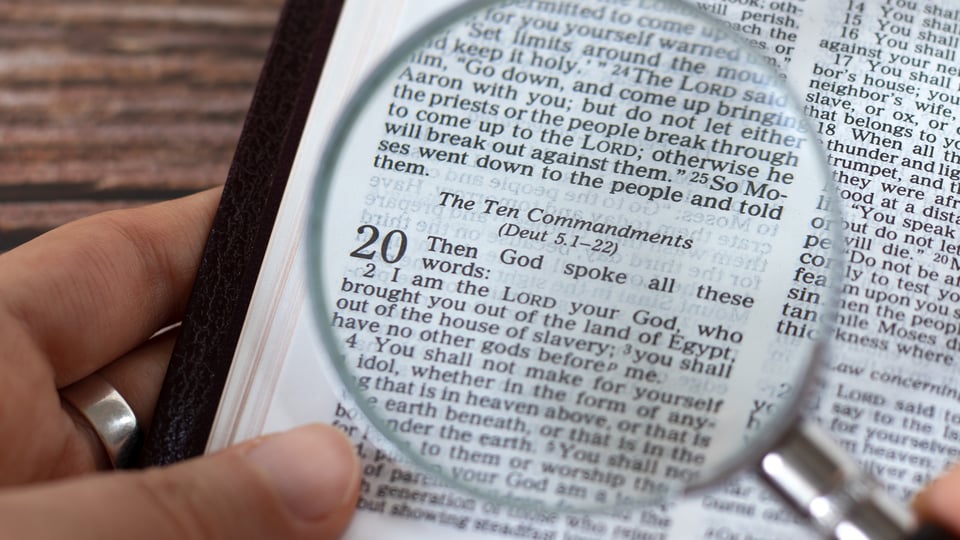
The Old Testament prophesied that the Messiah would magnify the law of God—not keep the law for us.
Image Credit:Marinela Malcheva/iStock via Getty Images
Many in the Protestant world believe Jesus perfectly kept the law so that you wouldn’t have to. Phrases commonly used to support this idea include:
- Jesus fulfilled the law on our behalf, freeing us from it.
- Jesus obeyed the law in our place.
- Jesus accomplished what we could not, so we do not have to.
- Jesus kept the commandments for us, allowing us to rest in His finished work.
- Jesus’ perfect law-keeping is credited to our account.
- Jesus fulfilled the law, and we are not judged by it.
The premise—reflected in all of these phrases—underpins the thinking of many who profess Christianity today. But is it true? How we answer that question is critically important because one’s view of law-keeping has a profound impact on how one lives.
So, did Jesus keep the law for you—or not?
Imputed righteousness?
There is no denying the immense sacrifice Christ made. He died as a perfect, sinless offering on our behalf (Hebrews 4:15). Scripture makes it clear that we are made righteous before God through Christ’s sacrifice (2 Corinthians 5:21; compare Romans 3:23-24).
This theological concept is often called imputed righteousness. But what exactly does that mean? If Christ’s righteousness is imputed to us, how is it applied, and what, if anything, does a Christian need to do regarding righteousness?
If righteousness is granted to a Christian, do we not have to do anything anymore?
To answer this, we must carefully study what God’s Word says about righteousness.
Three biblical facts about righteousness
Even though God declares repentant believers as “righteous” or “justified” in His eyes through Christ’s blood (Romans 5:9), there are still some facts we need to keep in mind about righteousness. Christ’s sacrifice covers our past sins (lawlessness). But what is our obligation going forward, after our past sins have been forgiven?
Righteousness must be actively pursued. It is not passive. Jesus says Christians must “hunger and thirst” for righteousness as much as for their daily food (Matthew 5:6, 10). Jesus said that righteousness is one of the two things we must “seek first” (Matthew 6:33). Paul urges us to “pursue righteousness” (1 Timothy 6:11; 2 Timothy 2:22).
Why would a Christian need to pursue righteousness if Jesus’ obedience freed us from any obligation to keep the law personally? The above passages clearly demonstrate that righteousness demands our personal effort and striving.
This call to righteous living does not diminish what Christ accomplished for us; rather, it is the only appropriate response to His sacrifice. Since the law reveals sin (Romans 3:20), Christians are commanded to live according to God’s law so they do not use their bodies for sinful purposes. For example, sexual immorality is a misuse of the body and is identified as sin in Scripture (1 Corinthians 6:18; 1 John 3:4).
These verses highlight our personal responsibility to live righteously.
Obedience leads to righteousness. Paul contrasts two paths of life: one of sin and one of righteousness. He explains that we constantly make choices, either to follow our sinful desires, which leads to sin, or to obey God, which leads to righteousness (Romans 6:16). A few verses later, he urges us to “present [our] members as slaves of righteousness for holiness” (verse 19).
If Jesus’ righteousness meant we are freed to do whatever we want, Paul’s emphasis on our obedience would seem unnecessary. Instead, Paul presents righteousness as something that must be lived out through obedient submission to God.
Though Paul has been seen as a champion of grace replacing the law, his words show that was not his teaching. “Shall we continue in sin that grace may abound? Certainly not!” (verses 1-2).
What is the purpose of the law?
Does this idea—that Jesus perfectly obeyed the law so we don’t have to—align with what Scripture reveals about the purpose of the law?
No!
Paul explains that “by the law is the knowledge of sin” (Romans 3:20). He further states that without the law, we would not understand what sin is (Romans 7:7). An example he provides is “you shall not covet.” Coveting is a sin of the mind, one we commit before we actually do anything. Without God’s commandments, we would not know that coveting was a sin.
God’s law defines righteousness (Psalm 119:172; Deuteronomy 6:25; Isaiah 48:18). The Bible often contrasts righteousness and lawlessness. Consider these examples:
A murderer cannot stand before a judge and claim innocence because another person lived a murder-free life. AnnaStills/iStock via Getty Images
- “For what fellowship has righteousness with lawlessness?” (2 Corinthians 6:14).
- “You have loved righteousness and hated lawlessness” (Hebrews 1:9).
- Lot was described as a “righteous man” who was vexed over the “lawless deeds” of those in Sodom (2 Peter 2:7-8).
Living without God’s law is defined as unrighteousness. When Christ returns, He will sadly tell many, “I never knew you” because they practice “lawlessness” (Matthew 7:23). (To learn more, read “Danger! Lawlessness Will Abound.”)
God’s law is given to teach us what is morally right and wrong, much like civil laws define acceptable and unacceptable behavior in society. But can obedience to the law be performed on someone else’s behalf? No.
If people run a red light or exceed the speed limit, they cannot tell the police officer that someone else perfectly obeyed the law for them. Likewise, a murderer cannot stand before a judge and claim innocence because another person lived a murder-free life. On these matters, we instinctively recognize that obedience to law is personal and cannot be transferred.
Yet many apply this reasoning when discussing God’s law—particularly keeping the seventh-day Sabbath, a clear commandment of God (Exodus 20:8-11; Deuteronomy 5:12-15). Scripture consistently presents God’s law as requiring personal obedience, not substitutionary law-keeping.
The connection between faith and righteousness
The apostle Paul criticized the people of Israel for thinking they could attain righteousness through law-keeping alone (Romans 9:31). He further explains that they didn’t seek it by faith (verse 32). The problem was not their law-keeping, but their lack of faith.
Seeking righteousness without seeking God’s forgiveness for sin is futile because it leads to self-righteousness (Romans 10:3). Although we strive to obey God’s law, our sinful nature and hostility toward God make perfect obedience impossible (Romans 8:7).
No amount of law-keeping can erase the sins we have already committed.
We need forgiveness for spiritual law-breaking, which is possible because Jesus Christ lived a sinless life so He could pay the penalty of sin on our behalf.
For example, if you are caught speeding, you cannot argue that you drive within the speed limit 99.9 percent of the time—the violation still stands. We need forgiveness for spiritual law-breaking, which is possible because Jesus Christ lived a sinless life so He could pay the penalty of sin on our behalf.
The issue was not with the law itself, but with the people (Hebrews 8:8). They lacked faith and had a nature at enmity against God (Romans 8:7). Without faith in what Christ has done, it’s impossible to please God (Hebrews 11:6). For this reason, the New Covenant was established through Jesus Christ’s death to give us God’s Spirit.
Rather than nullifying our obligation to keep the law, it enabled the law of God to be written in our hearts and minds (Hebrews 10:16).
To learn more, read “The New Covenant: What Is New About It?” and “What Is the New Covenant in Jeremiah 31:31?”
Abraham as an example
Some point to the statement “Abraham believed God, and it was accounted to him for righteousness” (Romans 4:3, 22) to argue that belief is all that is required, and nothing more (verse 24).
It is certainly true that righteousness begins with faith—belief, trust and confidence in God. However, Abraham’s life demonstrates that genuine faith is expressed through obedience.
Abraham’s life serves as a case study in active righteousness, marked by three key events.
First, Abraham demonstrated faith by believing God’s promises (Genesis 15:6). His trust in God’s word was foundational and was rightly accounted to him as righteousness.
Second, Abraham entered into a covenant with God, who commanded him to “walk before Me and be blameless” (Genesis 17:1). Abraham was righteous not only because he demonstrated faith, but because he actively walked with God and lived a blameless life. “Blameless” didn’t mean Abraham was perfect 100 percent of the time—the book of Genesis is very clear about his mistakes. But, overall, his life was one of faithful obedience.
Third, Abraham demonstrated complete obedience when God tested him by asking him to sacrifice his son Isaac (Genesis 22:1-2, 16-17). This act revealed the depth of Abraham’s trust and submission to God. Scripture later affirms that Abraham kept God’s charge, commandments, statutes and laws (Genesis 26:5).
James directly connects Abraham’s righteousness to his actions, stating that he was “justified by works” when he obeyed God (James 2:21-23). James explains that faith is made complete by works and emphasizes that faith in isolation—without obedience—is worthless and dead (James 2:20, 24; compare James 1:25).
Christ magnified the law
Did Jesus teach that His perfect obedience to God’s law is transferred to His followers and that no personal obedience is required thereafter? No. Instead, Jesus made it clear that He did not come to abolish the law, but to fulfill it (Matthew 5:17).
To “fulfill” the law doesn’t mean to abolish it; it means to bring out its full meaning and intent—to magnify it. Isaiah foretold that the Messiah would “magnify the law, and make it honourable” (Isaiah 42:21, King James Version). Jesus did this by revealing the law’s deeper, spiritual intent and application.
To “fulfill” the law doesn’t mean to abolish it; it means to bring out its full meaning and intent—to magnify it.
This magnification is especially clear in the Sermon on the Mount, when Christ expanded the law beyond outward actions to include the attitudes and intentions of the mind.
- Anger is the root of murder (Matthew 5:21-22).
- Lust is an inward form of adultery (verses 27-28).
- An oath should not be necessary; truthfulness is required in all speech (verses 33-37).
God declares that He does not change (Malachi 3:6; compare James 1:17), and Christ remains “the same yesterday, today, and forever” (Hebrews 13:8). His standard of righteousness is constant.
Rather than relaxing the law, Jesus expanded its meaning, showing its full spiritual intent. In that respect, He calls His disciples to a much higher standard of righteousness—not just the letter of the law that was found in the Old Testament, but also the spirit of the law. Instead of loosening God’s laws, He made them more binding!
God expects each individual to actively pursue righteousness, looking to Christ’s example and relying on His Spirit for strength and help.
So, did Jesus keep the law for us?
The Bible shows that while Christ obeyed God’s law perfectly and paid the penalty for our lawbreaking, He did not obey God’s law in our place. Rather, He kept the law perfectly to qualify as our Savior and set an example for how we should live.
Through repentance, faith and the power of God’s Spirit, Christians are called to live a righteous life within the confines of God’s law.
Far from freeing us from obedience, Christ’s sacrifice makes true obedience possible.
To learn which laws of the Old Testament still apply to Christians, see the article “Laws of the Bible.”
Date Posted: January 27, 2026
About the Author

Isaac Khalil
Isaac Khalil is husband to his lovely wife, Natasha, and father to son Eli and daughter Abigal. He loves to spend time with family and friends doing various things like watching movies, playing chess, playing board games and going out. He enjoys studying biblical topics and discussing the Bible with his friends. He is also a news junkie and is constantly reading and sharing news connected with Bible prophecy.