In His Kingdom parables, Jesus likened spiritual growth to that of a seed. What can we learn from this agricultural process?
Every year, growers around the world engage in an impassioned competition—the quest to grow the largest pumpkin on earth. From the fertile valleys of California to the greenhouses of Europe, to the warm fields in Kyogle, New South Wales, Australia, enthusiasts invest enormous effort into producing pumpkins that now approach 3,000 pounds (1,360 kilograms).
Some growers will pay hundreds of dollars for a single seed that has a proven “giant” lineage. Why? Because they know that within that small, pale shell lies extraordinary potential—the blueprint to produce something massive and impressive.
It’s astonishing to consider that such immense potential is locked inside something that fits on the tip of a finger. Yet this natural phenomenon mirrors a spiritual truth Jesus Christ used to describe how the Kingdom of God will grow.
How Jesus used seeds to teach about the Kingdom of God
In Mark 4:26-29, Jesus compared the Kingdom of God to a man scattering seed. The seed sprouts and grows, even though the farmer “does not know how.” God designed growth—both physical and spiritual—to be mysterious and miraculous.
Jesus used another example in verses 30-32, likening the Kingdom to a mustard seed. Though tiny, it grows into a plant large enough for birds to rest in its branches. Something small and unimpressive at first can become something great.
Spiritual growth often begins the same way—with a small stirring of conscience, a moment of clarity while reading Scripture, or a quiet reflection during a difficult time. These moments may seem small, but they contain enormous potential.
God plants the seed—where spiritual life begins
It is crucial to understand that spiritual awakening does not occur by human effort. Jesus said, “No one can come to Me unless the Father who sent Me draws him” (John 6:44). God initiates the process by softening a person’s heart so His “word” (Luke 8:11) can take root.
Spiritually, weeds represent sins, worldly distractions, anxieties and misguided priorities.
Our Christian life does not begin because of our brilliance or moral insight. It begins because God chooses to plant His truth in a prepared mind. Like a seed that carries the blueprint for life, God’s Word brings spiritual possibility—the opportunity to culminate in a spiritual harvest where the individual eventually becomes a member of God’s eternal family.
This is a miraculous process that humans cannot duplicate. Only God can open our minds and begin His transforming work within us.
The condition of the heart—the soil in Jesus’ parable
A seed’s potential is extraordinary, but its growth depends heavily on the soil into which it is planted. Jesus, in His parable of the sower (Matthew 13:3-9, verses 18-23), describes four types of soil, representing four kinds of hearts.
- Hard soil, the compacted ground of the wayside, represents a heart that doesn’t understand God’s Word. The seed cannot germinate, and spiritual growth doesn’t begin.
- Shallow soil, with its rocks and stones, describes the heart of a person who initially receives God’s Word with joy but gives up when difficulties arise.
- Crowded soil describes a heart that is fertile, but filled with weeds—worries, distractions and the pulls of the world—that choke out spiritual growth.
- Good soil symbolizes a heart that listens, understands and applies God’s message. Only this soil produces lasting fruit.
This parable reminds us that while God initiates spiritual life, we bear responsibility for maintaining the condition of our spiritual soil. We must guard our hearts from hardness, rootlessness and distraction.
We must cultivate humility, attentiveness and a willingness to change. Just as a gardener prepares the soil—removing stones, breaking up hardness and clearing weeds—so we must continually prepare our hearts to receive God’s instruction.
How spiritual growth occurs
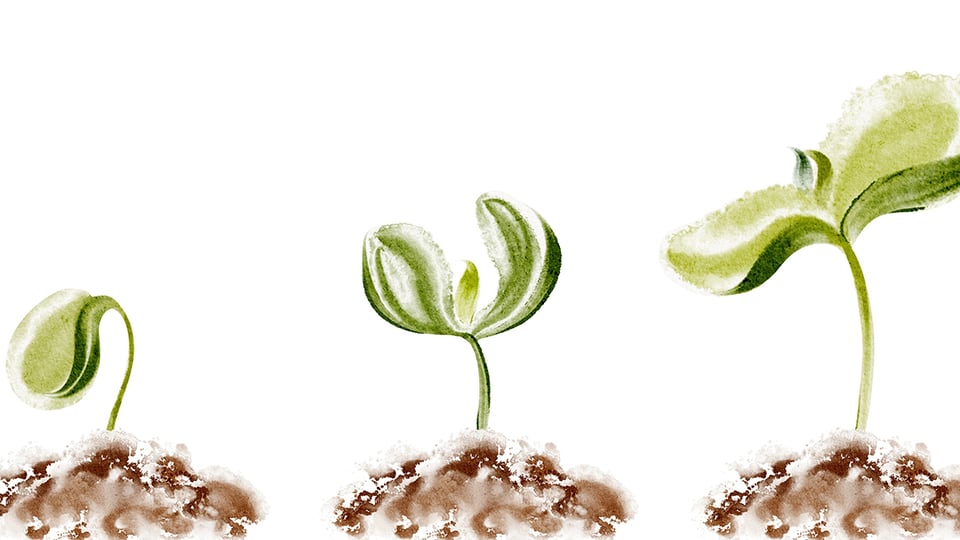
Once a seed is planted in good soil, proper conditions become essential. Without water, light and protection, even the most promising seed will wither. Spiritual growth follows the same pattern.
Paul described this process as “the washing of water by the word” (Ephesians 5:26). God’s Word cleanses us and provides direction, correction and encouragement. It provides the nourishment needed for spiritual growth.
God also established His Church—the Church Jesus founded—to help nurture our spiritual growth. The Church of God continues to teach and practice the same doctrine established by Jesus and the apostles. It serves as “the pillar and ground of the truth” (1 Timothy 3:15), guiding, teaching and supporting God’s people as they mature spiritually (Ephesians 4:11-14).
Additionally, Jesus promised that the Holy Spirit “will guide you into all truth” (John 16:13). Just as sunlight enables photosynthesis—transforming light into life—so the Holy Spirit illuminates Scripture, convicts us of sin and empowers us to change.
The Word of God, the Church Jesus founded and the Spirit of God work together to sustain spiritual growth. Without this combination, we cannot grow as God intends.
Daily habits that enhance spiritual growth
Like plants, spiritual growth thrives with consistency. A plant that receives water one day and then none for a long time will struggle and possibly die, even if planted in good soil. The same is true spiritually. Prayer, Bible study, obedience and fellowship act like spiritual rain and sunlight. These steady habits nourish our faith and strengthen our conviction.
Neglect, however, weakens spiritual growth. Someone who rarely prays, seldom studies the Bible, or avoids fellowship with spiritual brethren will struggle to grow. Conversely, steady spiritual habits build strength, resilience and stability.
Removing spiritual weeds—overcoming sin and distractions
Every gardener battles weeds. These noxious plants steal nutrients, block sunlight and choke healthy plants. Spiritually, weeds represent sins, worldly distractions, anxieties and misguided priorities.
Jesus warned that “the cares of this world” and “the deceitfulness of riches” can choke the Word and make it unfruitful (Mark 4:19). These weeds grow quickly if left unchecked.
Repentance is God’s method of weed removal. It is not a one-time event but a continual practice—removing wrong thoughts, habits and attitudes before they grow into something damaging. Without constant vigilance, a spiritual garden can become overgrown in a short time.
How trials can strengthen spiritual roots
While plants thrive under optimum conditions, they often develop their strongest roots during stress. Wind, heat or drought can force roots to go deeper. In the same way, God uses trials to develop spiritual strength.
James wrote that the testing of our faith “produces patience” (James 1:2-3). Trials can increase endurance, maturity and trust in God.
Paul encouraged Christians to be “rooted and built up in Him” (Colossians 2:6-7). Deep roots equip us to withstand life’s storms. Without trials, our roots would remain shallow.
Pruning and discipline—how God shapes us
Jesus used another agricultural image in John 15:2, explaining that God prunes the branches of His people “that [they] may bear more fruit.” Pruning can seem harsh or painful, yet a skilled gardener cuts away not only dead branches but even some live growth so the plant’s energy is directed toward producing better fruit.
Likewise, God uses discipline, correction and life experiences to shape us. Though the process can be uncomfortable, the result is greater spiritual maturity and improved fruitfulness.
Producing spiritual fruit
Every seed has a purpose: to grow, mature and eventually produce a harvest. Spiritually, God intends that we grow in our capacity to reflect His character and bear the fruit of righteousness.
As we mature spiritually, our lives increasingly reflect the fruit of the Spirit—love, joy, peace, patience, kindness, goodness, faithfulness, gentleness and self-control (Galatians 5:22-23). These qualities show Christ living in us and reveal the impact of God’s ongoing work.
The final harvest
In agricultural terms, harvest is the culmination—the moment the grower has anticipated from the beginning. Spiritually, the ultimate harvest occurs at the end of the age when God gathers those who have faithfully grown in His way. Jesus said, “The harvest is the end of the age” (Matthew 13:39). Revelation 14:15 portrays God reaping the mature harvest of His people—those who have allowed Him to complete His work in them.
This final harvest represents completion, reward and the fulfillment of God’s purpose for every believer.
Letting God complete His work in you
From seed to harvest, God’s pattern for spiritual growth mirrors the natural cycle He built into creation. It begins with His initiative—planting the seed of His Word into a receptive and responsive heart.
Growth continues through Bible study, prayer, obedience, fellowship with fellow believers and the power of the Holy Spirit. Trials strengthen us, pruning refines us and faithful perseverance leads to spiritual fruit.
Just as pumpkin growers tend their plants daily—watering, feeding, weeding and protecting them—we, too, must intentionally cultivate our spiritual lives. God provides the power, but we must cooperate with His work.
If we do our part, we can be reassured by Paul’s words to the Philippians, “He who began a good work in you will carry it on to completion until the day of Christ Jesus” (Philippians 1:6, New International Version).
For further study, read our booklets Change Your Life and Where Is the Church Jesus Built?
About the Author

David Treybig
David Treybig is a husband, father and grandfather. He and his wife, Teddi, have two grown children and seven grandchildren. He currently pastors the Austin, Texas, congregation of the Church of God, a Worldwide Association. He has served in the pastoral ministry for over 40 years, pastoring congregations across six states.