The city of peace has suffered an astonishing lack of peace. When will our longing prayers be fulfilled?
Eighteen years ago, my wife and I had the opportunity to visit Jordan and Israel. As a lover of history and student of the Bible, the prospect of visiting lands steeped in biblical and historical lore was exhilarating.
In particular, I was thrilled by the prospect of visiting Jerusalem. This “city of peace,” as it’s often called, features in many biblical stories, as well as centuries of rich, vibrant events. Sadly, Jerusalem has often been marred by violence and conflict.
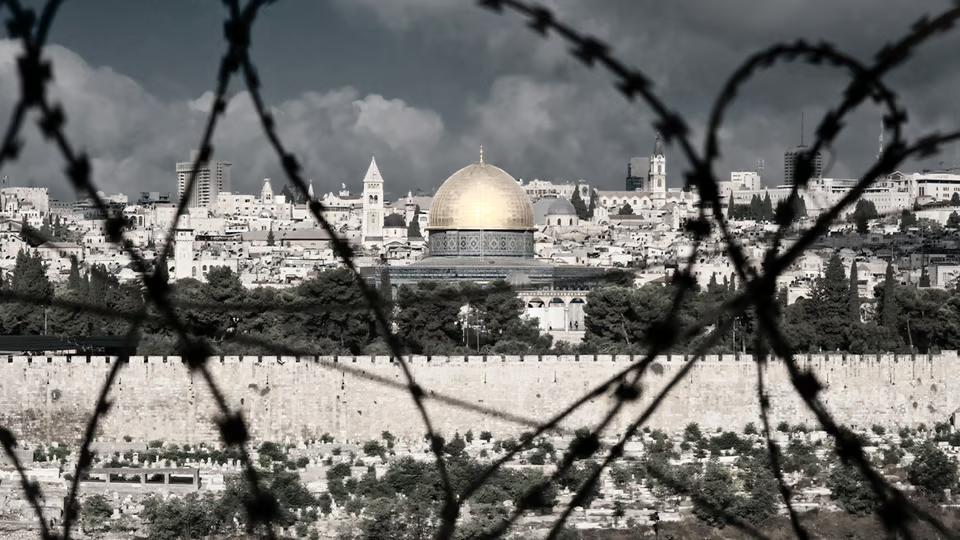
Viewing the Temple Mount from a vantage point on the Mount of Olives—its own slopes crowded with thousands of graves—was profoundly moving. The sight of the gleaming Dome of the Rock and the prominent Al-Aqsa Mosque evoked the passions, ambitions and failures of centuries of human experience. Countless stories of individuals and generational legacies are bound up in that view.
We wandered the labyrinth of narrow streets in the Old City crowded with vendors and bustling with people, inhaling the panoply of sights, sounds and scents.
We could sense the weight of history.
Beneath it all was a simmering tension. This tension echoes through history and radiates across much of the modern world. It is layered with discordant perspectives on religion, politics, ethnic and family allegiances, and religious and secular ideologies and practices.
A city of contradictions
Jerusalem is a city of contradictions. A city of peace. A city of strife and war. An ancient, timeworn bit of real estate tenuously perched atop fractured ethnic passions, divergent religious zeal and diplomatic land mines.
Is it any wonder a psalm attributed to King David urges believers to “pray for the peace of Jerusalem” (Psalm 122:6)? Yet centuries of experience reveal that peace for Jerusalem has proven to be elusive.
Is this prayer a pointless endeavor? Will this city, so mired by division and violence, ever experience real, lasting peace? Let’s consider what the Bible says.
A chosen city
The Bible reveals that Jerusalem was chosen by God to be a beacon of hope and a city where peace, stability and righteousness could flourish.
God declared, “I have chosen Jerusalem, that My name may be there” (2 Chronicles 6:6). Later, God affirmed Jerusalem as “the city which I have chosen for Myself, to put My name there” (1 Kings 11:36).
King David established Jerusalem as the administrative headquarters of Israel (2 Samuel 5:6-9; 1 Chronicles 11:1-9). He relocated the Ark of the Covenant to the city, making Jerusalem the religious capital for the Israelites (2 Samuel 6:12-17; 1 Chronicles 15-16).
His son Solomon built the magnificent temple in Jerusalem (1 Kings 5-6). This temple was the focal point of Israel’s connection with God and religious worship.
Jerusalem experienced a brief period of peace and stability under David and Solomon. Sadly, Solomon did not remain faithful to God. His descendants, with rare exception, led the nation against God. As they rebelled, the short-lived peace evaporated.
A city in conflict
Peace for Jerusalem has been frustratingly difficult to achieve. At the crossroads of empires and as a central square in multiple religious traditions, Jerusalem has been besieged, occupied, overthrown, destroyed and rebuilt over and over again.
In 586 B.C., the Babylonians conquered Jerusalem, destroyed the temple and relocated most of the Jewish inhabitants.
Later, Cyrus the Great permitted Jews to return and build the Second Temple. Yet peace remained elusive.
Alexander the Great overran Jerusalem. After the division of Alexander’s empire, the Seleucids (based north of Jerusalem in Syria) and the Ptolemies (based in Egypt) wrestled for domination of this special city.
Eventually, Rome exerted control, initially through subordinate kings and rulers.
But even Rome could not bring lasting peace. Jewish resistance led to brutal warfare. Jerusalem and its temple were razed to the ground.
Josephus, a first-century Jewish historian, described the destruction: “The rest of the wall, it was so thoroughly laid even with the ground by those that dug it up to the foundation, that there was left nothing to make those that came thither believe it had ever been inhabited. This was the end which Jerusalem came to” (The Jewish War, Book 7, chap. 1, sec. 1, translated by William Whiston).
After being rebuilt as a Roman city, Jerusalem was dominated by the Byzantine Empire, multiple Muslim dynasties and Crusaders before it was captured by the Ottoman Empire in 1517.
The Ottomans controlled Jerusalem until the British captured the city in 1917.
After the 1948 Arab-Israeli War, Jordanian and Israeli forces divided control of Jerusalem. In the Six-Day War of 1967, Israel established control over all of Jerusalem.
But peace remains fleeting. Conflict, skirmishes, terrorist attacks, aggression and hostility are a regular feature of life in Jerusalem.
A search for peace
Despite Jerusalem’s strife-ridden history and discouraging present-day conditions, David’s encouragement remains: “Pray for the peace of Jerusalem” (Psalm 122:6).
Psalm 122 is a beautiful, hopeful song. It is categorized as “a Song of Ascents.” James Boice’s An Expositional Commentary: Psalms explains, “These fifteen psalms (Psalms 120-34) seem to have been used by pilgrims who were making their way to Jerusalem for the three major annual feasts. Joseph and Mary would have sung these psalms as they made their way to the city with the young Jesus (see Luke 2:41), and Jesus would have sung them himself when he went up to Jerusalem with his disciples” (Vol. 3, p. 1070).
Pray for the peace of Jerusalem. This is a call of hope for this scarred city.
Unfortunately, even this instruction has been wielded as a cudgel. Groups on all sides of the complex and brittle issues involving Jerusalem openly call for peace. But peace on their terms often means more war, division and violence.
Isaiah observed, “The way of peace they have not known, and there is no justice in their ways; they have made themselves crooked paths; whoever takes that way shall not know peace” (Isaiah 59:8).
The human family does not know the way to peace. Since the Garden of Eden, humans have chosen a lifestyle of sin. Isaiah commented, “Your iniquities have separated you from your God; and your sins have hidden His face from you, so that He will not hear” (verse 2). One result, as Isaiah noted, is that humans “shall not know peace.”
Our separation from God must be healed before peace can be established—both in Jerusalem and around the world. Review our article “Sin Separates Us From God” for more information.
The peace we long for is not coming in this age, when God’s instructions are largely dismissed and ignored. In fact, Jerusalem will be a focal point of end-time conflict (Zechariah 12:1-3; see “Middle East Conflict”).
Peace is coming
Yet hope remains for Jerusalem.
Peace is coming. Real peace. Lasting peace. Peace for all.
Jesus Christ will return to a broken, corrupt, largely destroyed world. Read The Middle East in Prophecy for more details of prophesied events that will culminate with Jesus’ return.
Jesus’ return as King of Kings and Lord of Lords (Revelation 19:11-16) will be a seismic event in the quest for peace.
Zechariah describes this incredible future. Jesus will “stand on the Mount of Olives” and establish Jerusalem as the capital of His Kingdom on earth (Zechariah 14:1-4, 8). Jesus “shall be King over all the earth” (verse 9).
Real peace is coming. Zechariah declares, “Jerusalem shall be safely inhabited” (verse 11). The tension and conflict will be erased and replaced with peace for all peoples, nations, tribes and families.
God says, “I will return to Zion, and dwell in the midst of Jerusalem. Jerusalem shall be called the City of Truth” (Zechariah 8:3). God has great plans for Jerusalem. “Old men and old women shall again sit in the streets of Jerusalem . . . The streets of the city shall be full of boys and girls playing in its streets” (verse 4-5).
Jesus will rule, and people will “dwell in the midst of Jerusalem. They shall be [His] people and [He] will be their God, in truth and righteousness” (verse 8). Real peace will require learning truth and living according to God’s righteous laws.
This peace—and the way of living that builds it—will spread to all the world. “Yes, many peoples and strong nations shall come to seek the LORD of hosts in Jerusalem, and to pray before the LORD” (verse 22).
Find out more about Jesus’ plans to bring peace in The World to Come: What It Will Be Like.
Pray for the peace of Jerusalem
Real, lasting peace will come when Jesus returns and establishes the Kingdom of God on earth.
Like David, we should “pray for the peace of Jerusalem.”
Jesus’ model prayer affirms this. “In this manner, therefore, pray: Our Father in heaven, hallowed be Your name. Your kingdom come” (Matthew 6:10).
Praying for the Kingdom to come is praying for the peace of Jerusalem. Only then will Jerusalem, and the world, experience lasting peace.
God speed that day!
About the Author

Jason Hyde
Jason Hyde currently serves as the assistant pastor for three congregations of the Church of God, a Worldwide Association. He was ordained as a minister in 2014 and began serving in the full-time ministry in 2025.