What Is the Meaning of Isaiah 11:6: The Nature of Animals Changed?
Isaiah provides a vivid glimpse of a future where humans and wild animals live in peace. What will it take to bring this about—and what does this prophecy really mean?

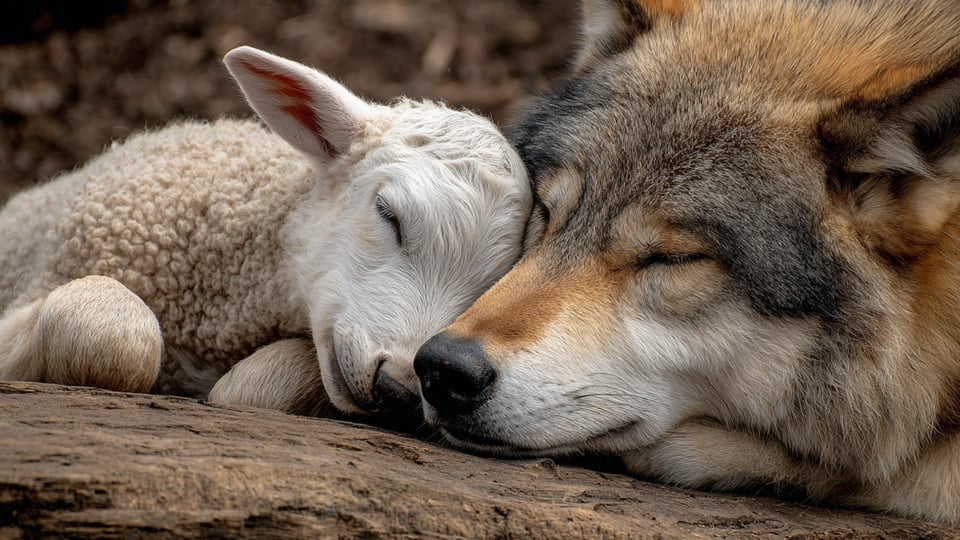
Isaiah’s prophecies describe a time when lambs and wolves will peacefully lie together.
Image Credit:LHT staff using AI
What does Isaiah 11:6 say?
“The wolf also shall dwell with the lamb, the leopard shall lie down with the young goat, the calf and the young lion and the fatling together; and a little child shall lead them.”
But it isn’t what we see in our world today.
For example, according to global health data, snakebites cause between 80,000 and 138,000 deaths per year. In today’s world, the idea of leaving our pets, livestock or kids alone in the presence of serpents is unthinkable.
In this world, humans and wildlife are often in conflict. Many species—like tigers—face serious population declines or even local extinction largely due to human-animal conflict. As humans expand into tiger habitats, tigers may encounter people or prey on livestock, which often leads to retaliatory killings by farmers defending their livelihood.
Let’s take a look at the prophecy that shows all this will change:
“The wolf also shall dwell with the lamb, the leopard shall lie down with the young goat, the calf and the young lion and the fatling together; and a little child shall lead them” (Isaiah 11:6).
When will this be?
One of the immediate questions that arises is, When will God bring this to pass?
At the beginning of Isaiah 11 (verses 1-5), we read about the future rule of Jesus Christ. This indicates that these peaceful conditions will come after Christ returns to the earth as King of Kings (Revelation 19).
The imagery of harmony and restoration aligns closely with other millennial prophecies, indicating that this transformation will occur during Christ’s thousand-year reign, described in Revelation 20:1-5.
To learn more about this time, read “The Millennial Reign of Christ.”
The meaning of Isaiah 11:6-9
Let’s now read more of these amazing verses about the nature of animals being changed:
“The wolf also shall dwell with the lamb, the leopard shall lie down with the young goat, the calf and the young lion and the fatling together; and a little child shall lead them. The cow and the bear shall graze; their young ones shall lie down together; and the lion shall eat straw like the ox. The nursing child shall play by the cobra’s hole, and the weaned child shall put his hand in the viper’s den. They shall not hurt nor destroy in all My holy mountain, for the earth shall be full of the knowledge of the LORD as the waters cover the sea” (Isaiah 11:6-9).
Isaiah’s prophecy describes lions subsisting on straw instead of the meat of other animals. LHT staff using AI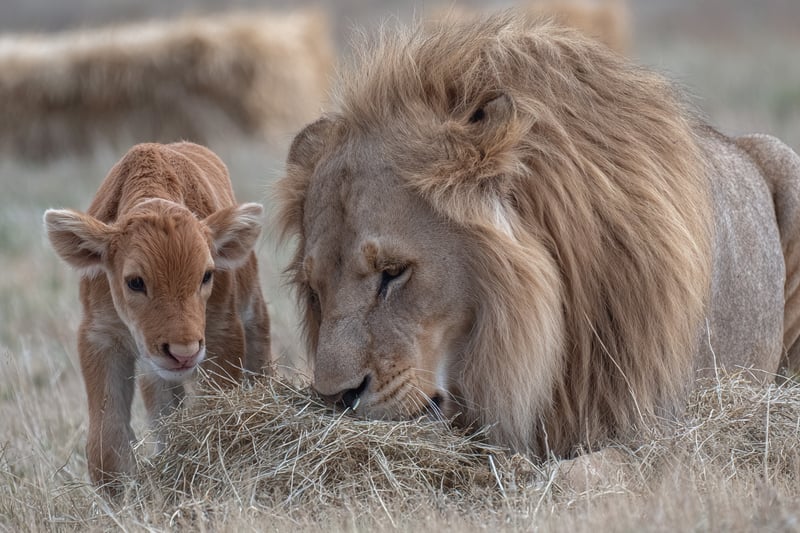
Wolves will no longer prey on sheep, but dwell peacefully among them. The leopard, a deadly predator known for dragging its kill into trees, will then relax gently beside the young goat. A young lion will lie down with a calf, not as a hunter but as a companion.
Even their physical nature will be transformed: the lion will eat straw like the ox. Its predatory instincts will be gone.
All these animals will be so tame that little children will be able to lead and play with them. Infants will play safely near snakes that are currently among the most dangerous in the world.
This prophecy offers us an exciting peek into the peace and restoration that will characterize Christ’s millennial reign. The full reality will surpass anything we can imagine. Based on these prophetic images, we can conclude that even creatures like mosquitoes will no longer pose a threat to mankind or animals.
This is something that only God’s miraculous intervention can bring about.
For a lion to live on vegetation would seem to require profound changes to its anatomy—from its teeth and jaws to its entire digestive system. No natural force or gradual process could accomplish such a drastic and immediate transformation—only the power of God.
Are these prophecies merely symbolic?
Some critics argue that this prophecy is purely symbolic, only representing the transformation God will bring about in human nature. While these prophecies certainly carry deep spiritual meaning and have implications for humanity, the language used indicates that the changes described will also be literal.
Isaiah’s prophecies point to a time when both human nature and the animal world will be dramatically transformed.
Isaiah’s prophecies point to a time when both human nature and the animal world will be dramatically transformed.
The level of detail in this passage suggests we should read it literally. It names seven different predators, five types of prey animals and human children. If the passage were purely symbolic, mentioning just one of each would have made the point. Additionally, it’s difficult to assign a symbolic meaning to the phrase the lion shall eat straw like an ox.
The words of this prophetic passage are vivid and real. They promise a future time when the very nature of animals will be transformed—helping to build the peaceful world we read about in many millennial prophecies.
The reign of Christ is also called “the times of restoration of all things” (Acts 3:21). One element of that restoration will be how the world was before sin entered the human realm. Genesis 2 describes a world where Adam lived peacefully with all the animals. They posed no risk to him.
This kind of world will be restored under Christ’s rule.
To learn more, read “The Prophesied Restoration of All Things.”
The more important change—human nature
Though these prophecies are literal, they also provide an essential symbolic message: If God can change the physical and instinctual nature of animals, He can change the evil nature of mankind as well. Other prophets foretell specifics about God changing the nature of mankind, starting with the heart (Ezekiel 11:19; 36:26-27; Jeremiah 31:33; Micah 4:1-4).
Isaiah’s prophecy concludes with this declaration about the change of human nature in the Millennium: “They shall not hurt nor destroy in all My holy mountain, for the earth shall be full of the knowledge of the LORD as the waters cover the sea” (Isaiah 11:9).
The knowledge of God, however, won’t be what changes animals and their behavior. The animals’ change will merely be a transformation of instinct and anatomy.
Only human beings—made in God’s image—are capable of spiritual growth and moral change through the knowledge of God. A vital aspect of this promise is that with the change in animals, there will also be a change in people. This change will create a world of peace at last—the kind of peace that has been elusive to man for the past 6,000 years.
The powerful message and meaning of the prophecy in Isaiah 11:6-9 is that Jesus Christ and God the Father will change the nature of animals and mankind during the Millennium. Though the change of the animals’ nature will be amazing to behold, it will pale in comparison to the change God’s Spirit will bring to human beings.
Images: Life, Hope & Truth staff, using AI
Date Posted: September 29, 2025
About the Author

Joshua Travers
Joshua Travers grew up in Athens, Ohio, where he continues to live. He graduated from Ohio University with a degree in social studies and Spanish education before attending Foundation Institute, Center for Biblical Education. There, he earned a certificate in biblical studies in May 2017.