Is Pope Leo’s Push for Unity Positive—or Dangerous?
Pope Leo has advocated for unity among all Christians. What is the biblical significance of these events? Should you join in such unity?

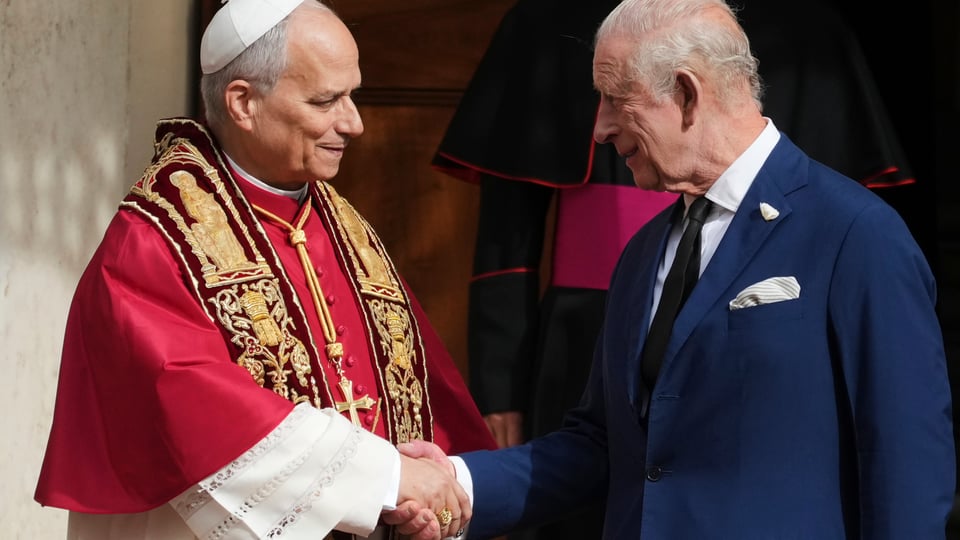
Pope Leo XIV and King Charles III at the Vatican after the two prayed together in the Sistine Chapel on Oct. 23, 2025.
Image Credit:Andrew Medichin / The Associated Press
At the end of October, a monumental event occurred—one that received little attention at the time and is now likely forgotten. When it happened, it was completely overshadowed by a family scandal that dominated the headlines.
It was something that had not taken place in 500 years. Did you notice it?
What was this historic moment?
King Charles and the pope prayed together.
The significance of this event was eclipsed by the ongoing Jeffrey Epstein scandal, during which Prince Andrew was stripped of his royal titles.
A display of unity
King Charles visited the Vatican and was granted the honorary title of “Royal Confrater,” meaning royal brother—a title typically given only to Catholic monarchs or those who have protected Catholic basilicas. In a reciprocal gesture, King Charles bestowed upon the pope the title of “Papal Confrater.”
As the reigning monarch, Charles also serves as the Supreme Governor of the Church of England. In this role, he represents the Anglican church. Praying together was a display of unity between two churches that have been separated for almost 500 years.
Should we rejoice that two groups, divided by centuries of conflict, are now moving toward reconciliation?
For some, this was a great leap forward. A moment of healing.
Anglican James Hawkey said, “There is a strong sense that this moment . . . offers a kind of healing of history.” He went on to say, “This would have been impossible just a generation ago.”
This shows just how much has changed in such a short time.
Some may wonder why this is significant. What does it mean today—and for the future? Should we not rejoice that two groups, divided by centuries of conflict, are now moving toward reconciliation? After all, isn’t unity a good thing?
To understand the significance of King Charles praying with the pope, we need to go back 500 years.
The Protestant Reformation
Our story begins in Germany in 1517, when Martin Luther, a doctor of theology in the Catholic Church, nailed his “95 Theses” to the door of the Castle Church in Wittenberg. In his theses he challenged the corruption and excesses of Rome—especially the sale of indulgences.
Indulgences are still being issued by the Catholic Church today, though much of the outright corruption of the 16th century has been removed. The year 2025 is designated as a Catholic Year of Jubilee—a time when Catholics can obtain special indulgences for souls supposedly in purgatory by making a pilgrimage to Rome.
Two years later, King Henry VIII of England wrote a critique of Martin Luther, earning him the title “Defender of the Faith” from the pope. However, a later pope would revoke it.
Why?
King Henry VIII sought to have his marriage to Catherine of Aragon annulled after she failed to produce a male heir. The pope refused the annulment, likely due to pressure from Catherine’s nephew, Holy Roman Emperor Charles V.
So, what did the king do? He remarried anyway, severed his allegiance to Rome and formed his own church—the Church of England. The pope excommunicated him and stripped him of his title, which Parliament later reinstated—one that King Charles still bears to this day: Defender of the Faith.
At this point, the pope had lost his authority over the English people, and as Protestantism spread across Europe, his influence waned even further.
King Charles praying with the pope is seen as a major step toward healing a deep wound for the Catholic Church, yet this is not the only wound that is healing.
The Great Schism
The first major split in the Catholic Church occurred in 1054 between the Eastern and Western churches, known as the Great Schism. The patriarch of Constantinople asserted that his authority was equal to the pope’s and was independent from Rome. In response, the pope excommunicated him.
This led the Eastern Orthodox churches to break away from Rome.
Both the Great Schism of 1054 and the Protestant Reformation of the 16th century challenged the pope’s authority. Pope Leo has resolved to heal this division.
The current pope seeks to bring the Orthodox churches back into communion with the mother church.
Interestingly, the pope who presided over the Great Schism of 1054 was Pope Leo IX.
The pope who faced the Protestant Reformation in the 16th century was Pope Leo X.
The current pope, Pope Leo XIV, seeks to bring these churches back into communion with the mother church.
Recently, Pope Leo and the spiritual leader of the Eastern Orthodox, Patriarch Bartholomew I, signed a commitment to work toward unity between the two churches. The timing of this event has not gone unnoticed by students of history. It occurred during Pope Leo’s visit to Turkey to commemorate the 1700th anniversary of the Council of Nicaea.
Upon his election, he reflected on the timing, saying, “My election has taken place during the year of the 1700th anniversary of the First Ecumenical Council of Nicaea . . . As Bishop of Rome, I consider one of my priorities to be that of seeking the re-establishment of full and visible communion among all those who profess the same faith in God the Father, the Son and the Holy Spirit. Indeed, unity has always been a constant concern of mine, as witnessed by the motto I chose for my episcopal ministry.”
And what motto did he choose? “In the One, we are one.”
So, what exactly is the significance of the Council of Nicaea?
Council of Nicaea: A push for the unity of the faith
What happened 1,700 years ago?
In 325, Roman Emperor Constantine convened a massive meeting in Nicaea (in modern-day Turkey), bringing together about 300 Christian bishops from across the empire. The major issue under discussion was the nature of Jesus—whether He was a created being or fully divine.
A priest named Arius claimed that Jesus was created by God and therefore not eternal or fully divine. In response to this controversy, the Catholic Church formulated the Nicene Creed, which became the foundation for the doctrine of the Trinity.
Pope Leo sees the Council of Nicaea in 325 as the first ecumenical council of the Roman Church and a model for promoting unity in our time.
Most people do not realize that many of the doctrines taught by the vast majority of churches are not found in the Bible, and even if they do realize this, most still accept them.
To mark this anniversary, the pope issued an Apostolic Letter titled “Unity of the Faith” in which he stated:
“We share the same faith in the one and only God, the Father of all people; we confess together the one Lord and true Son of God, Jesus Christ, and the one Holy Spirit, who inspires us and impels us towards full unity and the common witness to the Gospel. Truly, what unites us is much greater than what divides us! . . . In order to carry out this ministry credibly, we must walk together to reach unity and reconciliation among all Christians. The Nicene Creed can be the basis and reference point for this journey. It offers us a model of true unity in legitimate diversity. Unity in the Trinity, Trinity in Unity, because unity without multiplicity is tyranny, multiplicity without unity is fragmentation.”
He went on to urge Christians to “leave behind theological controversies” and “develop a common understanding.”
The doctrine Pope Leo emphasizes in promoting unity is the Trinity, a core belief shared by most churches. Yet this doctrine was formulated roughly 300 years after Christ and was not taught by Jesus or the apostles. (To learn more, read “The Trinity: What Is It?”)
Most people do not realize that many of the doctrines taught by the vast majority of churches are not found in the Bible, and even if they do realize this, most still accept them.
They often assume Paul’s warning—“For the time will come when they will not endure sound doctrine” (2 Timothy 4:3)—applies only to our day, when in fact it was already happening in his own time, as leaders in the early Church were already warning of the need to “contend earnestly for the faith which was once for all delivered” (Jude 1:3-4; see also 2 Corinthians 11:4, 13; Galatians 1:6-7; 2 Peter 2:1).
To fully understand this, we need to recognize that the Bible foretold the rise of a false, counterfeit Christianity.
A counterfeit Christianity
Revelation 13 describes two beasts rising to prominence and reaching their peak power in the end times. The first beast (verse 1) rises from the sea. This beast corresponds to the Roman Empire. Throughout history, it has experienced nine resurrections—with one final resurrection yet to come. (To learn more, read “Who Is the Beast?”)
The second beast rises from the land and represents a religious power that emerged from the Roman Empire—the Roman Catholic Church. Unlike the Roman Empire, which rose to great power, collapsed and reemerged in different forms, the Catholic Church has remained a constant presence throughout history, though its influence has fluctuated over time.
- Daniel described it as the little horn that persecutes the saints and changes times and laws (Daniel 7:8, 21, 25).
- In John’s vision of the four horsemen, it’s the white horse of deception (Revelation 6:2).
- In 2 Thessalonians 2:3 Paul referred to its future leader as “the man of sin,” who is also called the false prophet in Revelation (Revelation 16:13; 19:20; 20:10).
- In Revelation 17, it is depicted as the mother of harlots, who rides the beast (Revelation 17:1-5).
- Isaiah referred to it as the “daughter of Babylon” and the “Lady of Kingdoms” (Isaiah 47:1, 5).
In Revelation 13, this false religious system is depicted to look like a lamb, but speak like a dragon (Revelation 13:11). This reveals two sides of this beast: its outward appearance and its inner nature.
The outward appearance resembles a lamb—a symbol associated with Jesus Christ. This is clearly a counterfeit lamb, representing a counterfeit Christianity teaching a counterfeit Christ.
This has been happening since the days of the early Church. Paul warned the early Church about Satan, who appears as an angel of light, and about his ministers, who present themselves as ministers of righteousness while teaching a counterfeit gospel (2 Corinthians 11:4, 14-15).
This counterfeit lamb in Revelation 13 speaks like a dragon—a symbol used exclusively for Satan (Revelation 12:9; 20:2).
We have long warned about this religious body’s continual efforts to reunite with those who have left it in protest. These efforts will continue and will serve to strengthen the grip of this false Christianity on its adherents and the world.
A push for unity
During the church service, King Charles sat to the pope’s left on a specially created chair, called a throne, inscribed in Latin with “Ut unum sint”—“That they may be one” (a partial quote of John 17:21). In ecumenical circles, this partial quote of Scripture is referred to as the John 17 Movement, using Christ’s words to encourage Christians to pursue unity.
Should we simply put aside our differences, as the pope suggests—“leave behind theological controversies” and “develop a common understanding”? Is this what Christ is teaching in John 17:21?
Consider: Have the Father and Jesus ever disagreed on anything, or at any point said, “Let’s set aside our differences for the sake of unity”? Certainly not.
The standard of unity in this verse is not our own, but the perfect unity between the Father and the Son.
God places great emphasis on truth, as Christ stated:
- “I am the way, the truth, and the life” (John 14:6).
- “True worshipers will worship the Father in spirit and in truth” (John 4:23).
- “Sanctify them by Your truth. Your word is truth” (John 17:17).
- “Everyone who is of the truth hears My voice” (John 18:37).
Truth sets a Christian apart. Christians cannot discard truth for the sake of unity. God expects us to discern whether doctrines come from Him or from Satan.
Consider the test Jesus gives for discerning doctrine. He says we can tell whether teaching comes from the Father (John 17:17). To be true, a teaching must align with Scripture—the Word of God. Isaiah stated it this way: “To the law and to the testimony! If they do not speak according to this word, it is because there is no light in them” (Isaiah 8:20).
In contrast, Satan speaks from his own authority. Christ warned: “When he speaks a lie, he speaks from his own resources, for he is a liar and the father of it” (John 8:44).
Applying this test exposes the Trinity doctrine and many other doctrines taught within Roman Catholicism and Protestantism as false.
Unity built on a lie cannot stand. A true Christian must not compromise truth, for “no lie is of the truth” (1 John 2:21).
Date Posted: December 22, 2025
About the Author

Isaac Khalil
Isaac Khalil is husband to his lovely wife, Natasha, and father to son Eli and daughter Abigal. He loves to spend time with family and friends doing various things like watching movies, playing chess, playing board games and going out. He enjoys studying biblical topics and discussing the Bible with his friends. He is also a news junkie and is constantly reading and sharing news connected with Bible prophecy.