
LHT staff using AI
What does 1 Peter 2:24 say?
“Who Himself bore our sins in His own body on the tree, that we, having died to sins, might live for righteousness—by whose stripes you were healed.”
As one of the apostles closest to the Savior, Peter had an insight into Christ’s life that very few others had. When Peter spoke of Christ “leaving us an example, that you should follow His steps” (1 Peter 2:21), thousands of memories must have come to his mind.
In the New Testament, we read many of Peter’s memories about Christ’s life and example. According to tradition, Mark worked with Peter to record his account of Christ’s life, giving us the Gospel of Mark and a vivid picture of Christ’s example.
But what Christ accomplished goes beyond what people witnessed during His time on earth. Centuries before His birth, the prophet Isaiah foretold the profound impact of Christ’s sacrifice.
Christ’s role as the Messiah
Peter begins 1 Peter 2:24 by pointing to Christ’s role as the Messiah: “who Himself bore our sins in His own body on the tree.”
Jesus Christ, the only human to ever live a perfect and sinless life, took on the penalty of all of the sins of mankind.
In order to free us from the death penalty for our sins, Christ willingly sacrificed Himself. He took our punishment upon Himself and died the death of the lowest criminal—execution by crucifixion.
The brutality of Christ’s sacrifice was unthinkable, yet He did it for you, for me and for all mankind. Through His righteous blood, the penalty for our sins has been paid, and those who repent can be made just and free from guilt, no longer under sin’s death penalty.
We remain liberated from that penalty as long as we stay close to God, continue to repent when we stumble and consciously strive to live righteously according to God’s law (Matthew 19:16-19) and overcome our weaknesses.
That’s incredible, but the impact of Christ’s sacrifice doesn’t end there.
What did Isaiah prophesy about the stripes of Jesus Christ?
God prophesied through Isaiah about Jesus Christ and His selfless sacrifice centuries before crucifixion even existed as a form of execution.
Part of this astonishing prophecy declares, “But He was wounded for our transgressions, He was bruised for our iniquities; the chastisement for our peace was upon Him, and by His stripes we are healed” (Isaiah 53:5).
Christ’s suffering was predicted long before He came to earth as a human, as was His role in restoring our relationship with God.
The brutality of Christ’s sacrifice was unthinkable, yet He did it for you, for me and for all mankind.
“His stripes” refer to the deep wounds He sustained in the scourging that preceded His crucifixion. In Mark’s Gospel, we read, “So Pilate . . . delivered Jesus, after he had scourged Him, to be crucified” (Mark 15:15, emphasis added throughout).
This scourging was almost as traumatic as the actual crucifixion.
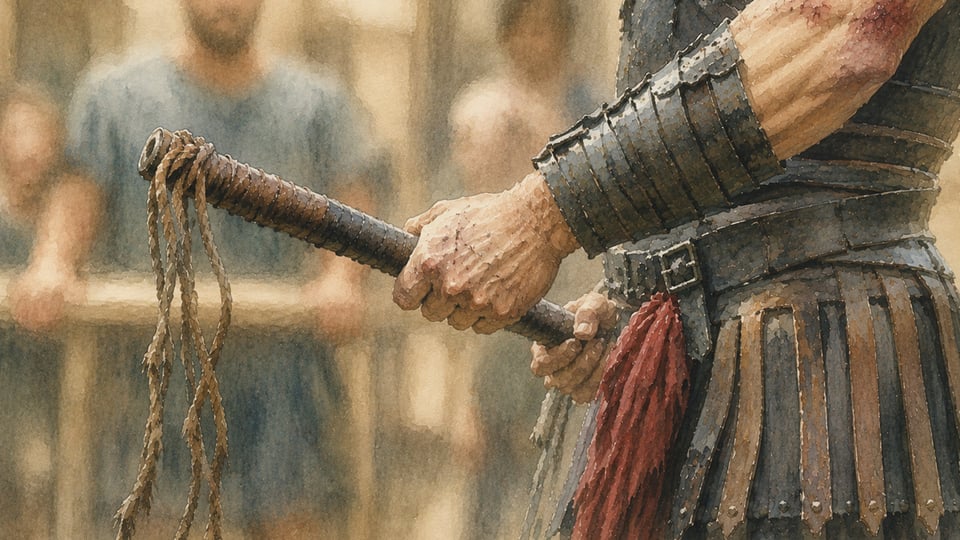
Scourging was usually carried out using a whip made of leather thongs woven with shards of metal and bone. Each strike tore into the flesh, often ripping it from the victim’s back and exposing muscle and bone.
The beating was so brutal and bloody that many died from the scourging alone, before ever being placed on the crucifixion device—an upright stake, cross or tree trunk.
Yes, Jesus’ scourging was prophesied hundreds of years before it occurred. But how was His scourging connected with our healing?
To learn more about what His body endured during the crucifixion, read “This Is My Body Given for you.”
Who is healed?
Isaiah prophesied that “we” are healed by the stripes of Jesus Christ. However, when Peter quoted it, he changed it from “we” to “you”—“by whose stripes you were healed.”
This isn’t an error or a misquote. Peter intentionally adapted Isaiah’s words, making them more intensely personal for his readers—even those of us reading them nearly 2,000 years later.
All of God’s people are healed by the sacrifice of the Messiah. This sacrifice isn’t something that we should treat lightly or think of in vague terms. Although it is for all of mankind, it is a very personal sacrifice that Christ consciously made for you.
What does this healing encompass?
When we hear the word healing, our minds usually go to physical problems of the human body—from minor injuries to terminal diseases (and everything in between). Christ’s entire ministry was marked by miraculous healings that drew large crowds and stirred the resentment of religious leaders.
Such physical healing is definitely an element of what Christ’s sacrifice accomplishes, but it is also so much more than that.
During His earthly ministry, Christ encountered a paralytic who needed His help. His response to the man was, “Son, your sins are forgiven you,” which drew outrage from some because only God can forgive sins.
When Christ returns, the blessing of healing that His stripes made possible will be open to the entire world.
In order to prove that He had the power to forgive the man’s sins, Christ went on to declare, “I say to you, arise, take up your bed, and go to your house,” which resulted in the man standing up, picking up the bed and walking out (Mark 2:1-12).
By forgiving the man’s sins before healing him physically, Christ showed that our greatest need is not physical healing, but reconciliation with God. Our deepest and most important need is to be reconciled to God through the removal of our sins. Christ’s ability to both forgive sin and heal the man’s paralysis was visible proof of His divine identity and authority.
The same God who can heal diseases can forgive sin.
Sin has caused all of the suffering of mankind. It has caused each of us great harm. It has earned us the death penalty and caused our separation from the holy, righteous God.
Christ’s sacrifice allows that rift to be healed, reconciling us to our heavenly Father. Physical wounds and diseases, often caused by sin, sometimes our own and sometimes those of others, can also be healed through Christ’s stripes.
Time and time again, Christ’s sacrifice has allowed healing—both spiritually and physically. While it is not a promise to solve every physical affliction in this present time, we have that future promise because of Christ’s sacrifice.
Ultimately, after Jesus Christ’s return, all will experience the effects of this healing. Malachi prophesied that Jesus would return “with healing in His wings” (Malachi 4:2). When Christ returns, the blessing of healing that His stripes made possible will be open to the entire world.
What do you have to do?
Christ died for you, and He was scourged so that you could have spiritual and physical healing.
In order for you to lay claim to these incredible promises, however, you have to choose to follow the message of His ministry: “Repent, and believe in the gospel” (Mark 1:15).
Christ gave His life and did far more than you, or anyone else, could ever have a right to ask of Him. But through His sacrifice—“by His stripes”—you can repent and ask God for healing from your spiritual and physical ailments.
Date Posted: June 3, 2026
About the Author

Joshua Travers
Joshua Travers grew up in Athens, Ohio, where he continues to live. He graduated from Ohio University with a degree in social studies and Spanish education before attending Foundation Institute, Center for Biblical Education. There, he earned a certificate in biblical studies in May 2017.