Is Posting the 10 Commandments on Walls Enough?
Texas approved displaying the 10 Commandments in all state schools. God wanted them written down, but is just displaying them what He intended?

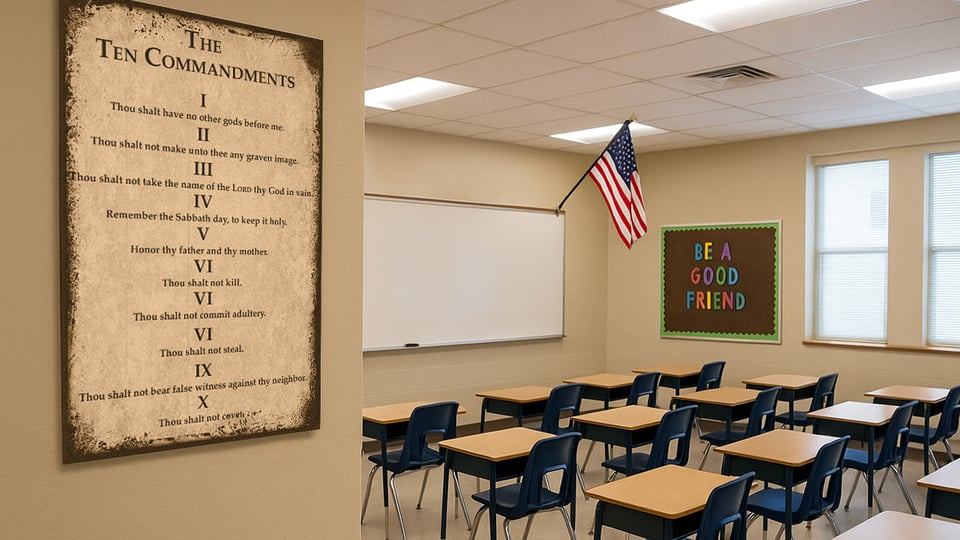
LHT staff using AI
Texas has passed legislation requiring the 10 Commandments to be displayed in all public school classrooms, sparking a national debate.
Some argue that religion is a private matter and that the state should remain neutral, while others see the 10 Commandments as foundational to the nation’s laws and heritage—and therefore worthy of public display.
Beyond the issue of posting them in schools, this controversy should raise deeper questions about the role of the 10 Commandments in modern life.
Which version of the 10 Commandments?
During the Texas legislative debate, the question was raised: Which version of the 10 Commandments should be displayed?
While it’s certainly not wrong to display God’s commandments in schools, is that actually where God wants them to be written?
God personally spoke the 10 Commandments to the people of Israel in Exodus 20. A slightly reworded version appears in Deuteronomy 5. So the Bible provides two similar—yet not identical—versions of the 10 Commandments.
Additionally, various religious traditions have their own unique versions.
For example, Roman Catholics combine the first two commandments—lessening the emphasis on idolatry—and divide the final commandment on coveting into two separate commands.
Furthermore, there are different translations and interpretations of the 10 Commandments. For more details, see “10 Commandments List.”
But do greater questions remain?
Keep the Sabbath holy
During the floor debate in the Texas House of Representatives, James Talarico questioned Candy Noble about the Fourth Commandment, which commands keeping the Sabbath day holy. He pointed out the irony of debating the bill on Saturday, the biblical Sabbath day, and continuing the debate on Sunday, observed by many mainstream Christians as the Sabbath.
Talarico asked whether the legislature should postpone the vote to avoid violating the Fourth Commandment, prompting laughter from the audience.
Noble responded by stating that the Sabbath is “a day of rest” and noted its importance for us to keep, citing God’s example during creation. She also emphasised the historical significance of the 10 Commandments in American education and legal systems. She avoided questions about personal observance, emphasizing that the bill aims to honor historical traditions, not enforce religious practice.
Many mainstream Christians agree that the 10 Commandments are important, recognizing that prohibitions against murder or theft are essential to a stable society. Even nations that don’t uphold Judeo-Christian traditions have laws on these points.
However, when it comes to the Sabbath command, most mainstream Christians either dismiss it as no longer binding or reinterpret it to allow for worship on Sunday instead of the biblical seventh-day Sabbath.
But consider what the commandment actually states in Exodus 20:8-11.
The command begins with the word remember (verse 8). In fact, it’s the only commandment that admonishes us to remember—which shows that God foresaw the human propensity to forget and reject it.
Then, it instructs us to “keep it holy.” Keeping the Sabbath holy means setting it apart as special—distinguishing it from all other days.
One of the major ways we keep it special is by refraining from all normal work during that 24-hour period (verses 9-10). God has given us six other days we can labor on.
The commandment clarifies which day to observe by specifying the Sabbath as the “seventh day” (verse 10). The Bible never describes the Sabbath as any other day. The seventh day is not the Jewish Sabbath, it is God’s Sabbath.
To learn more, read “Jewish Sabbath? Or Is the Sabbath a Gift for All?” and “Who Changed the Day of Worship From Saturday to Sunday? Why?”
Hypocrisy
James Talarico asked whether legislators themselves should be expected to keep the commandments, referencing the Ninth Commandment against lying and the Seventh Commandment against adultery—which once again drew laughter from the audience.
In response, Candy Noble emphasized that the bill is intended to “honor our historical, educational, and judicial heritage,” but conceded that we should also strive to keep the commandments.
Merely displaying a list of the 10 Commandments will not lead a community, state or nation to obedience or morality.
Talarico’s questions highlighted the hypocrisy of displaying the commandments and not following them.
Jesus frequently clashed with the Pharisees, accusing them of being “full of hypocrisy and lawlessness” (Matthew 23:28). Echoing modern times, the Pharisees loved to extol the virtue of the 10 Commandments and even added extra details to them—yet they often found various loopholes around obeying them personally.
By calling them hypocrites, Jesus was saying they were merely playacting—performing as religious for an audience—but not truly religious on the inside. Christ desires people to genuinely seek Him, not human praise.
He wants people to pursue His Kingdom and righteousness above all else (Matthew 6:33).
Where do God’s laws really need to be displayed and written?
While it’s certainly not wrong to display God’s commandments in schools, is that actually where God wants them to be written?
In the Old Covenant, God inscribed His laws on stone tablets with His own finger (Exodus 31:18; Deuteronomy 9:10). However, ancient Israel was unwilling and unable to keep those laws because they never fully internalized them (Deuteronomy 5:29; Hebrews 8:7-8).
The core purpose of the New Covenant is to provide God’s Spirit, which allows the laws of God to be written on the human heart and mind.
Their problem wasn’t a lack of seeing or hearing the words, it was having a heart and mind unwilling to obey and embrace those words. That’s why God established the New Covenant.
The core purpose of the New Covenant is to provide God’s Spirit, which allows the laws of God to be written on the human heart and mind—“I will put My laws in their mind and write them on their hearts; and I will be their God, and they shall be My people” (verse 10).
John affirms that a true Christian led by God’s Spirit keeps God’s commandments out of love, not obligation. “For this is the love of God, that we keep His commandments. And His commandments are not burdensome” (1 John 5:3).
Merely displaying a list of the 10 Commandments (in one form or another) will not lead a community, state or nation to obedience or morality. Without God’s Spirit engraving these laws on the human heart, people will naturally continue to resist them (Romans 8:7-8).
God is looking for people who genuinely desire to have His laws written deeply on their hearts and minds—not those who merely use His commandments as a political symbol, seeking to engrave them on walls while ignoring or even laughing at the idea of obeying them.
Do you uphold the 10 Commandments—not by merely posting them on walls, but by reflecting them in your thinking and daily living?
Date Posted: August 18, 2025
About the Author

Isaac Khalil
Isaac Khalil is husband to his lovely wife, Natasha, and father to son Eli and daughter Abigal. He loves to spend time with family and friends doing various things like watching movies, playing chess, playing board games and going out. He enjoys studying biblical topics and discussing the Bible with his friends. He is also a news junkie and is constantly reading and sharing news connected with Bible prophecy.