Do Not Add to God’s Word
God instructed Israel not to “add to” or “take away from” His commandments. Yet many today have forgotten this important warning.


Bangon Pitipong/iStock via Getty Images
It’s cleaning day and a mother tells her son to help her with the monthly chores. “Son,” she says, “please go and dust down all the windows. Then, later this afternoon, I’ll wipe them down with a special cleaning solution.”
Ever the attentive son, the boy goes about wiping down all the windows in the house. But as he finishes, a thought strikes him: I know, I’ll clean the windows too. Won’t Mom be so happy when she sees all her windows sparkling like new!
So, he grabs a cleaning bottle from the closet and sets about spraying down each window and wiping it with a paper towel.
“Mom, look!” the boy cries. “I cleaned the windows for you!” Then, seeing his mother’s disappointed look, he adds, “I thought it would be nice.”
The boy turns and, much to his horror, finds horrible streaks running down every window.
The following afternoon is filled with more grueling labor, as the boy sets about cleaning the windows a second time, now with a healthy dabbing of glass cleaner.
The boy in this story had good intentions. Although he had clear instructions to complete a specific task, he thought he was going above and beyond, only to discover that there was a reason for his mother’s specific commands. The boy, well-meaning though he may have been, made a serious mistake.
Windows can be cleaned. Stains and streaks can be washed away. Other slip-ups, however, are not so easily reversed.
When God gives His children a command, He expects them to follow it. But, just like a well-intentioned child trying to go above and beyond, humans often obscure what was otherwise a very clear message with ideas of their own.
As they were about to enter the Promised Land, God warned the people of Israel not to amend any of His commandments with their own ideas: “You shall not add to the word which I command you, nor take from it, that you may keep the commandments of the LORD your God which I command you” (Deuteronomy 4:2; compare Deuteronomy 12:32).
These passages are crucial in defining humanity’s relationship with God’s Word. They make two undeniable demands of us: that we neither add to nor take away from the Word of God.
Both concepts require further exploration. This blog post will explore the error of adding to God’s Word. Is this an issue you should be concerned about?
Do not add to the Word of God
Taking away from God’s commandments seems self-explanatory, but adding? What would adding to God’s Word look like? You might be surprised to find you’ve seen it in your everyday life—and often!
Adding to God’s commandments can take many forms, but typically it includes passing off a man-made belief or doctrine as being divinely inspired.
Adding to God’s commandments typically includes passing off a man-made belief or doctrine as being divinely inspired.
While some men ignore certain statutes of God, others feel He didn’t go far enough. They take it upon themselves to “fix” His teachings to better fit their standards and ideas.
The underlying concept they miss is that God’s standards should be our standards.
The problem of people adding to God’s Word is neither new nor unique. It is an inclination that sincere religious men and women have struggled with for centuries. Well-meaning though they may be, adding to the Word of God always leads to problems—major problems.
Like the young boy “helping” his mother with household chores, humans have a knack for making a mess out of what God intended to be crystal-clear.
The peril of first-century Judaism
When Jesus came to earth, one of His purposes was to turn people away from the tenets of first-century Judaism and point them back to God and His divinely inspired ways.
This was not due to any change in God’s teachings, but rather because the religious authorities had introduced countless traditions and regulations, placing unnecessary burdens on the Jewish people.
By the first century, the Jews had developed a rigorous system of oral traditions. Among other things, their oral law sought to put a hedge around certain commandments, such as the Sabbath, by adding extra stipulations and regulations not found in Scripture.
Their oral law defined 39 different categories of work that they taught broke the Sabbath. It also included rigorous handwashing routines to keep them from uncleanness and other extra rules to keep them from ever coming close to breaking God’s commandments.
By the time Jesus Christ came to earth, Judaism bore little resemblance to the religion of its ancient forefathers.
In Mark 7, Jesus rebuked the Pharisees for substituting their own human-made rules and regulations for divine commandments. He called the Pharisees hypocrites and declared that such worship was nothing but vanity—uselessness (verses 6-7). “All too well you reject the commandment of God,” He lamented, “that you may keep your tradition” (verse 9).
Jesus went even further in Matthew 23. He called their traditions “heavy burdens,” done to be seen by men (verses 4-5). He even stated that such rigorous man-made traditions obscured the truth (verse 13)!
Jesus had to correct the Jews because their entire way of thinking had strayed far from what God had intended when He originally gave them His law. After generations of blatantly disregarding His commandments, they had overcorrected by going to the opposite extreme. They created laws of their own and came to value them more highly than God’s commandments.
These laws obscured their view of the bigger picture. The windows on their proverbial houses were streaked with the mire of their man-made traditions. Because of this, they missed the point of Jesus Christ’s teachings.
Such is the danger of adding one’s own words to the Word of God. Could we ever make that mistake?
Do professing Christian groups add to the Word of God?
You may be thinking that Christianity is a far cry from first-century Judaism. But in some important areas, the similarities may be more significant than we realize.
Over time, various professing Christian groups have developed different approaches to interpreting the Bible, and in the process, traditions and ideas have been added that go beyond what Scripture teaches. These additions may take different forms across denominations, but are worth careful examination.
The Church of Jesus Christ of Latter-day Saints believes the Book of Mormon is divinely inspired and equal to the Holy Bible. ericsphotography/iStock via Getty Images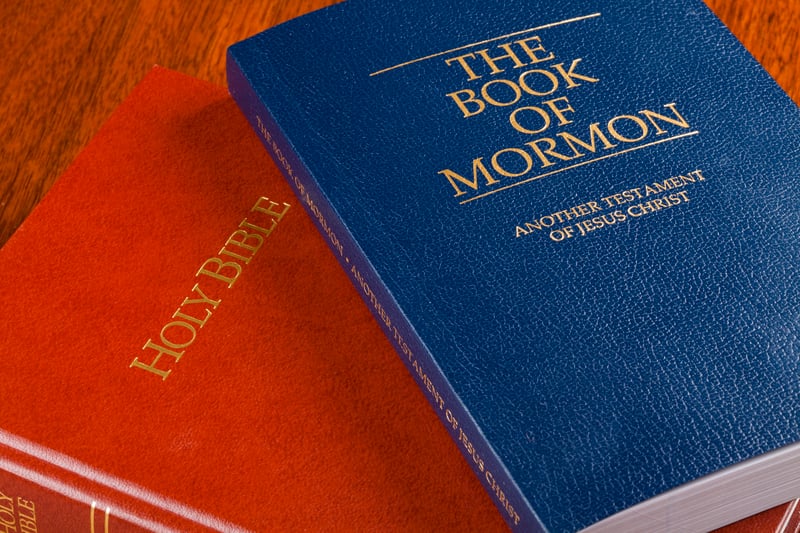
The official belief of the Church of Jesus Christ of Latter-day Saints is that the Book of Mormon is the divinely inspired word of God. Although this book lacks the same level of historical authenticity as the Bible and even clashes with it in places, it is revered by millions as equally divine.
Most Christian denominations don’t claim to have other books on par with the Bible, but many attempt to add to the Word of God in other, more discrete ways.
In Catholicism, many long-held beliefs and practices originate not only from Scripture but from what is known as divine tradition or sacred tradition—teachings developed and preserved throughout the church’s history, including papal declarations and church councils. This comprehensive system of doctrinal writings is not dissimilar to the Jewish oral law.
Examples of such teachings include doctrines like the assumption of Mary, purgatory, prayers to saints and the pope as the vicar of Christ.
Even the traditions of Protestant groups, which arose in part to reform Catholic practices, retain many elements that are not rooted in Scripture. Doctrines like the Trinity, Sunday worship and holiday observances were all retained from Roman Catholicism. (To learn more, read “The Reformation That Didn’t Go Far Enough.”)
Our purpose is not to condemn, but to encourage examination of beliefs in light of the Bible. Are we building our belief systems on what Scripture teaches?
The danger of adding to the Word of God
God’s Word is given to men for doctrine, reproof, correction and instruction in righteousness so we can be complete and thoroughly equipped for every good work (2 Timothy 3:16-17). The Bible’s instruction is not insufficient or incomplete. What right do we have to decide that Scripture is incomplete and needs additions? What gives us the right to add our own thoughts to God’s inspired Word?
Few set out intending to add to the Word of God. They almost always begin with good intentions—but good intentions can take you only so far.
Like a parent giving clear instructions to his children, God tells us how He wants to be worshipped. He tells us all we need to know in His divinely inspired book, the Holy Bible.
The natural result of adding our own words to those of God is that human reasoning will always sneak in, no matter how careful or well-meaning we might be. This was the first-century Jews’ trespass, for which they were rebuked by Jesus Christ. It is a continued issue in many Christian denominations today.
Warnings against adding to the Word of God
This is no light matter. In the Bible, we are warned of the perils of adding to God’s Word.
Proverbs 30:5-6 warns that those who add to God’s Word will be rebuked by Him and be found liars.
Even more dire, the apostle John records, “If anyone adds to these things, God will add to him the plagues that are written in this book” (Revelation 22:18).
God takes the sanctity of His Word very seriously, as should anyone who claims to follow Him.
What do you believe?
Where do your beliefs come from? If a belief isn’t from Scripture, ask yourself why you believe it.
Are you believing the traditions of men over the Word of God?
Date Posted: November 3, 2025
About the Author

Jordan Iacobucci
Jordan Iacobucci attends the Raleigh, North Carolina, congregation of the Church of God, a Worldwide Association.