The Bible is filled with words written by and about this ancient king. What key lessons does God want us to derive from his life?
We humans are fascinated by the lives of the rich and famous. Whatever the latest activity or opinion of a celebrity, athlete or media influencer, people want to know everything about it.
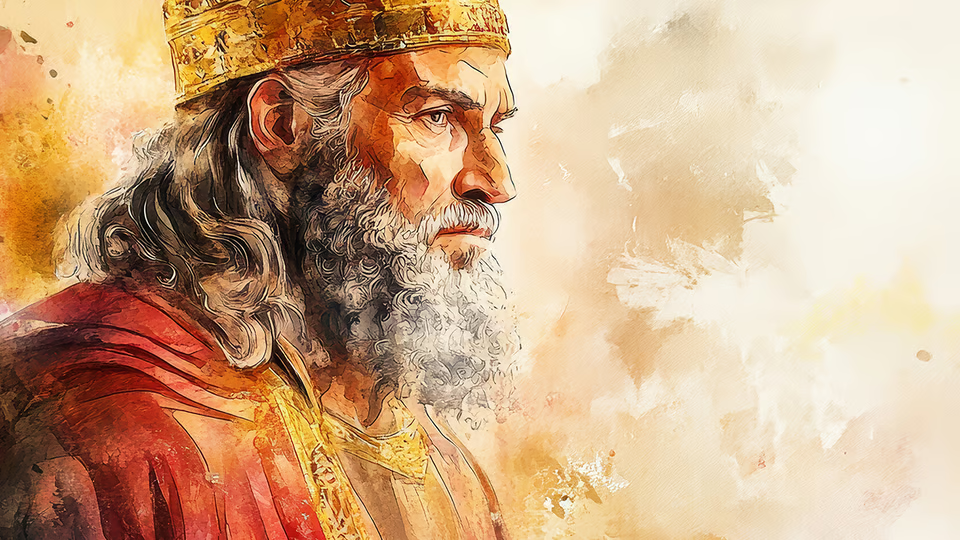
This fascination isn’t new. Long before social media and tabloids, the Bible recorded the story of a man whose fame spread across nations, whose wisdom drew rulers and scholars from around the world, and whose wealth was unmatched in his day. That man was King Solomon.
But this famous king suffered from a condition that still plagues humanity. It is highly contagious, affecting both rich and poor, and it is lethal to having a good relationship with God.
Thankfully, Solomon’s ailment is well documented, and his own writings can help us recognize and avoid it.
Solomon’s contributions to the Bible
In terms of knowledge and wisdom, Solomon was well qualified to contribute to the writing of the Old Testament. The Bible says, “He spoke three thousand proverbs, and his songs were one thousand and five” (1 Kings 4:32).
Concerning wisdom, God answered Solomon’s request for an understanding heart to discern between good and evil. In response to this humble petition, God said, “I have given you a wise and understanding heart, so that there has not been anyone like you before you, nor shall any like you arise after you” (1 Kings 3:12).
Some of this ancient king’s wisdom is recorded for us in the book of Proverbs. It has been estimated that at least 650 of the proverbs in this book were written by Solomon (Adam Clarke’s Commentary). His writings also include Ecclesiastes and Song of Solomon.
A wonderful beginning
When Solomon became king, he “loved the LORD, walking in the statutes of his father David” (1 Kings 3:3). One of his first acts as king was to offer a thousand burnt offerings to God.
When God appeared to him in a dream and asked him what he wanted, Solomon asked for wisdom to do the job he had been given (verse 9). Pleased with his humility, God not only granted him more wisdom than any other human past, present or future, He also gave Solomon what he had not requested: riches and honor (verses 10, 13).
During his lifetime, Solomon became the very picture of prosperity, wisdom and fame. Rulers from surrounding nations, including the queen of Sheba, traveled great distances to hear him speak and to witness the peaceful prosperity the citizens of his kingdom enjoyed (1 Kings 10:4-9, 24).
Solomon’s humility was a key element that facilitated his wonderful beginning relationship with God and the admiration of others.
Documenting this important concept, Solomon wrote, “By humility and the fear of the LORD are riches and honor and life” (Proverbs 22:4, emphasis added throughout). The psalmist likewise declared, “The fear of the LORD is the beginning of wisdom” (Psalm 111:10).
Solomon knew the principle well—and for a time, he lived it.
Solomon’s demise
Solomon also understood how God’s favor could be lost. In Proverbs 11:2 he wrote, “When pride comes, then comes shame; but with the humble is wisdom.”
Solomon realized that we humans have hearts that can lead us astray. During his dedication prayer for the newly completed temple, Solomon asked God to hear and forgive “when each one knows the plague of his own heart” and comes to Him in prayer (1 Kings 8:38-39).
Tragically, Solomon failed to heed his own warnings. He succumbed to the plague in his heart.
As one who had extraordinary wisdom and knowledge, Solomon surely knew the guidance for kings God had given (Ecclesiastes 1:16). Years earlier, Moses had written that a king of Israel should not “multiply horses for himself” or “wives” or “silver and gold” (Deuteronomy 17:16-17).
Solomon ignored all three of these directives.
- Horses and chariots: Solomon developed a lucrative enterprise, importing horses and chariots for his own nation and also to sell to neighboring nations (1 Kings 10:26-29).
- Wives: Solomon “had seven hundred wives, princesses, and three hundred concubines; and his wives turned away his heart” (1 Kings 11:3).
- Wealth: Each year Solomon received 666 talents of gold, roughly $2 billion in today’s value (1 Kings 10:14). Though God had blessed him with immense wealth, he continued to tax the people at a rate they considered a burdensome heavy yoke (1 Kings 12:4).
In his old age, Solomon’s wives were particularly instrumental in his demise, as they “turned his heart after other gods.” Continuing, the passage notes, “And his heart was not loyal to the LORD his God, as was the heart of his father David” (1 Kings 11:4).
Solomon’s lack of loyalty to God was evidenced by the pagan temples he built for his wives and his participation in the worship of those pagan gods (verses 5-10).
Solomon’s punishment
Because of his disobedience and disrespect for the God who had given him all his wisdom, wealth and fame, God brought two forms of punishment upon Solomon.
First, God said He would tear away part of Solomon’s kingdom and give it to his servant (verses 11-13). This occurred when Solomon’s son, Rehoboam, began to reign. Due to his harsh rule, 10 tribes revolted under the leadership of Jeroboam to form the northern kingdom of Israel (1 Kings 12).
Second, God raised up adversaries to Solomon (1 Kings 11:14, 23, 26). The peace of his early reign dissolved.
Solomon’s paradox
It is perplexing for us to understand how Solomon went astray. How could the wisest man in history make such foolish choices?
This contradiction is the basis for what some psychologists call Solomon’s paradox—the tendency to give wise advice to others while failing to apply it to ourselves.
Solomon displayed exceptional wisdom when judging others’ disputes (1 Kings 3:16-28). Yet in his personal life, he ignored his own counsel and made unwise choices.
For instance, he had earlier written, “The righteous should choose his friends carefully, for the way of the wicked leads them astray” (Proverbs 12:26).
But Solomon surrounded himself with ungodly influences.
It seems prolonged exposure to idolatry wore down the wisest man in the world. Solomon did not fully follow God. He was influenced by his foreign wives, and he built high places to the pagan gods for them (1 Kings 11:5-10).
Many years later, during the first century, Paul expounded on the importance of not spending an excessive amount of time around people who will negatively influence us. He wrote, “Do not be unequally yoked together with unbelievers. For what fellowship has righteousness with lawlessness? And what communion has light with darkness?” (2 Corinthians 6:14).
The lesson is clear: having wisdom, knowledge, wealth and fame do not guarantee loyalty to God.
Solomon’s self-diagnosis
The book of Ecclesiastes is believed to have been written by Solomon in his latter days as he reflected on his life and the mistakes he had made. In the second chapter of this book, he reflects on his experiments on how to have a successful life.
It seems that he tried everything, including laughter, enjoying excellent food and drink, accomplishing great building projects, success in business, listening to beautiful music, the acquisition of wealth, and the collection of treasures from around the world.
Yet his verdict was bleak: “Then I looked on all the works that my hands had done and on the labor in which I had toiled; and indeed all was vanity and grasping for the wind. There was no profit under the sun” (Ecclesiastes 2:11).
Despite his unparalleled riches, Solomon discovered that material success doesn’t automatically equate to spiritual success. He found that without God, life is meaningless—“all is vanity” as he described it (Ecclesiastes 1:2).
Solomon’s final advice
In the closing words of Ecclesiastes, Solomon summed up the most important wisdom he could provide future generations:
“Let us hear the conclusion of the whole matter: Fear God and keep His commandments, for this is man’s all. For God will bring every work into judgment, including every secret thing, whether good or evil” (Ecclesiastes 12:13-14).
After a lifetime of seeking fulfillment in almost every imaginable way, Solomon realized that obedience to God is the only source of lasting meaning.
Lessons for us
- Humility is essential. Solomon began well because he approached God humbly. We must do the same.
- Guard your heart. Even the wisest can fall if they allow wrong influences to take root.
- Wisdom must be lived, not just spoken. Knowing the right path is meaningless without walking it.
- Material success is empty without God. True purpose comes only from fearing God and keeping His commandments.
Let’s learn from Solomon’s paradox. Instead of ending in compromise, let’s finish strong in wholehearted obedience to God.
For further study, read our free booklet God’s Purpose for You.
About the Author

David Treybig
David Treybig is a husband, father and grandfather. He and his wife, Teddi, have two grown children and seven grandchildren. He currently pastors the Austin, Texas, congregation of the Church of God, a Worldwide Association. He has served in the pastoral ministry for over 40 years, pastoring congregations across six states.