Interest in the book of Enoch has grown following the discovery of fragments of 1 Enoch among the Dead Sea Scrolls. What do we need to know about these writings?
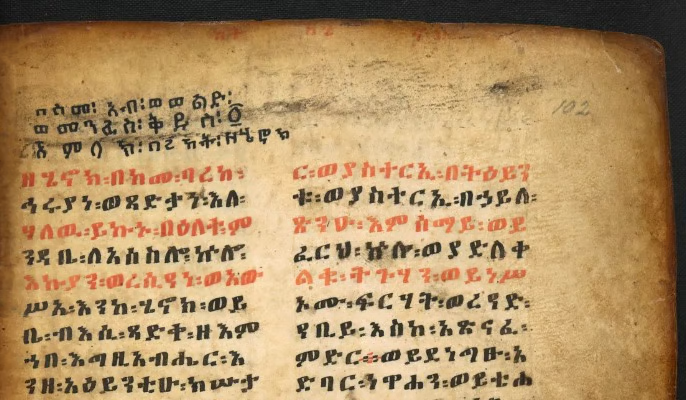
Public Domain, commons.wikimedia.org
When fragments of this ancient manuscript were found in the Qumran Caves near the Dead Sea beginning in 1947, scholars and lay readers alike were intrigued by this mysterious and apocalyptic book.
But what exactly is the book of Enoch, and why has it been excluded from the Bible by most branches of Judaism and Christianity?
What are the books of Enoch?
The term book of Enoch generally refers to 1 Enoch, but there are actually three books commonly attributed to Enoch:
- 1 Enoch: Also known as the Ethiopic Book of Enoch, this is the most well-known and is preserved in its entirety in the Ge’ez language (ancient Ethiopic).
- 2 Enoch: Known as the Slavonic Book of Enoch, it survives only in Old Church Slavonic.
- 3 Enoch: A later rabbinic work, also known as the Hebrew Book of Enoch, dating to the fifth to sixth centuries.
These books are part of a larger group of ancient writings known as the pseudepigrapha—a term meaning “falsely attributed.” These writings are not included in the biblical canon and were often penned under the names of well-known biblical figures in order to lend them credibility.
1 Enoch and the canon
Of the three Enochic texts, 1 Enoch is by far the most influential. It covers a wide range of topics, including visions of heaven and hell, angels, cosmology, apocalyptic visions and a unique solar-based calendar.
Despite its popularity in some early Christian circles, 1 Enoch has never been included in the official biblical canon of Judaism or the vast majority of Christian churches. Only the Ethiopian and Eritrean Orthodox Churches regard it as Scripture.
The primary reason for this exclusion is that 1 Enoch contains teachings that conflict with canonical Scripture, and it lacks verifiable apostolic or prophetic authorship. The ancient Jewish community did not include it in the Tanakh (the Hebrew Bible), nor was it included in the Septuagint—the Greek translation of the Hebrew Scriptures widely used in Jesus’ time.
Its omission from both of these key Jewish texts—and later, from Christian canons—speaks volumes about how it was viewed by those responsible for preserving Scripture.
A common argument for inclusion
Some proponents of 1 Enoch argue for its inclusion in the canon based on Jude 1:14-15, which seems to quote from 1 Enoch 1:9.
“Now Enoch, the seventh from Adam, prophesied about these men also, saying, ‘Behold, the Lord comes with ten thousands of His saints, to execute judgment on all’” (Jude 1:14-15).
This passage is similar to 1 Enoch 1:9, but it is not certain that Jude is quoting directly from the book of Enoch. Both Jude and the book of Enoch could have been quoting an original source that is now lost.
Even if Jude was quoting from the book of Enoch, this does not mean he endorsed the entire book as divinely inspired. Other authors of books in the Bible quoted and referred to nonbiblical sources (Acts 17:28; Joshua 10:13; Numbers 21:14; 1 Kings 11:41; 2 Chronicles 13:22). Simply quoting a nonbiblical source would not validate the entire referenced work.
Authorship and composition
Those advocating inclusion of 1 Enoch often claim it was written by Enoch, the great-grandfather of Noah, mentioned in Genesis 5:24: “And Enoch walked with God; and he was not, for God took him.”
However, textual analysis indicates that 1 Enoch was not written by one man, but rather experts believe it was compiled over centuries by multiple authors. Scholars generally identify at least five distinct sections, each composed at different times.
Why the book of Enoch was rejected
So why wasn’t 1 Enoch included in the Bible? The primary reason is that it contradicts clear biblical teachings.
The recognized books of the Bible do not contradict each other. They are amazingly consistent, written by multiple men over hundreds of years all inspired by God via the Holy Spirit (1 Peter 1:10-12; 2 Peter 1:21; 2 Timothy 3:16).
Jesus affirmed that God’s Word is truth (John 17:17) and cannot be broken (John 10:35). The psalmist likewise wrote, “The entirety of Your word is truth” (Psalm 119:160).
The book of Enoch fails this test of consistency.
Here are a few key contradictions.
Mistaken belief that Enoch was taken to heaven
The book of Enoch claims that Enoch was taken to heaven, where he received visions and messages from God (2 Enoch 38:1; 2 Enoch 67:1).
However, Genesis 5:24 simply states that “God took him.” It does not say where.
Jesus later said that “no one has ascended to heaven” (John 3:13).
The book of Enoch is a fascinating piece of ancient literature. However, it is not Scripture. It was never accepted as part of the biblical canon by Judaism or mainstream Christianity. It contains theological errors, contradicts the Bible and was not authored by the pre-Flood Enoch, despite its name.
The example of Elijah, who was taken up in a whirlwind, illustrates that being “taken” by God can refer to being relocated as opposed to being taken to the divine realm (2 Kings 2:11).
Elijah was taken up into the sky (Genesis 1:8), which could be called the first heaven, not the “third heaven” where God’s throne is (2 Corinthians 12:2). Elijah must have been transported through the atmosphere to another place on earth, since he wrote a letter many years later (2 Chronicles 21:12-15).
Thus, the book of Enoch’s core premise is built on a misinterpretation of the Genesis passage and stands in direct contradiction to the words of Jesus.
For additional clarity on this point, see the article “Are Enoch and Elijah in Heaven?”
Mistaken teaching on fallen angels marrying women
A central theme in 1 Enoch is the story of fallen angels—called the Watchers—who descended to earth, took human wives and fathered a race of giants called the Nephilim (1 Enoch chapters 6-16).
This story is based on a misinterpretation of Genesis 6:1-4, which speaks of the “sons of God” and the “daughters of men.” While the term sons of God can refer to spirit beings or humans, Jesus clarified in Mark 12:25 that spirit beings do not marry.
The book of Enoch’s interpretation not only contradicts Jesus, but also introduces mythical elements not found in Scripture, including 4,500-foot-tall giants. (Even if this number was a scribal error, and it was supposed to be 450-foot-tall giants, it remains mythical.)
It’s an entertaining story, but it isn’t true.
For additional study, see “Who Were the Sons of God in Genesis 6?”
Mistaken teaching on the immortality of the soul
The book of Enoch says that the souls of the wicked go to Sheol, where they will be tormented forever (1 Enoch 9:10; 22:10-13; 103:7-8). This sounds like later Christian ideas of hell, but it clashes with the biblical teaching.
The Bible teaches that the soul is mortal. Ezekiel 18:4 says, “The soul who sins shall die.” There is no conscious awareness after death. Ecclesiastes 9:5 says, “The dead know nothing,” and Psalm 6:5 adds, “In death there is no remembrance of You.”
The concept of an immortal soul was a Greek philosophical idea, particularly from Plato, and was not a belief held by early Israelites.
The Jewish Encyclopedia notes: “The belief that the soul continues its existence after the dissolution of the body is a matter of philosophical or theological speculation rather than of simple faith, and is accordingly nowhere expressly taught in Holy Scripture . . .
“The belief in the immortality of the soul came to the Jews from contact with Greek thought and chiefly through the philosophy of Plato, its principal exponent, who was led to it through Orphic and Eleusinian mysteries in which Babylonian and Egyptian views were strangely blended” (article “Immortality of the Soul”).
See our online article “Do Humans Have an Immortal Soul?” for additional explanation.
The Enoch calendar
The book of Enoch presents a solar calendar it says was revealed to Enoch by the angel Uriel. It divides the year into four seasons, each having two 30-day months and one 31-day month—totaling 364 days.
However, this calendar does not include intercalation—a method of adding days to synchronize the calendar with the actual solar year (approximately 365.25 days). Without this adjustment, the calendar would drift out of alignment with the seasons.
By contrast, the Hebrew calendar is a lunisolar calendar carefully maintained by the Jewish people, who were entrusted with the “the oracles of God” (Romans 3:1-2). Through the years the Jews have meticulously preserved both the Old Testament Scriptures and a highly accurate lunisolar calendar that includes intercalation to keep it in step with both the lunar months and the solar year, ensuring the biblical holy days fall in their proper seasons.
Final observations
The book of Enoch is a fascinating piece of ancient literature. It provides insight into how some Jews during the Second Temple period viewed the cosmos, angels, judgment and end times. It documents the influence of Greek philosophy on Jewish thinking regarding the soul, and its vivid imagery and imaginative narratives have captivated generations of readers.
However, the book of Enoch is not Scripture. It was never accepted as part of the biblical canon by Judaism or mainstream Christianity. It contains theological errors, contradicts the Bible and was not authored by the pre-Flood Enoch, despite its name.
While it may serve as an interesting historical and literary text, we should not be deceived into thinking it is equal to the inspired Word of God. It should be read with a cautious and critical eye.
For further study, see “The Canonization of the Bible.”
About the Author

David Treybig
David Treybig is a husband, father and grandfather. He and his wife, Teddi, have two grown children and seven grandchildren. He currently pastors the Austin, Texas, congregation of the Church of God, a Worldwide Association. He has served in the pastoral ministry for over 40 years, pastoring congregations across six states.