Video games have become some of the most popular forms of entertainment for both men and women. But is there a dangerous dark side of gaming?
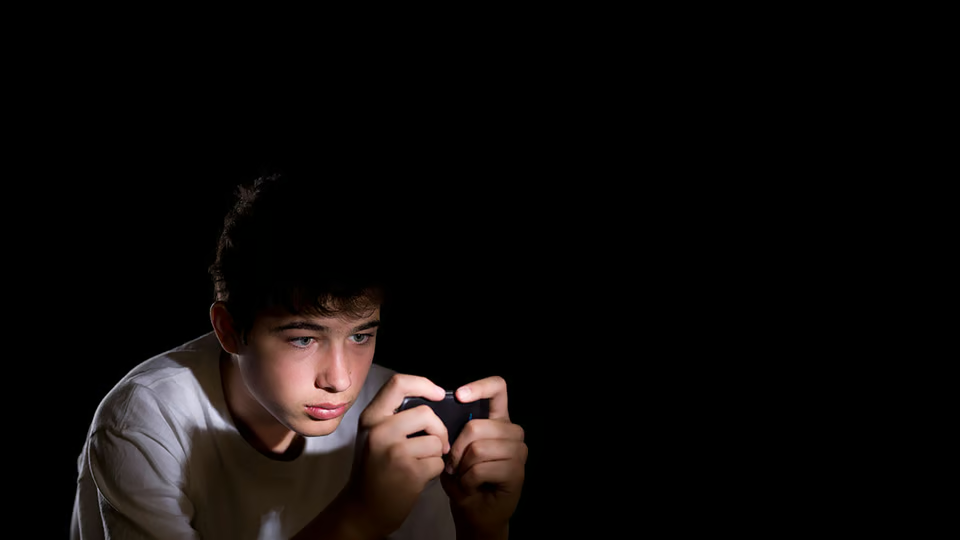
It started innocently, like so many things do. Rob (name changed to protect identity) was just having a good time hanging out with friends. But what started off as just having fun turned into something far more serious.
Rob’s experience with the dark side of gaming
Rob’s foray into online gaming started with first-person shooter games. He and his friends would get together, network their laptops and play multiplayer role-playing games for hours.
Then, in 2004, Rob was introduced to a new game: World of Warcraft (WoW). Up to that point, he had played games that had a set number of levels, making it possible to “win” the game. WoW was the first game that Rob played that one could never win.
That was because almost every other month the game makers would come out with new content for players to purchase. Rob had always been a highly motivated, goal-oriented and competitive person; so World of Warcraft presented an irresistible challenge.
From hobby, to habit, to gaming addiction
WoW, like other massively multiplayer online role-playing games, is set up to create an alternate, fantasy life for the player. The avatar that each player creates has its own identity, profession and skill set. Players select a realm to play in and can join guilds with other players. It can be a very interactive and social game, involving the completion of quests. In fact, success in these games is often dependent on the amount of time a person puts into it. So they are designed to encourage hours of play time.
For Rob, World of Warcraft became an escape from his increasingly depressing life. A breakup with his girlfriend, his inability to keep up with the demands of his college classes—all could be pushed out of his mind while playing the game.
Rob created a completely different reality for himself through the game. In the game he was powerful and accomplished. It was only when he’d take a break from playing that his feelings of inadequacy, anxiety and depression would creep back in.
Rob found himself playing WoW more and more. The game was so in-depth that, if he didn’t have to stop for real-life activities, he could play all day. “I’d start playing when I woke up, and before I knew it, it was night time.” Gaming addiction began to consume him; he’d think about the game all day long, even when not playing. He’d even dream about it.
Trying to kick the gaming addiction
Rob played WoW for three years. Twice he attempted to quit playing. “You never want to think of yourself as an addict,” he explained. Yet he knew the game was beginning to affect his life in negative ways. He was struggling to make his morning classes. He stopped working on his homework. His real social life suffered.
“I’ve never wanted to do anything else in my life with such intensity. It was an extremely powerful compulsion,” he admitted. Rob was a gaming addict.
At one point he thought he’d kicked the gaming addiction. He stopped playing, focused on college and was doing better. He even got a summer job and was able to discipline himself throughout the summer in order to keep the job—playing the game only for limited periods of time.
When he returned to college that fall, he felt sure that he had the habit under control. It wasn’t going to interfere with his life anymore.
But then, just as in the past, Rob found his way back to the game and started playing later and later, and it got harder to get up in the mornings. He’d wake up and realize he’d missed his classes again. Then, to combat the anxiety and stress of that choice, he’d turn to WoW.
Finally he chose to withdraw from all classes. He’d made a lot of money that summer, so he could still afford rent. He pretended to his family that all was well and played WoW for three months straight. “I thought I’d love it. I got really good at it, but I had this crushing feeling at the same time. It wasn’t fulfilling.”
What had begun as a hobby developed into a habit and now was a legitimate gaming addiction.
Addiction and the brain: the chemistry of habits
What happened to Rob can happen to any of us. Knowing how habits develop and understanding brain chemistry are keys to unlocking the reasons why.
In his best-selling book The Power of Habit Charles Duhigg writes about the habit loop.
According to Mr. Duhigg, habits are formed because our brain is constantly looking to save effort, so it converts a sequence of actions into an automatic routine, called chunking. This is at the root of how all habits form. Left to its own devices, the brain will efficiently turn routines into habits (2012, pp. 17-19).
There are three components to the habit loop: the cue, the routine and the reward. The cue is anything that triggers the brain to know what pattern or routine to launch. The routine has been established by doing the same thing over and over. And the reward comes at the end. Over time, as the brain repeats this three-step loop, it becomes more automatic. The cue and the reward then become powerfully linked together, and a craving and sense of anticipation develops.
Rob discovered that firsthand after he thought he’d kicked gaming addiction for good. By this time he was married, had a job that paid well and hadn’t played WoW for years. Then, after an old friend visited, Rob was enticed back to the game. He played one time, and then decided he couldn’t go back down that path; he had too much to lose.
But to his dismay, the urge to keep playing was so strong that it became an obsession. He thought about the game constantly.
“I’ve never wanted to do anything else in my life with such intensity. It was an extremely powerful compulsion,” he admitted. Rob was a gaming addict.
You can find helpful information in our article “Freedom From Addiction” and related articles.
Dangers of gaming
Rob is not alone in his struggle with excessive gaming. Anyone who works in a public school system with adolescents will tell you that many young people are affected by this problem—especially boys.
Although video games have become popular with both men and women, studies have found that men are much more likely to become addicted and develop gaming disorder. Males are struggling in many areas today (see our blog post “Why Real Men Are Becoming Extinct” to view some of the statistics).
Though there are many factors that explain these statistics, one factor could be the overuse of gaming. According to an insightful Psychology Today article, some major problems associated with excessive gaming are:
- Impulsive behavior.
- Greater acceptance of violence.
- Stunted social skills.
Violent video games
Although there has been a boom of casual and nonviolent “cozy” games, many popular games are still heavily based on violence. Dozens of horror games include disturbing, violent imagery and demonic creatures, and series like Grand Theft Auto and Call of Duty put the user behind a gun to kill sometimes hundreds of realistically rendered models of human beings—often with graphic depictions of blood and gore.
Scientific studies confirm that constantly bathing the mind in violent images leads to desensitization to violence. In other words, those who play violent video games have a reduced sympathy and sensitivity to real violence.
In 2000 a joint report was released by the American Medical Association, the American Psychological Association, the American Academy of Pediatrics and the American Academy of Child and Adolescent Psychiatry.
It said: “The conclusion of the public health community, based on over 30 years of research, is that viewing entertainment violence can lead to increases in aggressive attitudes, values and behavior, particularly in children . . . Moreover, prolonged viewing of media violence can lead to emotional desensitization toward violence in real life . . . Preliminary studies indicate that the negative impact [of violent video games] may be significantly more severe than that wrought by television, movies, or music.”
This has been proven again and again over the years. In 2019, a study conducted in Malaysia found that male teenagers who played violent video games exhibited higher levels of aggression and anger, and lower levels of empathy and altruism.
The American Academy of Child and Adolescent Psychiatry echoed this warning, saying that children and teenagers exposed to screen violence may “become ‘immune’ or numb to the horror of violence” and even “imitate the violence they observe on screens.”
Dealing with the dark side of gaming
The real question is, What positive purpose does extreme gaming have? Does spending countless hours playing electronic games enrich a person’s life? Does playing violent video games make a person better or more peace-loving? Will it help a person get better grades?
It would be hard for anyone to answer yes to any of those questions.
To make wise decisions about dealing with the dark side of gaming, consider these factors:
1. Consider the time. People who are addicted to playing video games can spend more than five hours a day gaming! These hours in front of a screen accomplishes nothing productive or positive.
The Bible teaches that we should strive to be active and productive (Proverbs 10:4; Ecclesiastes 9:10; 1 Thessalonians 4:11) and use our time wisely (Ephesians 5:16). The Bible warns that idleness is destructive (Proverbs 12:11; 19:15; 31:27).
2. Excessive gaming can cause a person to live in a fantasy world and retreat from healthy social interaction with real people. Heavy gamers can even retreat into this antisocial behavior when they are with others—gaming on their phone or laptops instead of interacting with the people surrounding them. This is a telltale sign of gaming addiction.
The Bible teaches that our lives are to be based on love—outgoing concern—for others (Matthew 22:39; 1 Thessalonians 4:9). Love cannot be expressed when we retreat from human contact as a result of any kind of addiction.
3. Violent games and horror games are dangerous. For better or worse, the things we allow into our minds affect our thoughts and behaviors. Violent games may damage our minds in ways we might not expect, causing us to lose empathy for others and be angry. In contrast, God intends that we keep ourselves “unspotted from the world” (James 1:27) and that we show love and concern for other people. We should remember that the spirit of the Sixth Commandment doesn’t merely condemn murder, but teaches us to avoid the thoughts and attitudes that lead to it (Matthew 5:21-22; Mark 7:20-23). This raises an important question: Does immersing ourselves in virtual violence help us develop God’s mind of love, or desensitize us to violent behavior contrary to His way of life?
If you are serious about living by God’s standards, violent and horror-themed video games that simulate killing and contain disturbing imagery should not be a part of your—or your children’s—life.
Avoiding or overcoming the dangers of gaming
This is an issue that we hope our readers will think deeply about.
If you are spending hours playing video games and recognize that it is negatively affecting your life, it is time to take action. The Bible teaches that one method of removing negatives from our lives is to cut them off at the source and avoid the temptations (1 Corinthians 6:18; 2 Timothy 2:22). Overcoming the misuse of gaming can require removing a video game console from your home, disabling the software on your computer or canceling your gaming subscription.
If you are a parent, monitor your children closely in this area. If you allow electronic games in your home, closely monitor their usage and whether or not the game is appropriate. Do not let your children waste hours of time being sedentary in front of a computer or TV screen. Also, be aware of mobile games. If your children are withdrawing in social and family situations to play games, it may be time to take action.
Game over
After weeks of struggle, Rob was finally able to let it go, thanks to the help of family and friends and reconnecting with his religious upbringing. He came to see that the game had become a type of idolatry for him, and he believes strongly that he was under spiritual attack. Others may find it necessary to seek professional help to break free from the gaming addiction. Though we naturally resist seeking help, the benefits can be worth it.
We hope Rob’s story, and the other information in this article, will help others to avoid or overcome this serious problem.
5 Signs of Gaming Addiction
Are you (or is someone you know) gaming way too much? Here are five warning signs of gaming addiction from an expert on gaming addiction, Dr. Doug Hyun Han of Chung-Ang University Hospital:
- A disruption in regular life patterns (like playing all night and sleeping during the day).
- Slacking on responsibilities (such as work and school).
- Needing a bigger fix (gaming longer to get the same level of enjoyment).
- Withdrawal symptoms (such as anxiety or irritability) when disconnected from the game.
- Cravings (constant thoughts about the game when doing other things).
About the Author

Debbie Caudle
From Canada to California and then Wyoming to Texas, Debbie Caudle’s journey has taken a lot of twists and turns, but through it all she’s had a lifelong desire to help others improve their lives. She has worked over 25 rewarding years as a licensed counselor, working with individuals, couples, children and families. This experience has taught her a lot about the challenges people face in conquering their worst fears and hurdling their toughest obstacles.

Erik Jones
Erik Jones is a full-time writer and editor at the Life, Hope & Truth offices in McKinney, Texas.