A 10th of the psalms share the label “A Song of Ascents.” When we consider them carefully, what spiritual insights can we gain from the 15 psalms known as the Psalms of Ascent?
CarlFourie via GettyImages
Imagine being among the ancient Israelites traveling up to Jerusalem for God’s festivals. When your family stops to make camp for the night, perhaps you hear other travelers singing one of the meaningful Psalms of Ascent.
This was likely a familiar scene for Israelites traveling to Jerusalem for one of three pilgrimage festivals—the Feast of Unleavened Bread, the Feast of Weeks and the Feast of Tabernacles (Deuteronomy 16:16).
What are these Psalms of Ascent, and what significance do they hold for us today?
The Psalms of Ascent in history
The Hebrew word translated “ascents” is maʿalot, which literally means “going up.” The songs have also been called songs of degrees, pilgrim songs and gradual psalms.
Although there are other theories about the way these songs were used, most biblical scholars think the Psalms of Ascent were sung by pilgrims headed to Jerusalem for a feast, particularly the Feast of Tabernacles in the fall.
The “going up” would have related to the understanding that to go to Jerusalem was to “go up.” In the minds of the people of Israel, as The Expositor’s Bible Commentary points out, “every direction from Jerusalem is down” (Vol. 9, p. 356), and therefore going to Jerusalem was “going up.”
This is only partly a geographic reference. Jerusalem does sit on a mountain, but other mountains are higher. This concept of going up to Jerusalem was also a recognition that the city, as Israel’s spiritual center, represented God and His ways, which are higher than ours.
We are all pilgrims
Like the Israelites headed to Jerusalem for the festivals, all God’s people are on a journey. We are all pilgrims, like the patriarch Abraham. God called him out of his familiar life to a land that was unknown to him.
Hebrews tells us that Abraham “dwelt in the land of promise as in a foreign country, dwelling in tents” as a sojourner, or pilgrim (Hebrews 11:9). He was looking for, and headed toward, “the city which has foundations, whose builder and maker is God” (verse 10).
Two chapters later we are told that Christians have been called to seek the same city, “the one to come” (Hebrews 13:14). Like Abraham, we leave behind the familiar to draw close to God.
This is where the Psalms of Ascent become significant to us. Though composed at different times by different authors (including David and Solomon), these songs all came to be associated with “going up” to Jerusalem. They are songs for pilgrims.
Spiritual insights from the Psalms of Ascent
Each of these 15 Psalms of Ascent has a different focus, but together they strengthen the hearts of all who seek to draw close to God. That’s because all these songs, according to BibleHub.com, “encouraged unity, fostered hope, and reminded [the Israelites] of God’s enduring protection.”
These short psalms—all but one have no more than nine verses—offer glimpses of different stages in the Christian journey, from repentance and fear to joy and victory. We all experience these feelings at different times and in different ways.
Here are brief summaries of the 15 Psalms of Ascent, considering their significance for us:
Psalm 120
At its beginning, this song is a prayer for help. It progresses to a lament about living in Meshech, and “among the tents of Kedar” (verse 5). These names are symbolic, as Bible Gateway’s online Encyclopedia of the Bible points out, drawing on real places that “represent ‘the evil society’ in which the psalmist lives.”
This mirrors the reality Christian pilgrims face. We are not to be part of the world, though we are still in the world (John 17:14-16). Like the psalmist, we long for peace among people who don’t.
In some ways, this could be seen as a starting point for the Christian journey. Repentance is the beginning of the process, and it comes only as we begin to see that the ways of the world around us are evil. Repentance is a prayer for help, just as requested in the opening verse of this psalm.
Psalm 121
Recognition of who God is, and of His power, is at the heart of faith. Yet we generally do not begin our spiritual pilgrimage with a full understanding of the character and power of God. We are often searching—still learning the source of our help as we “lift up” our eyes.
This psalm helps by first reminding us that God is the One “who made heaven and earth” (verse 2). It is filled with reassurances that God is always aware of our circumstances—He “shall neither slumber nor sleep” (verse 4).
The psalm concludes with the promise that God will preserve His children in all situations, whether “going out” or “coming in” (verse 8). This promise is for now, and it is “even forevermore.”
Psalm 122
Up to this point, neither the city of Jerusalem nor God’s house, the temple, has been mentioned. But this psalm, in its nine simple verses, mentions both, and more than once each.
Jerusalem is a real city, but it stands for much more. It stands for God’s throne, His temple and His Kingdom. It stands for our future hope, the New Jerusalem (Revelation 21:2, 10; see also Revelation 3:12). It is the ultimate destination of our individual pilgrimages.
This psalm speaks of the desire to enter “the house of the LORD” (verse 1). That house, the temple, signifies the presence of God. It represents the human longing for a relationship with the Eternal God and the joy we can have because of that relationship (verse 1).
And that is the whole purpose of “going up” to Jerusalem. A related expression occurs in the description of the city as the place “where the tribes go up” (verse 4).
Psalm 123
Like Psalm 121, this song uses the imagery of “lifting up” one’s eyes. It is a poetic way of expressing an urgent sense of searching.
In the former, it was a matter of looking for protection in God’s power. In Psalm 123, the individual is looking for mercy (verses 2-3) and comfort in the midst of trial.
As humans, we are weak. We sin, even after conversion. God, however, “is rich in mercy” (Ephesians 2:4), ready to forgive as we earnestly confess our sins.
Like the pilgrim of this psalm, “our eyes look to the LORD our God, until He has mercy on us” (verse 2).
Psalm 124
This is the first of the Psalms of Ascent that reflects a more meditative moment. It is not an urgent cry for protection or mercy, and it is not an anticipation of joyously entering God’s presence.
Instead, this song is a call to remember. In times of peace and prosperity, God’s people must take time to reflect on all that God has done in our lives (Isaiah 46:9). That is how we stay on course.
Much of the Bible is a remembrance of God’s interventions in human history. Those accounts, together with our own memories of how God has responded to our personal needs, give us perspective and bolster our faith.
Psalm 125
All people, atheists as well as those who believe in a god or the God, put their trust in something or someone. In modern, secular societies, money is often the focus of that trust.
This psalm reminds the pilgrim that those who trust in the true God, the God of the Bible, “cannot be moved,” just as Mount Zion could not be moved (verse 1).
It concludes with this thought, worded as a prayer: “Peace be upon Israel!” (verse 5). For Christians, the prayer would be for our fellow pilgrims, the Church: “Peace and mercy be upon them, and upon the Israel of God” (Galatians 6:16).
Psalm 126
The first verse of this psalm hints that it was composed after the Jews returned to Jerusalem from Babylonian exile. It highlights God’s great deliverance from slavery to freedom.
As such, it is a reminder to us that we, as Christians, have been “brought back” from our captivity to sin (Romans 6:6, 16-17, 20). We have been delivered from empty, meaningless lives to serve a loving, merciful God.
From time to time during our individual pilgrimages, we should pause to consider this deliverance. As we do, we can join voices with those who proclaim, “The LORD has done great things for us” (verse 3).
Psalm 127
Hamilton Photography via Lightstock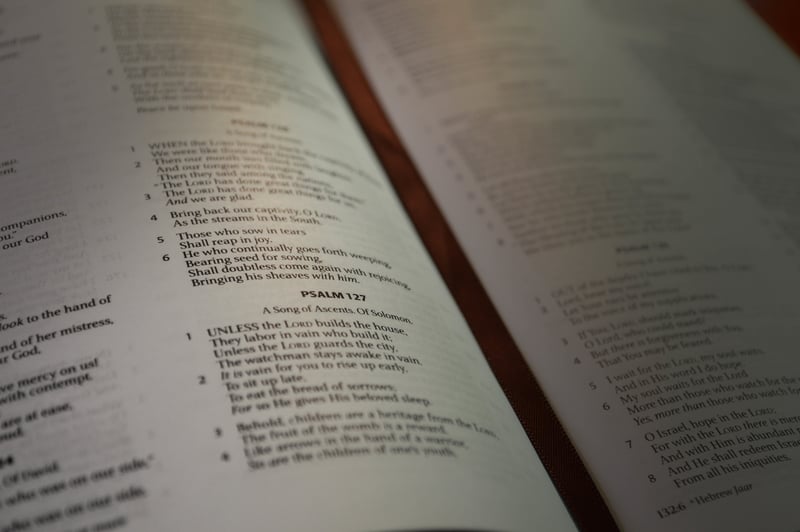
As the midpoint of the Psalms of Ascent, this song honors God Himself. Life without Him is meaningless, empty and without assurance.
We cannot build our own lives and families with any kind of confidence if we do not put God at the center of all that we do. He should be foremost in our hearts and minds.
When we look to God, we become His beloved. As such, we can rest assured, knowing that He blesses “His beloved even in his sleep” (verse 2, New American Standard Bible).
Psalm 128
Just as Psalm 124 is a call to remember the peace and prosperity resulting from a relationship with God, this psalm reminds us of His blessings. It begins with a bold assertion: “Blessed is every one who fears the LORD” (verse 1).
A short list of blessings follows. It begins with blessings on one’s livelihood, or “the labor of your hands” (verse 2), and concludes with blessings on one’s marriage and family (verse 3).
The last two verses are themselves a blessing on the audience of the psalm, emanating from God’s presence in Zion, a reflection of the pilgrim’s anticipation of arriving in Jerusalem. Like Psalm 125, this psalm ends with a prayer, “Peace be upon Israel!” (verse 6).
Psalm 129
It is not merely a few of God’s people who will experience persecution. The apostle Paul warned his protégé Timothy that “all who desire to live godly in Christ Jesus will suffer persecution” (2 Timothy 3:12).
Long before that warning, Psalm 129 acknowledged such persecution. (The Hebrew word ṣārar, translated as “afflicted” in the New King James Version, can also carry the meaning of “persecuted,” as it is translated in the NASB95.)
This psalm provides a perspective for Christian pilgrims. First, we must recognize that we live in a world currently under Satan’s sway, and therefore, we can expect to be persecuted (verses 1-3).
Second, and more important, all persecution will end with the coming Kingdom of God, when God will “cut in pieces the cords of the wicked” (verse 4). The wicked will disappear, even as “grass on the housetops” withers away (verse 6).
Only those committed to God and His ways will remain.
Psalm 130
Similar to the first psalm of ascent (Psalm 120), this one begins with a desperate plea for help. What sets this psalm apart is the emphasis on a willingness to wait.
“I wait for the LORD” (verse 5), the psalmist asserts. He then restates his intent, declaring, “My soul waits.” Finally, he expresses the same thought in terms of hope, which is the expectation attached to our waiting.
As we mature during our Christian journey of faith, we come to understand that deliverance is not always immediate. We must wait. We must be patient.
And we must not forget that we will have a wonderful future at the end of our journey, a future that fills us with hope.
Psalm 131
This psalm is the first of three with only three verses. The others are Psalms 133 and 134, the last two of the Psalms of Ascent.
An attitude of humility dominates this short psalm. As we approach God, we must obey James’ instruction: “Humble yourselves in the sight of the Lord, and He will lift you up” (James 4:10).
Psalm 131 concludes with an assurance. When we approach God in humility, we can “hope in the LORD from this time forth and forever.”
Psalm 132
In contrast to the preceding psalm, this one has 18 verses, making it the longest of the Psalms of Ascent. It is all about God’s temple and His presence.
The psalmist takes comfort and strength from knowing God’s promises regarding Zion and the temple: “This is My resting place forever” (verse 14).
Although God’s temple has been destroyed twice, once by the Babylonians in about 586 B.C., and once by the Romans in A.D. 70, Scripture assures us that God will once again make His presence known at His temple in Jerusalem.
The prophet Ezekiel recorded a vision of God’s presence leaving the temple in Jerusalem (Ezekiel 10) prior to its destruction in 586. The prophet also recorded a vision of God’s presence returning at the beginning of Christ’s millennial reign (Ezekiel 43).
Like the psalmist, Christian pilgrims can take comfort and strength from studying and knowing God’s promises. When our hopes are realized, we will “shout aloud for joy” (Psalm 132:16).
Psalm 133
The theme of this psalm (the next to last among the Psalms of Ascent) is unity. The psalmist begins it with the observation that seeing people dwell together in unity is wonderful.
This is a fitting theme to be placed near the end of the pilgrimage. Jerusalem would have been packed with crowds, and people can become selfish and rude in such situations.
God’s people, however, are to love their neighbors as themselves (Leviticus 19:18; Mark 12:31). Our loving Father is creating a family, and He will not tolerate selfishness that destroys family unity.
As Christian pilgrims, we must also aspire to unity. As we become more like Christ, we will be “of one accord” (Philippians 2:2).
Psalm 134
The last of the Psalms of Ascent is a call to praise God: “Bless the LORD, all you servants of the LORD” (verse 1). This psalm also mentions “the house of the LORD.”
As pilgrims reached their destination, the house of the LORD, it would have been quite natural for them to express their gratitude and praise to the God who had watched over them during their journey.
Christian pilgrims should likewise be ready to praise God, not only at the establishment of His Kingdom, but each day as we approach Him in prayer.
Inspiration and joy through the Psalms of Ascent
God’s people would have been inspired and excited by the whole experience of “going up” to Jerusalem for one of His feasts. Their anticipation of the feast made the journey special as well.
As Christian pilgrims, we can join them in rejoicing, looking to the Psalms of Ascent for comfort, strength and reassurance along the way.
About the Author

Bill Palmer
Bill Palmer has devoted much of his life to writing and editing. He studied journalism at TCU in Fort Worth, Texas, prior to attending Ambassador College in Pasadena, California.