The Book of Jubilees falsely claims to be divine revelation to Moses. It rewrites and adds to Genesis and Exodus. What should you know about Jubilees?
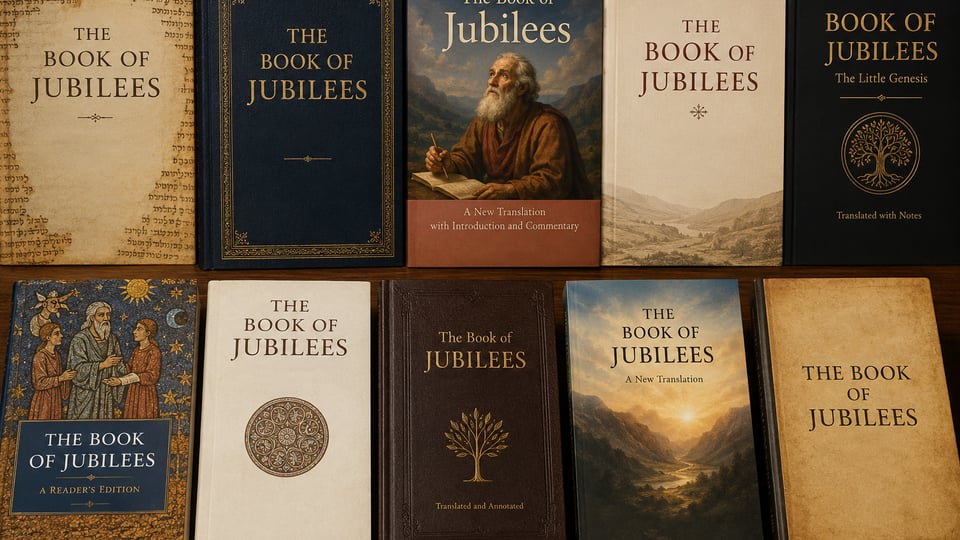
Secrets are hidden in this ancient manuscript. That’s the sensational claim of a YouTube video with more than a million views.
According to the video, the book provides answers to biblical mysteries. What is this book of secret revealed knowledge, supposedly banned by organized religion?
It’s the Book of Jubilees, one of the best-known books of the pseudepigrapha, a collection of ancient nonbiblical writings.
What is the Book of Jubilees?
That YouTube video with its sensational claims doesn’t offer real insight. Its purpose is to get clicks, and therefore revenue. It exaggerates and distorts the nature of this ancient book.
So then, what is the Book of Jubilees? Does it have any value for the modern world?
While the book is useful to biblical scholars, it’s not because it solves ancient mysteries with hidden knowledge. Instead, it is just one resource biblical scholars and historians use to understand aspects of the world that led up to the New Testament era.
It is not inspired and, in fact, in many ways it contradicts Scripture. But it sheds light on the mindset of pious Jews just before the time of Christ. The book was the product of “a strict form of Judaism reacting to the Hellenizing tendencies of the Hasmonean rulers.” Thus scholars have found background information about how aspects of first-century Judaism diverged from the Bible.
Why is it called the Book of Jubilees?
It seems the ancients used different names for the book, including Little Genesis, Lesser Genesis, the Testament of Moses, the Life of Adam and the Book of Adam’s Daughters. However, its most commonly used title was the Book of Jubilees.
That’s because one of the most prominent features of the manuscript is its division of history into jubilees. Our English word jubilee comes from the Hebrew yōḇel, which refers to the long blast of a ram’s horn once every 50 years.
Scripture describes a joyous occasion that was to occur once each 50 years (Leviticus 25:11). Slaves were to be set free and families to regain control of lands they had sold (verse 10).
It was supposed to be a reset, a fresh start that gave the downtrodden another chance. (To learn more about the jubilee and its significance, read our article “The Spiritual Meaning of Jubilee.”)
This fresh start is not what the Book of Jubilees emphasizes. Instead, the author presents the history of the world (from Adam to Moses) in terms of jubilee periods of 49 years.
In claiming a 49-year period for a jubilee, the book contradicts Scripture, which clearly specifies the 50th year as the jubilee year.
How does the Book of Jubilees differ from the Bible?
The status of gentiles and their prospects are one major difference between Scripture and the Book of Jubilees. This book offers gentiles no hope for any kind of relationship with God.
It claims that God assigned angels to lead gentiles away from Him, that He commanded Jacob not to eat with gentiles, and that He would not permit gentiles to keep the Sabbath.
In contrast, God’s plan revealed in the Bible has never excluded gentiles who wanted to share in Israel’s blessings. Even as He spelled out how the Passover was to be kept, He made provision for the stranger who “wants to keep the Passover” (Exodus 12:48).
Countless passages in Scripture reflect God’s intent to include the whole world in His coming Kingdom. One such passage in Isaiah is especially moving:
“Also the sons of the foreigner who join themselves to the LORD, to serve Him, and to love the name of the LORD, to be His servants—everyone who keeps from defiling the Sabbath, and holds fast My covenant—even them I will bring to My holy mountain, and make them joyful in My house of prayer. Their burnt offerings and their sacrifices will be accepted on My altar; for My house shall be called a house of prayer for all nations” (Isaiah 56:6-7).
Jubilees rewrites the biblical book of Genesis as well as part of Exodus. In doing so, the author included many direct quotes from Scripture. However, he freely inserted additional text and deleted words that did not suit his purpose.
He also whitewashed the patriarchs, presenting them in the most favorable light. In contrast, the biblical record includes the sins and mistakes of men and women of faith. This characteristic of true Scripture is one that sets it apart from other ancient writings.
By attempting to rewrite a portion of the Bible, the author of the Book of Jubilees ignored an explicit warning from God: “You shall not add to the word which I command you, nor take from it, that you may keep the commandments of the LORD your God which I command you” (Deuteronomy 4:2).
There are many other ways in which the Book of Jubilees strays from the theology of the Old Testament, as well as from what was later taught in the New Testament. It is beyond the scope of this article to discuss all of them.
What was the purpose of the Book of Jubilees?
It seems one of the major intentions of the author of Jubilees was to champion a nonbiblical solar calendar of 364 days. This is a radical departure from the Hebrew calendar described in the Bible, which is lunisolar, or based on both the solar year and lunar months.
We see this difference in the creation accounts of each book. In the biblical account, God creates lights—more than one—“to divide the day from the night; and let them be for signs and seasons, and for days and years” (Genesis 1:14).
The Book of Jubilees, on the other hand, changes the statement to be regarding a single light source, the sun: “And God appointed the sun to be a great sign on the earth for days and for sabbaths and for months and for feasts and for years and for sabbaths of years and for jubilees and for all seasons of the years” (Jubilees 2:17).
How does Jubilees’ calendar differ from God’s calendar?
Each month of the Hebrew calendar begins and ends with the new moon. Since the lunar cycle is approximately 29.5 days, the months have different lengths. In addition, 12 months of 29 or 30 days does not correspond to the solar cycle of 365.25 days.
For this reason, the Hebrew calendar compensates with an intercalary month. This additional month is inserted into the calendar seven years out of every 19. (For more about the Hebrew calendar and its incredible accuracy for lining up with the solar year, see “Festival Calendar: Which Calendar Should We Use?”)
The Book of Jubilees calls for the months to be 30 or 31 days long, so that the 12-month year would be 364 days. This difference, though, affects more than the length of the year.
It alters the days on which God’s festivals fall. Most are to be observed on a specific day of a specific month, which is itself determined by the lunar cycle, not the solar cycle.
The author of the Book of Jubilees insists that failing to follow his 364-day solar calendar “disturbeth the seasons” (Jubilees 6:55). Those who make observations of the moon, he argues, will celebrate God’s festivals on the wrong dates, thereby making “an abominable (day) the day of testimony, and an unclean day a feast day” (verse 56).
This is completely backward, calling God’s good system evil (Isaiah 5:20).
Who wrote the Book of Jubilees, and when?
We don’t know who actually wrote it. However, there are hints within the book itself. The insistence on observing a 364-day solar calendar is one such clue.
We know that the Essenes followed a solar calendar, just as called for by the author of the Book of Jubilees. The Essenes, according to Bible Gateway’s Encyclopedia of the Bible, “formed the third important school of thought in the time of Christ (with the Pharisees and the Sadducees).”
Modern scholars have theorized that members of this strict sect were the people who isolated themselves in the wilderness of Judea in Qumran, overlooking the Dead Sea. The fact that archaeologists have found 15 fragments of the Book of Jubilees there supports this belief.
Whether or not a member of the Essene community wrote the book, the Encyclopedia of the Bible points out that the book “influenced that community more than any other group in Judaism.”
It’s difficult to determine exactly when the Book of Jubilees was written. However, most scholars believe the date of composition ranges from the middle to end of the second century B.C.
What do Christians need to know about the Book of Jubilees?
This ancient work does not contain secrets hidden from the world, and it was not banned. The reason it is less well known is that it was never part of the recognized canon for mainstream Christianity or Judaism. (For more about canonization, see our article “The Canonization of the Bible.”)
The Ethiopian Orthodox Church, however, does include the book in its canon, but its concept of canonicity is a looser designation.
What Christians today need to know is that the ancient world, like our modern world, distinguished between sacred and secular. Even the Qumran community, which had a high regard for the book, did not consider it part of the Bible.
It was not inspired by God and contains many wrong, nonbiblical teachings. However, it is a resource for biblical scholars and historians. It sheds light on the character and nature of the world into which Jesus was born, and the environment from which Christianity emerged.
You need not read the Book of Jubilees yourself to understand Scripture, but if you have an interest, it is freely available online. Just remember that it is not Scripture, it does not reveal secrets or clear up mysteries, and it presents ideas that contradict the Bible.
About the Author

Bill Palmer
Bill Palmer has devoted much of his life to writing and editing. He studied journalism at TCU in Fort Worth, Texas, prior to attending Ambassador College in Pasadena, California.