It was through Delilah’s persistent efforts that Samson, the amazingly strong man who judged Israel for 20 years, met his tragic end. Who was Delilah?
bauhaus1000 via Getty Images
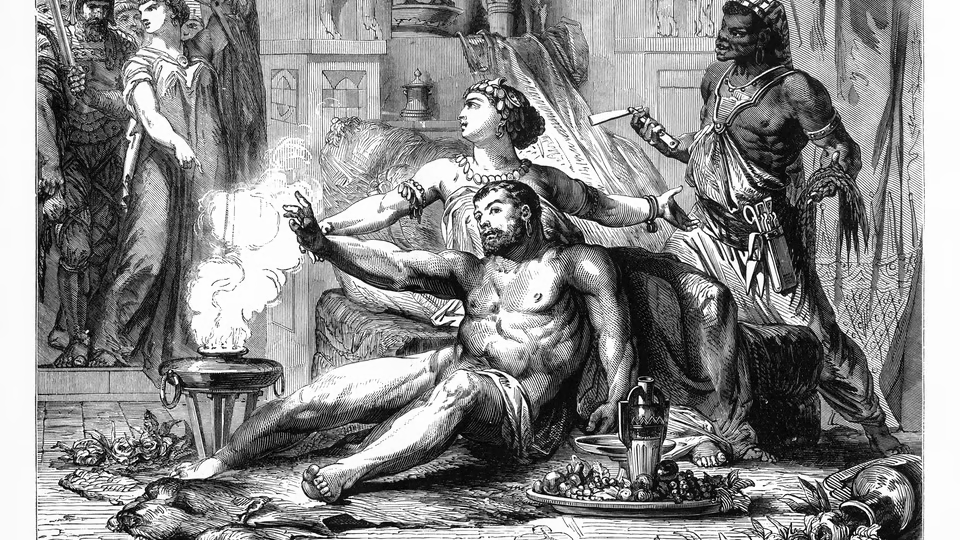
Mention the biblical hero Samson, and before long Delilah, the woman who orchestrated his capture, will also come to mind. Few female names in Scripture are as well known, and yet Delilah appears in only one chapter of the Bible.
How did she achieve such name recognition? Just who was Delilah?
The legacy of Delilah
Delilah has been the inspiration for movies, television shows and songs, though the plots are rarely, if ever, true to Scripture. One of the best-known movies—released in 1949—is the classic Cecil B. DeMille film Samson and Delilah.
This interest has continued. Why such fascination with Delilah? After all, as noted above, she appears in only one chapter of the Bible.
It seems that the story of Samson and Delilah has resonated with people through the centuries. In fact, the online Britannica asserts that “her name has since become synonymous with a voluptuous, treacherous woman.” Similarly, Bible Hub’s Topical Encyclopedia labels Delilah as “the archetype of the femme fatale.”
Who was the Delilah of the Bible?
Unfortunately, the brevity of the biblical account leaves some unanswered questions, making it difficult to be sure who Delilah was. Was she a harlot? Was she a Philistine? We don’t know.
Many readers have assumed that Delilah was a harlot because Judges 16 begins by telling us that “Samson went to Gaza and saw a harlot there, and went in to her” (verse 1). The harlot mentioned in this verse, however, is not the same woman, nor is she connected to Delilah.
We know this because the biblical account divides the two events in Samson’s life with the words, “Afterward it happened” (verse 4). In addition, verse 3 ends with a description of Samson taking the city gate of Gaza to the top of a hill facing Hebron, a city deep in Israelite territory.
Whether Delilah made her living as a prostitute makes no difference to the story. She and Samson clearly shared an intimate relationship, yet there is no mention of a marriage as there was with the unnamed woman of Timnah identified earlier as his wife (Judges 14:1-2; 15:6).
We are not told Delilah’s ethnicity. Unlike Samson’s deceased bride, who was explicitly called a Philistine, Delilah is described only as “a woman in the Valley of Sorek” (Judges 16:4). But it is likely she was a Philistine. The Expositor’s Bible Commentary states, “Her proximity to the Philistine-occupied area and her close contact with their leaders indicate that she probably was one of [the Philistines]” (Vol. 3, p. 475).
What we do know about Delilah
Although the Bible leaves some questions unanswered, it does provide some illuminating details about Delilah. One of the most important is the place where she lived, the Valley of Sorek.
She would have lived closer to Samson’s hometown of Zorah than to Gaza, an important Philistine city on the Mediterranean Sea, farther to the south. It was this city to which Samson’s captors later took him (verse 21), and where he died.
Her home was also much closer to that of Samson’s unnamed wife, a Philistine woman who had lived and died in Timnah (Judges 14:1-2; 15:6). Like Samson’s hometown of Zorah, Timnah bordered the Valley of Sorek.
This valley may well have been rich in vineyards since the word sorek means “choice vine.” Expositor’s Bible Commentary also points out that the mention of this valley by name was “perhaps a hint that the Nazirite vow [under which Samson lived] was in grave danger.”
The Valley of Sorek separated the Philistine-controlled territory from the Israelite-controlled territory, though the exact boundary undoubtedly fluctuated with the fortunes of war. It was, in many ways a borderland and probably home to both Israelites and Philistines.
How did Delilah defeat Samson?
Even though Delilah does not appear in Scripture until Judges 16, Samson’s story starts in chapter 13, which describes the miracles leading up to his birth. The intervening chapters describe his marriage (chapter 14) and his victory over the Philistines (chapter 15).
To the Philistine kings and their armies, Samson was invincible. With God’s help, he had killed 1,000 Philistines by himself with the jawbone of a donkey (Judges 15:15).
How, then, did this woman succeed when so many Philistines had died trying to overcome Samson? The answer to this question is the key to unlocking Delilah’s character.
“He loved a woman”
When the biblical narrative introduces Delilah, we are told that Samson “loved a woman” (Judges 16:4). That love would be better labeled attraction or even lust.
The narrative tells us nothing that would lead us to believe that the two were married. Whether Delilah was a harlot or not, and whether she was a Philistine or not, she and Samson entered into an illicit relationship.
Although Samson had feelings for Delilah, the biblical record leaves it up to us to discern her feelings about him. The very next verse provides a basis for making that determination. It describes the Philistine lords offering Delilah a substantial bribe, one that she accepted.
An enormous sum of money
Each of the lords promised to give her 1,100 silver pieces. The total would have been 5,500 pieces of silver, which would be close to 140 pounds! In contrast, Judas betrayed Christ for only 30 pieces (Matthew 26:14-15).
This enormous sum of money offered by the Philistine lords pointed to their desperation. It also reveals their recognition that they could not attack Samson directly and expect to win. Instead, they would have to rely on subterfuge.
Delilah took up this task. Whatever her feelings for Samson were, the silver was more important to her. Using Samson’s lust against him, she would induce him to reveal the secret of his strength, effectively laying the groundwork for his own destruction.
Knowledge of the past
It may be that Delilah had heard about what Samson’s Philistine wife had done some 20 years earlier (Judges 15:20). At the beginning of their seven-day wedding feast, Samson had posed a riddle to the 30 Philistine men assigned to be his companions (Judges 14:11-12).
These men could not solve the riddle, so they threatened Samson’s new bride (verse 15), demanding that she obtain the answer for them. She asked him for the answer repeatedly, and he finally gave her the answer (verse 17).
This betrayal initiated a chain of events that resulted in the death of Samson’s wife and father-in-law, as well as his revenge by slaying 1,000 Philistines (Judges 15). The story likely circulated among the Philistines and would have given them insight into Samson’s character.
Delilah lived in the area where Samson had so spectacularly defeated the Philistines. She had probably heard the story more than once.
Parallel betrayals
When enticing Samson to reveal the secret of his strength, Delilah seems to have followed the pattern set by his deceased wife 20 years before.
Both women repeatedly asked Samson to reveal his secrets (Judges 14:16-17; 16:6, 10, 13). Both women questioned Samson’s love for them (Judges 14:16; 16:15).
Finally, both women persisted, nagging Samson and wearing down his resolve. He gave the riddle answer to his wife because “she pressed him so much” (Judges 14:17), and he gave the secret of his strength to Delilah because “she pestered him daily” (Judges 16:16).
Samson put his life in Delilah’s hands. Unlike his wife, who acted out of fear, Delilah betrayed Samson’s “love” for riches.
Delilah as a symbol of sin
Delilah was a real person, but in some respects, she has come to symbolize sin itself. That’s because the manner in which she attacked Samson demonstrates the way sin works in our lives. Here are three ways she represents sin.
1. Lust. Samson was first drawn to Delilah through his “love” for her. True love, godly love, is appropriate, but Samson was drawn by an inappropriate “love” that falls outside the boundaries God had established.
In the same way, we are drawn to sin by illicit desire. The apostle John wrote: “If anyone loves the world, the love of the Father is not in him. For all that is in the world—the lust of the flesh, the lust of the eyes, and the pride of life—is not of the Father but is of the world” (1 John 2:15-16).
Delilah is justly described by Bible Hub’s Topical Encyclopedia as “symbolizing the seductive power of sin.”
2. Deceit. Delilah also practiced deceit to entice Samson to his own destruction. In the same way, sin often seems to be a pleasant choice.
It is this “deceitfulness of sin” (Hebrews 3:13) that sometimes leads us astray. What the world offers, though, is an illusion of happiness. It can never satisfy.
3. Fatigue. Delilah wore Samson down by repeatedly asking him to reveal the secret to his great strength. Along the way, she accused him of mocking her (Judges 16:10, 13, 15), and she questioned his love for her (verse 15).
In the same way, sin challenges our commitment to God’s way of life, and it can wear us down. That’s why the apostle Paul exhorted Christians not to “grow weary while doing good” (Galatians 6:9).
What Delilah teaches us
Delilah had little concern for the man who loved her, instead placing great value on the bribe offered to her. She was greedy, deceitful and manipulative, betraying the trust of her lover.
It is no wonder that she is remembered as “the archetype of the femme fatale.” The story of Samson and Delilah is a warning to us about unbridled desire as well as the “deceitfulness of sin.” In addition, this story reminds us that we must be ever vigilant, never allowing fatigue to compromise our commitment to God.
About the Author

Bill Palmer
Bill Palmer has devoted much of his life to writing and editing. He studied journalism at TCU in Fort Worth, Texas, prior to attending Ambassador College in Pasadena, California.