Brutality characterized his regime, but so did magnificent building projects. What motivated this biblical villain known to history as Herod the Great?
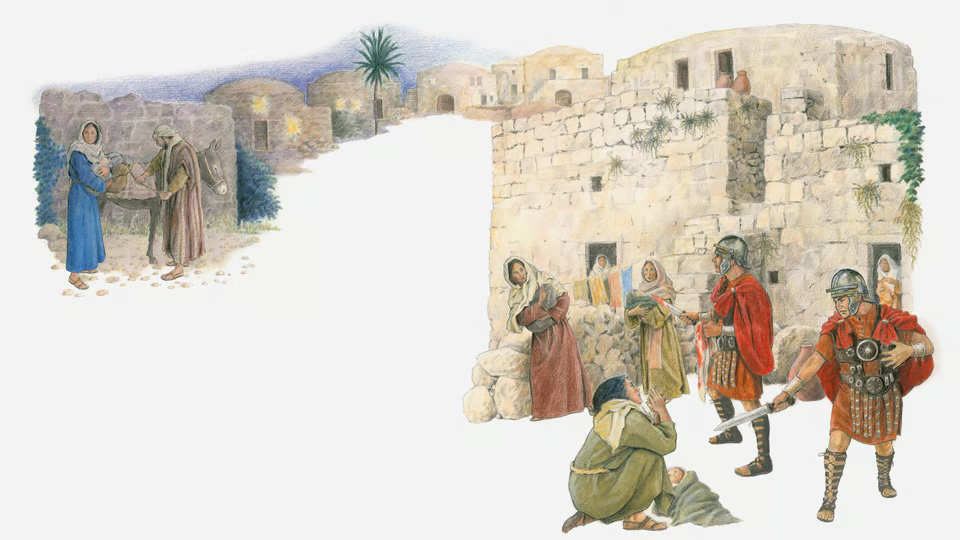
Artist’s conception of the slaughter of the innocents by Herod the Great trying to eliminate the threat he felt when he learned the Messiah, King of the Jews, had been born.
Image Credit:Eric Thomas via Getty Images
Soldiers seemed to be everywhere in the village, wresting infants and toddlers from their mothers. Without mercy, these innocent children were slaughtered as helpless parents looked on. All this to satisfy a selfish and paranoid old man, Herod the Great.
How could a man who ordered such a monstrous act be called “the great”?
Why “Herod the Great”?
The Bible does not add “the great” to this king’s name. It was the first-century Jewish historian Josephus who first used that designation.
He did so to distinguish King Herod from his descendants who bore the same name. The meaning for Josephus had nothing to do with grandeur, but with the fact that this Herod was the older, or greater, of the Herods and the first of the Herodian dynasty.
The label probably remained popular with historians because of Herod’s grand building program, according to the online World History Encyclopedia. Building impressive structures across the lands he controlled was an ongoing ambition for Herod.
What did King Herod build?
Herod the Great built more structures than can be discussed in this article. To get a feel for what he accomplished, consider one of the most notable, the Jerusalem temple and the Temple Mount on which it stood.
To enlarge the Temple Mount, encompassing about 35 acres, workmen had to fill in a deep valley.
The temple and secondary structures on the Temple Mount were a source of wonder. According to Josephus, the white stones, seen from a distance, looked “like a mountain covered with snow” (The Jewish War, 5.5.6).
It’s no wonder, then, that Jesus’ disciples wanted “to show Him the buildings of the temple” (Matthew 24:1). They, like most people, were in awe.
Who was Herod the Great?
Herod the Great was a descendant of Idumaeans (Edomites) who converted to Judaism during a period of conquest by the Hasmonean king John Hyrcanus. Herod’s foreign lineage was one reason he was unpopular with his Jewish subjects.
Though he is only mentioned in a few verses, there is much we can learn from the disturbing and brutal story of Herod the Great.
A second reason he was unpopular was that throughout his reign he was on friendly terms with the Romans. On top of that, he pursued policies such as Greek-style athletic competitions, which offended the Jews. (The contestants in many of the games competed while naked.)
Though he was concerned about what his subjects thought of him, Herod also understood that to retain power, he needed to retain the favor of the Romans.
Sometimes, that was very difficult.
Backing the wrong man
In the war between Mark Antony and Octavian (who later became Caesar Augustus), Herod backed Antony, a man who had been important in his rise to power. But when Antony lost the war for control of the Roman Empire, Herod knew he might face the vengeance of Rome.
Rather than wait to be arrested and executed, he decided to voluntarily present himself to Caesar. Before doing so, however, he assisted Didius, the Roman governor of Syria, in preventing gladiators loyal to Antony from fleeing to Egypt.
Herod also put to death Hyrcanus II, the only individual who might reasonably claim a place nearer to the throne than himself. This would leave Octavian with no clear alternative to choose as ruler in Judea.
A bold choice
Then, when Herod appeared before Caesar, he did what few others would do. Instead of lying about his loyalty to Antony, Herod confessed that he had been true to Octavian’s enemy.
Josephus wrote of this meeting in The Jewish War. Herod’s request that Caesar “consider how faithful a friend, and not whose friend” he had been showcases Herod’s political brilliance (1.20.1-2).
The clear message was that Herod could be trusted to remain loyal to Caesar and encouraged Caesar to show him mercy. The plan worked. Caesar not only spared Herod, but also enlarged his kingdom.
Bribery and murder
Throughout his reign, Herod pursued a lifelong policy of bribery to sway powerful Romans, including both Mark Antony and Octavian. For potential threats within his dominion, he resorted to murder. Sometimes the one tactic paid for the other.
One such example occurred early in his reign. In this case, murder came first—Herod ordered the executions of 45 nobles.
According to Emil Schürer in A History of the Jewish People in the Time of Jesus Christ, these individuals were some “of the most wealthy and the most prominent” citizens (Vol. 1, p. 420). Herod then confiscated their wealth, using it to fund his ongoing campaign of bribery.
As might be expected, neither of these policies resulted in the king’s personal security. Schürer notes that Herod devoted most of his energy during the first four to five years of his reign to simply trying to survive others’ attempts to eliminate him.
What motivated Herod the Great?
It’s clear from the record of history that King Herod was a narcissist, consumed by an insatiable thirst for power and personal glory, regardless of the cost to other people. One incident that highlights this trait occurred just days before his death.
Herod ordered all the prominent Jews throughout his kingdom to travel to Jericho, where he had them confined inside the hippodrome. These individuals, who had committed no crimes, were to be put to death when Herod himself died.
The reason for this horrible plan was that Herod did not want the day of his death to be a day of celebration, but one of mourning and grief. Fortunately, no one carried out his orders, and those who had been imprisoned were released after he died.
Schürer notes that when this scheming, brutal monarch died, he was “unwept by those of his own house, and hated by all the people” (A History of the Jewish People in the Time of Jesus Christ, Vol. 1, p. 464).
The quest for honor and power
Herod’s narcissism seems also to have been a big part of his motivation for enlarging the temple and Temple Mount. It was not his goal to honor God, but rather to gain honor himself.
Josephus wrote that Herod wanted to make the temple and Temple Mount “larger in compass, and to raise it to a most magnificent altitude, as esteeming it to be the most glorious of all his actions . . . and that this would be sufficient for an everlasting memorial of him” (Antiquities of the Jews, 15.11.1, emphasis added).
Sadly, as selfish and evil as Herod was, other rulers of the time were not much better. For that matter, despots and tyrants throughout human history have ruled as he did.
Jesus spoke to His disciples about this approach to authority: “You know that those who are considered rulers over the Gentiles lord it over them . . . Yet it shall not be so among you; but whoever desires to become great among you shall be your servant” (Mark 10:42-43).
The slaughter in Bethlehem
Herod’s lust for power and paranoia about losing it reached a crisis point when “wise men from the East” came to Jerusalem looking for “He who has been born King of the Jews” (Matthew 2:1-2).
Many people were anticipating the long-awaited Messiah and heard about these wise men’s arrival. But Herod became alarmed at the prospect of losing his grip on power (verses 2-3). He called the chief priests and scribes and learned from them that the Messiah would be born in Bethlehem (verses 4-8).
As he sent the wise men to Bethlehem, he attempted to learn the identity of this baby boy by trickery. He pretended that he, like the wise men, wanted to worship the child (verses 7-8). He “was exceedingly angry” when the wise men did not return to Jerusalem to give him the identity of the Messiah (verse 16).
In a desperate and brutal attempt to retain power, Herod ordered the slaughter of every boy, from newborn to 2 years old, in Bethlehem and the surrounding area. Ironically, at this point Herod was already ill with the disease that would claim his life and end his rule.
Aside from a brief reference to this king in Luke, Herod is nowhere mentioned in Scripture except the Gospel of Matthew. (Half a dozen of his descendants also bore the name Herod, and some of them also appear in biblical accounts.)
As a result, Herod the Great is primarily remembered as the brutal despot who orchestrated the slaughter of innocents.
What this means for us
It’s easy to look at Herod the Great and condemn his wickedness. He was a truly wicked man. What’s not so easy or comfortable is considering what we can learn from his bad example. Could we be tempted by some of the same attitudes that were behind his horrendous actions?
Here are a few of the attitudes exhibited by Herod that we all must resist:
- Deceitfulness: Herod attempted to deceive the wise men about his motives. If we’re honest with ourselves, we all are guilty of working to make ourselves look as good as possible. This is not always wrong, but if we mislead others in the process, we are doing what King Herod did.
- Pride: In the end, Herod thought his life and position were more important than the lives of all the innocent young boys he condemned to death. This was the culmination of a series of smaller choices focused on self and selfish choices. If we aren’t careful, we can convince ourselves that what we want is more important than what others want.
- Ignoring God’s will: Herod didn’t stop to consider God’s will when he ordered the slaughter in Bethlehem. The very fact that the wise men were seeking the prophesied Messiah should have been enough to alert Herod that he was opposing God. How often do we ignore God’s will in our lives, perhaps compromising with His law and telling ourselves, “God will understand”?
- Anger: Herod acted in anger, rashly ordering his soldiers to kill children. Anger is a universal emotion, and it can easily lead to bad decisions. Have you ever said something you later regretted because of anger? Or have you done something in anger that you wish you could undo? Be careful, and learn to control your anger before it takes control of you.
Though he is only mentioned in a few verses, there is much we can learn from the disturbing and brutal story of Herod the Great. For more about why God records the stories of evil people, see the article “Villains of the Bible.”
About the Author

Bill Palmer
Bill Palmer has devoted much of his life to writing and editing. He studied journalism at TCU in Fort Worth, Texas, prior to attending Ambassador College in Pasadena, California.