Millennia before the Nazis attempted genocide against the Jews, their ancestors also faced annihilation. That threat came from the evil Haman in the Bible.
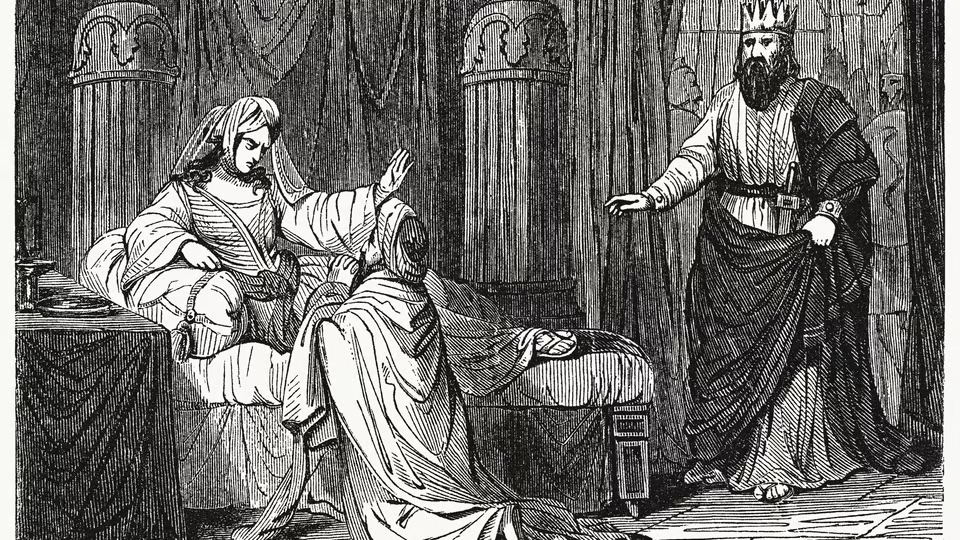
Haman shamelessly begging Queen Esther for his life, adding to the king's anger.
Image Credit:ZU_09/DigitalVision Vectors via Getty Images
Leaving the Persian palace, the high official was exultant. He alone had been invited to dine with the king and his queen. What an honor!
Then he saw Mordecai, a man who “did not stand or tremble before him,” and a consuming anger immediately supplanted the joy in this powerful man (Esther 5:9, 12-13).
Why such rage?
The pride of Haman
Throughout the book of Esther, Haman is portrayed as a man of excessive pride. He had a high opinion of himself, and he clearly wanted everyone else to view him as worthy of great honor.
For instance, when the king asked Haman what he would suggest as a suitable act for “the man whom the king delights to honor” (Esther 6:6), Haman could not even imagine the possibility that the king had anyone else in mind. Haman immediately assumed that the king planned to honor him.
Not long before that moment, Haman had bragged to his wife and his close associates about his material success (Esther 5:10-11). He had accumulated great wealth; he had been promoted into the highest office in the empire under that of the king himself (Esther 3:1); and he alone had been invited to dine with the king and the queen.
This man even bragged about the number of his sons. According to the ancient Greek historian Herodotus, the Persians in that time viewed “big numbers [of sons] to be a source of strength.” For Haman, his sons were badges of honor.
He bragged about all these things because he wanted to be seen as exceptional. Status and rank were vital to him. One man, however, stood up to him and got under his skin.
Haman’s anger at Mordecai
From the time Haman had been promoted, Mordecai had refused to “bow or pay homage to Haman” (Esther 3:2), and that aroused great wrath in Haman.
Scripture tells us that in explaining his refusal to other men, “Mordecai had told them that he was a Jew” (verse 4).
Haman’s rage
Whatever Mordecai’s reason for not bowing, Haman deeply hated him and, by extension, all his people. Choosing to wait until he could “destroy all the Jews,” Haman “disdained to lay hands on Mordecai alone” (Esther 3:6). To accomplish his goal, this bitter man set about manipulating the king.
Once he had gained the king’s permission with his offer of 10,000 talents of silver (verse 9), he wrote a letter to be sent to all the provinces of the empire. The king’s statement that “the money and the people are given to you” (verse 11) refers to the right to plunder Jewish property.
Bitterness is an obsessive passion that leaves no room in the heart for joy.
The text of the letter Haman wrote reflects the intensity of his rage. It instructed officials “to destroy, to kill, and to annihilate all the Jews” (verse 13). According to Expositor’s, this “piling up of verbs . . . is a literary device that expresses the idea of thoroughness” (Vol. 4, p. 814).
For Haman, nothing less than complete destruction was acceptable.
Haman, the villain of the book of Esther, had not set himself up in opposition to Mordecai alone, or even to the Jewish people. He had set himself up against God!
Haman’s bitterness
The bragging incident cited earlier occurred after the first of two banquets Esther prepared for her husband, the king, and for Haman (Esther 5:6-8). Haman was in high spirits as he left that first banquet.
But the mere sight of Mordecai refusing to “tremble before him” (verse 9) rendered Haman incapable of gratitude or joy. Instead, he allowed hatred and bitterness to dominate his thoughts.
After assembling his wife and associates so he could brag to them, Haman admitted that all his riches and accomplishments, including the prospect of attending the queen’s special banquet the next day, meant “nothing, so long as I see Mordecai the Jew sitting at the king’s gate” (verse 13).
Bitterness is an obsessive passion that leaves no room in the heart for joy.
Haman’s wife and associates proposed a solution to his anger and bitterness. He should build a gallows on which to execute Mordecai, after which he could enjoy the second banquet (verse 14).
The gallows Haman built
What had been proposed was far more than necessary to murder Mordecai. At 50 cubits, or approximately 75 feet, the platform would have been extremely high.
“The height of the gallows was exorbitant and is not taken seriously by some commentators,” according to Expositor’s, “but it is consistent with what we know of Haman’s vanity and obsessive desire for revenge” (Vol. 4, p. 821).
The gallows would destroy Mordecai, but more than that, it would make his execution visible throughout the city. Killing Mordecai was one thing, but making it a public spectacle undoubtedly appealed to Haman’s pride as well as to his bitterness.
God and justice in the book of Esther
The book of Esther never mentions God directly, but it is impossible for us to read it without seeing God’s hand in the lives of Esther, Mordecai and Haman. There are too many “coincidences” to dismiss His presence and His sovereignty in human affairs.
Mordecai’s confidence that God was working behind the scenes is evident in his admonition to Esther that if she didn’t act, “relief and deliverance will arise for the Jews from another place,” while asking, “Yet who knows whether you have come to the kingdom for such a time as this?” (Esther 4:14).
Esther showed her dependence on God by fasting and asking the Jewish community to fast with her (verse 16). This implies earnestly seeking God’s favor and intervention.
And God’s intervention can be seen in the way human plans are turned upside down. Perhaps the greatest of these reversals is in what happened with the gallows Haman built.
Haman had intended to kill Mordecai in such a way that everyone in the capital city would see his end. God reversed this, and it was Haman whose death on the gallows was the spectacle (Esther 7:10).
Some other notable reversals in the book of Esther that show God’s hand include these events:
- Mordecai went from mourning to being honored (Esther 4:1). Haman went from being honored to mourning (Esther 6:11-12).
- Haman was forced to honor Mordecai as he himself had expected to be honored (verses 6-10).
- Mordecai was given Haman’s place as second in power only to the king (Esther 8:2).
- The Jews throughout the empire weren’t killed, but rather those who planned to rise up against them were killed (Esther 9:1).
Lessons for today
Haman’s life provides two major warnings for Christians today. First, we must beware of pride, which “goes before destruction” (Proverbs 16:18).
Pride destroys us because it directs our focus on ourselves. We can become so consumed with our status, our honor and our position that we forget how little we really are compared to the Almighty God.
And second, we must understand the destructive power of bitterness. Bitterness is often the result of wrongs—whether based in reality or on perception—that we have experienced.
We have to let these experiences go, not allowing our thoughts and emotions to linger over them (Hebrews 12:15). That’s why the apostle Paul urged the members of the Church to “put away” bitterness so they would not “grieve the Holy Spirit” (Ephesians 4:30-31).
Haman allowed both pride and bitterness to direct his steps. We dare not follow!
About the Author

Bill Palmer
Bill Palmer has devoted much of his life to writing and editing. He studied journalism at TCU in Fort Worth, Texas, prior to attending Ambassador College in Pasadena, California.